Sind · Calcutta · Kannauj to Kashmir
PHILATELY & THE INDIAN STORY
Part I — Philately & Stamps · Part II — Indian Philately · Part III — Beginner's Guide
Preface
A postage stamp is a strange object. It is mass-produced in millions, sold for small change, and designed to be destroyed — smeared with ink, torn from an envelope, thrown away. And yet more of them survive than almost any other printed thing of comparable age. A newspaper from 1854 is a rarity. A stamp from 1854 sits in a dealer's stockbook, one of thousands, waiting for someone to notice it.
That is the first paradox of philately, and it is the reason the hobby exists at all. Stamps are common enough that anyone can start, and rare enough — in the right combinations of date, condition, and circumstance — that no one ever finishes.
This book has three parts, and they do different jobs.
Part I is about stamps in general: what they are made of, how they are printed, why they are perforated, what a watermark is for, how a cover can be read like a document, and how to tell a genuine rarity from an expensive disappointment. It is a toolkit. It is written so that a reader who has never held a pair of stamp tongs can finish it and know what they are looking at.
Part II is about India, and it is written because India's philatelic story is one of the strangest and richest in the world. In 1852, three years before the subcontinent had a unified postal service, a British administrator in Sind issued a small circular stamp that became the first adhesive postage stamp in Asia. Two years later, an army surveyor running a map-printing office in Calcutta produced a set of four stamps for the whole of British India, one of which — printed in two colours, in two separate passes through the press — went out with the Queen's head upside down on a handful of sheets. Those errors are now among the great rarities of world philately.
Then, for the next century, something happened in India that happened nowhere else on this scale. Alongside the stamps of British India, more than fifty princely states issued their own. Some were printed on hand presses in palace outbuildings. Some carried inscriptions in Devanagari, Urdu, Malayalam, Telugu and Gujarati. Some are crude; some, like the coloured rectangulars of Jammu and Kashmir, are among the most beautiful pieces of paper any post office anywhere has ever sold. They stopped, all of them, around 1950. What they left behind is a body of material that a collector can spend a lifetime inside.
The third part is a different kind of writing altogether. It is a practical beginner's guide: what to buy first and what it will cost, how to soak a stamp off paper, how to keep a collection safe through an Indian monsoon, how to buy without being cheated, and a plan for your first ninety days. Parts I and II explain the hobby; Part III gets you doing it. It is written as steps, checklists and tables rather than narrative, and it stands on its own. A reader who wants to start this week can begin there and come back to the rest.
There is no shortage of general books about stamps, and there is a serious specialist literature on India. There are very few books that do both, and that is the gap this one is trying to fill: a complete grounding in philately, followed by the Indian story told properly, in one place, for a reader who might be starting from nothing.
A word about who this is for. It is written for three people at once — someone who has just been given a shoebox of stamps and has no idea what to do with it; someone who has been collecting for twenty years and wants the technical detail; and someone who does not collect at all and simply likes history. The next section explains how the book keeps all three of you reading.
You do not need to own a single stamp to begin.
How to Use This Book
The main text
Every stage is written as continuous narrative, for a reader with no prior knowledge. If you read nothing but the main text, straight through, you will get the whole story and none of the technical undergrowth.
The boxes
Three kinds of box interrupt the narrative. Each is for a different reader. Skip the ones that are not for you — that is what they are there for.
Catalogue numbers
Where a stamp is identified by catalogue number, the convention is:
SG 1 — Stanley Gibbons · Sc 1 — Scott · Mi 1 — Michel
Stanley Gibbons is used as the default for India and the Commonwealth, because it is the standard reference for this material and because its India listings are the most complete. Scott numbers are given alongside where the two systems diverge confusingly. A full concordance table is in the back matter.
Indian States are numbered per Stanley Gibbons Part 1 (Commonwealth), with the state name always given in full — "Travancore SG 1", never just "SG 1".
Prices and values
This book gives very few prices, and the ones it gives are indicative only.
Catalogue values are not market values. They are a dealer's asking guide for a sound example in the stated condition, and real transactions happen anywhere from ten per cent to two hundred per cent of them depending on the stamp, the year, and the room. Where value matters to a decision — what to buy, what to insure, what to walk away from — the book explains the reasoning rather than quoting a figure that will be wrong within a year.
Currency
Pre-decimal Indian currency runs through Part II constantly:
- 12 pies = 1 anna
- 16 annas = 1 rupee
- so 192 pies = 1 rupee
Decimal currency arrived on 1 April 1957: 100 naye paise = 1 rupee, with "naye" (new) dropped from 1964. A full conversion and postal rate table is in the back matter.
Measurements
Perforations are quoted in the standard way — the number of holes in 2 centimetres. "Perf 14" means fourteen holes per 2 cm on all sides. "Perf 14 × 13½" means fourteen horizontally, thirteen and a half vertically.
Stamp dimensions, where given, are in millimetres, design area only, not including margins.
Images
Almost every stamp discussed is illustrated. Where a distinction matters — two die types, a genuine against a forgery, a correct stamp against an error — the images are placed side by side at the same magnification, because that is the only way the comparison is useful.
Enlargements are marked with their magnification. Anything shown at more than 3× is doing so because the detail cannot be seen otherwise.
Where to start
If you want to start collecting now: go straight to Part III, Stage 19. It is the hands-on guide (kits, budgets and a first-ninety-days plan), and it assumes nothing. Come back to Part I when you want to know why things are done the way they are.
If you are new: read Stages 1 and 2, then jump wherever you like. Stage 2 is the vocabulary stage and everything else assumes it.
If you already collect: Stage 2 will be revision. Start at Stage 5 or go straight to Part II.
If you are here for the history: Part II stands on its own. Start at Stage 10.
PART I — PHILATELY & STAMPS
Stage 1What Philately Is
1.1The word itself
The hobby is older than its name. People began saving postage stamps within months of the first one being issued in 1840, and for the next twenty-four years nobody had a proper word for what they were doing. "Stamp collecting" was accurate but sounded childish. The French, briefly, used timbromanie — stamp-madness — which was worse.
In November 1864, a French collector named Georges Herpin proposed a replacement in the pages of Le Collectionneur de Timbres-Poste. He built it out of two Greek words: philos, loving, and ateles, meaning free of charge or exempt from tax. A postage stamp, he reasoned, is the mark that tells the recipient the letter has already been paid for — that it arrives free of any further charge. Philately, therefore: the love of things carried free.
It is a slightly awkward etymology and collectors have grumbled about it for a century and a half, but it stuck, and it stuck everywhere. The word travelled almost unchanged into dozens of languages, which tells you something about how fast the hobby spread.
images/part-1/ch01-herpin-article.jpg1.2Collector or philatelist?
There is a distinction here, and it is worth understanding early, though nobody should be precious about it.
A collector acquires and arranges. The pleasure is in completion, in the look of a filled page, in the hunt for the one missing value. This is a perfectly good way to spend forty years and it is how almost everybody starts.
A philatelist studies. The pleasure is in finding out something that was not previously known — that a particular flaw appears only on stamps from one corner of one plate, that a cover took a route nobody had recorded, that two stamps catalogued as identical were in fact printed eight months apart on different paper. A philatelist may own very few stamps. Some of the most respected have owned almost none, working instead from photographs and other people's collections.
Most people are both, in different proportions at different times. A collector who buys a batch of the 1854 Indian half anna and starts noticing that some of them look subtly different has just become a philatelist without deciding to. That is usually how it happens.
1.3The branches
Philately is not one hobby. It is a dozen, loosely federated, and most collectors do two or three without noticing.
Traditional philately is the study of the stamps themselves — designs, printings, papers, watermarks, perforations, errors, and the sequence in which a country issued them. This is the mainstream, and Stages 2 through 5 are essentially a course in it.
Postal history studies the mail, not the stamp. A traditional collector wants a clean example of the two-anna green. A postal historian wants a battered envelope with that stamp on it, sent from Madras to Aden in 1856, showing the rate, the route, and three transit markings on the reverse. Stage 6 makes the case that this is the most interesting branch of the hobby, and does not entirely apologise for the bias.
Thematic (or topical) collecting organises by subject rather than country — birds, trains, medicine, chess, Gandhi, cartography. A good thematic collection is not a scrapbook; the best ones tell an argument, with the stamps as evidence, and they are judged at exhibition on how well they do it.
Aerophilately covers airmail — routes, first flights, crash mail, rocket mail, balloon post. India has a strong claim here: the world's first officially recognised airmail flight carrying post took off from Allahabad in February 1911.
Astrophilately covers space mail: covers carried on spacecraft, launch-site cancellations, and the surprisingly deep documentation of the space programmes.
Revenue philately — sometimes called fiscal philately — covers stamps used to pay taxes and duties rather than postage: court fee stamps, share transfer stamps, receipt stamps, tobacco duty. It is enormous, badly catalogued, cheap, and almost completely ignored, which for a certain kind of collector is the entire attraction. India is exceptionally rich in this material.
Postal stationery covers items where the stamp is printed as part of the object — pre-stamped envelopes, aerogrammes, postcards, wrappers. India's postcard, at a quarter anna, was for decades the cheapest form of written communication available to anyone on earth, and it is a serious field.
Maximaphily collects maximum cards: a picture postcard, a stamp showing the same subject, and a cancellation from the relevant place, all three in agreement. It is more demanding than it sounds.
images/part-1/ch01-thematic-page.jpg1.4Why people collect
It is worth being honest about the motives, because they shape what you should buy.
History you can hold. This is the strongest one. A cover posted from Bombay in 1857 was handled by people living through the Rebellion. It is not a representation of that world; it was in it. Very few historical objects are both this direct and this affordable.
Art in miniature. Stamps were, for a century, the most widely distributed printed art in existence, and the engraving on the best of them is extraordinary work at a scale of a few square centimetres. Some collectors care about nothing else.
Geography and the exotic. The traditional entry point: names on paper from places you will never go. Bussahir. Soruth. Nowanuggur. Half of the appeal of Indian States collecting is that the states no longer exist.
The systematic pleasure. Some minds simply enjoy completing a set, and there is no need to dress this up as anything more elevated. It is a real and durable satisfaction.
Research. The discovery that there are open questions — genuinely unanswered things, in a hobby a century and a half old — and that an amateur with patience can settle one.
Money. Last, and deliberately so. Some stamps have been very good investments. Most have not. Stage 9 and Stage 17 deal with this properly, and the short version is that buying new issues as an investment is close to a guaranteed loss, while buying scarce classic material in good condition has historically held value well. The people who made money from stamps were, almost without exception, people who would have collected anyway.
1.5What this book will and will not do
It will teach you to identify what you are looking at, to judge its condition, to spot the common fakes, to read a cover, to store material without destroying it, and to build a collection with some coherence to it.
It will give you the history of Indian philately from the pre-stamp dak runners to the present, in more detail than any general book and, I hope, in a form that a beginner can actually use.
It will not value your collection. Nobody can do that from a book, and anybody who offers to do it from a photograph is either guessing or selling something.
It will not tell you what to collect. The most common piece of advice given to new collectors — "specialise early" — is bad advice given to people who do not yet know what interests them. Buy widely and cheaply for a year. The specialisation will announce itself.
Stage summary. Philately got its name in 1864 and its habits earlier. It divides into traditional study, postal history, thematics, and a set of specialisms. People come to it for history, art, order, discovery, and occasionally money — usually in that order of reliability. The next stage is the technical foundation for all of it.
Stage 2Anatomy of a Stamp
This is the stage the rest of the book leans on. Everything that follows — how to date an issue, how to spot a forgery, how to tell two apparently identical stamps apart and discover that one is worth fifty times the other — depends on the vocabulary set out here.
A postage stamp has five physical components, and each one carries information: the design, the paper, the gum, the separation, and the printing method. Learn to read all five and you can identify almost anything.
2.1The design
The vignette is the central pictorial element — the portrait, the scene, the emblem. On bi-coloured stamps this is usually the part printed in the second colour, and therefore the part that can end up upside down.
The frame is the border surrounding it. On classic stamps the frame often carries the intricate machine-turned patterns known as engine-turning or guilloche, produced on a geometric lathe. These were a security device: the patterns are almost impossible to copy by hand, and a forger who tries produces something that looks right at arm's length and wrong under a lens.
The denomination or face value. Watch for stamps where the value is expressed in words rather than numerals, in a script you cannot read — a great many Indian States issues are identified primarily by their inscriptions.
The country name. Britain famously does not carry one, being the country that invented the stamp and never saw the need. Everyone else does, though not always in the alphabet you expect. India's stamps have carried, at various times, "EAST INDIA POSTAGE", "INDIA POSTAGE", "INDIA", and भारत.
Inscriptions and imprints — the printer's name, the designer's initials, the year of issue, and on modern stamps the microprinting used as a security feature.
Marginal markings on the sheet, not the stamp: plate numbers, control numbers, colour registration marks, traffic lights, sheet numbers. These are enormously useful for identification and are the reason experienced collectors will pay a premium for a marginal example.
2.2Paper
Paper is the most reliable dating tool in philately and the most commonly overlooked. Two stamps from the same design can be twenty years apart and worth wildly different sums, distinguishable only by what they are printed on.
Wove paper is the default. Hold it to a light and it looks uniform, faintly cloudy, with no pattern. It is made on a fine woven wire mesh. Almost all stamps ever issued are on wove paper.
Laid paper shows a pattern of close parallel lines when held to the light, with a second set of widely spaced lines crossing them. This comes from a mould made of parallel wires. Laid paper was common in the mid-nineteenth century and appears on several classic issues, sometimes as an error when the wrong stock was fed into the press.
Chalk-surfaced paper has a fine coating of chalk. It was a security measure: attempting to wash a cancellation off a chalky paper stamp destroys the surface. It appears extensively on King George V and King George VI Commonwealth issues. The test: touch the surface lightly with a fresh silver wire — a silver "pencil" costs very little — and chalky paper leaves a grey mark. Ordinary paper does not. This single test resolves a large number of otherwise identical-looking Commonwealth stamps.
Granite paper has small coloured fibres visible in it, another anti-forgery measure.
Coated, phosphor-coated and fluorescent papers belong to the modern era and are discussed under 2.8.
Thickness and toning matter too. A stamp described as "thin paper" or "thick paper" in a catalogue is being distinguished from an otherwise identical printing, and the difference can be substantial in value.
2.3Watermarks
A watermark is a deliberate thinning of the paper, made during manufacture by a raised design on the papermaking mould, so that the thinner areas transmit more light. It is invisible face-on and obvious when you know how to look.
Watermarks exist to make forgery harder and to control the paper supply, and they are the single best tool for separating printings that are otherwise identical.
How to see one:
- The dish method. Place the stamp face down in a black watermark tray — a small shallow dish of black glass or plastic — and look. Often the watermark is visible dry, against the black background.
- Watermark fluid. If not, add a few drops of watermark detector fluid. The fluid fills the paper fibres, momentarily equalising the translucency of the thick and thin areas, and the watermark springs out. It evaporates in seconds leaving no trace. Older texts recommend benzine or lighter fluid; modern proprietary fluids are safer and non-flammable. Never use water — it dissolves the gum and can cause the ink to run.
- Backlighting. Hold to a strong light. Works for bold watermarks, fails for subtle ones.
- Digital methods. Photograph the stamp face down on a lightbox and increase contrast heavily. This works surprisingly well and is entirely non-destructive.
Watermark orientation matters. The same watermark can be found upright, inverted, reversed, or sideways, and catalogues list these separately, sometimes at very different values. Orientation is described as seen from the back of the stamp.
The Indian sequence is worth memorising early, because it dates a stamp instantly: Elephant's Head on the earliest De La Rue printings; Star from the 1870s; Single Star and later Multiple Star; Multiple Stars through the King George period; and the Ashokan Capital watermark of the Republic.
2.4Gum
The adhesive on the back. It matters more than beginners expect, because for mint stamps the state of the gum is a major component of value.
Gum arabic was the standard until the mid-twentieth century. It is glossy, brittle, and it cracks and yellows with age. In humid climates it will also stick to whatever is next to it, which is why so many older Indian mint stamps are found stuck down.
PVA (polyvinyl alcohol) replaced it from the 1960s. It is matt, more flexible, more stable, and usually has a slight blue or grey tint from an added dye.
Self-adhesive gum arrived in the 1990s. It cannot be soaked off in the traditional way and creates real long-term conservation questions, since the adhesives are chemically active and can stain.
The grading vocabulary:
- MNH — mint never hinged. Full original gum, undisturbed, no hinge mark. The premium condition.
- MH / LH — mounted (hinged) / lightly hinged. A hinge has been applied and removed, leaving a mark or a thin.
- MNG / unused — mint no gum. Either it never had any, or it has been washed off.
- OG — original gum. RG — regummed, which is a form of fraud when undeclared.
Regumming is the application of fresh gum to a stamp that has lost its own, to pass it off as MNH. It is common, profitable, and detectable: regummers rarely get the perforation tips right. On a genuinely gummed stamp the gum stops cleanly at the edge of the perforation teeth; on a regummed one it usually runs over the tips, which then feel slightly stiff and look glazed. Hold the stamp edge-on to a light and examine the teeth.
2.5Separation
How stamps are divided from one another. This is a dating tool and a major identification key.
Imperforate. No separation at all — the sheet is cut apart with scissors. All stamps before 1854 were imperforate, including the Penny Black and the 1854 Indian lithographs. Value depends heavily on margins: an imperforate stamp with four clear even margins is worth many times one cut into the design.
Rouletted. A cut, not a hole — no paper is removed. Small blades or wheels slit the paper along the dividing lines. Varieties include percé en ligne (straight cuts), percé en scie (saw-tooth), percé en arc, and serpentine roulette. Common on Indian States issues, where perforating equipment was often unavailable.
Perforated. Holes punched out, so paper is removed. Introduced by Henry Archer in Britain and in official use from 1854.
Measuring perforations. The perforation gauge measures the number of holes in a 2-centimetre span. A stamp measuring "perf 14" has fourteen holes per 2 cm on every side. "Perf 14 × 13½" means fourteen along the horizontal edges, thirteen and a half along the vertical. This is not a trivial detail; entire catalogue listings turn on half a perforation.
The three perforating machines, distinguishable by looking at the corners:
- Line perforation — one row punched at a time, horizontal and vertical passes independent. The corners are irregular, holes overlap or miss, and no two corners look the same.
- Comb perforation — punches three sides of a row of stamps at once, then advances. Corners are neat and regular, but there is a characteristic slight misalignment where each comb stroke meets the last.
- Harrow perforation — punches an entire sheet or pane in one stroke. Every corner perfect.
2.6Printing methods
Identifying the printing method is the most useful single skill in this stage, because it is the fastest route to detecting a forgery. A forger working with lithography cannot reproduce the physical characteristics of intaglio, no matter how good the drawing is.
You need a 10× magnifier. Nothing more.
Recess printing (intaglio, line engraving). The design is cut into a steel die. Ink fills the grooves, the surface is wiped clean, and paper is pressed hard into the grooves to lift the ink out. The result: the ink sits on top of the paper as a raised ridge you can feel with a fingertip, and the back of the stamp often shows a faint embossed impression of the design. Lines are crisp, of varying depth, and terminate in fine points. This is the classic method for banknotes and for the finest stamps. Run your finger lightly across the face — if you feel texture, it is recess.
Typography (letterpress, surface printing). The reverse of recess: the design is raised on the plate, like a rubber stamp. Ink sits only on the raised parts. The result: ink is pressed into the paper, so the design shows slight indentation on the front and a corresponding faint relief on the back. Lines tend to be of uniform thickness and often show a heavier deposit of ink at the edges of each line, where the pressure pushed the ink outwards. Very widely used for definitives.
Lithography. Printing from a flat surface, relying on the mutual repulsion of grease and water. No relief at all. The result: completely flat ink, no texture, slightly soft edges to the lines, and under magnification a faint mottling. Lithographed stamps often show small breaks and irregularities in fine lines, because the transfer process degrades slightly with each impression. The 1854 Indian issues are lithographed, and Stage 12 depends on this.
Photogravure. Photographic transfer to a cylinder etched into a grid of tiny cells. The result: the whole design breaks into a screen of dots, visible at 10×, including in areas that look like solid colour. Edges of the design are slightly ragged where they cross the screen. Dominant for mid-twentieth-century stamps.
Offset lithography. Litho transferred via a rubber blanket. Flat like litho, but usually cleaner. Modern standard.
Modern digital and combination printing. Contemporary stamps frequently combine offset for the background with intaglio for a portrait, or add foil, embossing, holograms and thermochromic inks.
2.7Overprints and surcharges
An overprint is additional printing applied to a finished stamp. A surcharge is an overprint that changes the face value.
They exist for practical reasons: a change of government, a change of currency, a shortage of one denomination, a stamp designated for official use. And because they are applied as a secondary operation, often locally and hurriedly, they generate errors in profusion — inverted overprints, double overprints, misplaced overprints, wrong fonts, missing letters.
They are also the easiest thing in philately to forge. A forger who cannot produce a convincing stamp can very easily add three words to a genuine common one and multiply its value a hundredfold. India is a heavily affected area: the Convention States overprints, the wartime "SERVICE" overprints, and the Indian Expeditionary Force overprints have all been extensively faked.
What to check on any overprint: the exact typeface and letter spacing against a known genuine example; the position relative to the design, which on genuine settings is consistent within narrow limits; the ink, which should sit on top of the stamp's own ink and show the right sheen; and whether the underlying stamp is a printing that was actually in stock at the time the overprint was applied. That last check catches a great many fakes.
2.8Phosphor, tagging and security features
From the late 1950s, postal administrations began adding invisible markings so that automatic sorting machines could orient and cancel mail.
Phosphor bands are strips of luminescent material printed over the design, invisible in daylight and glowing under ultraviolet light. The number and position of bands is a catalogue distinction.
Phosphor-coated paper (PCP) carries the compound across the whole surface.
Fluorescent and optically brightened papers glow under UV even without deliberate tagging, simply because of brighteners added during manufacture — which incidentally makes UV a useful test for anachronistic paper in a forgery.
A UV lamp — a small handheld one costs little — will also reveal repairs, thinned patches, added margins, and chemically removed cancellations, all of which fluoresce differently from the surrounding original paper. It is the single most useful diagnostic tool after the magnifier.
Stage summary. Five components, each carrying information. Design tells you the country, the value and often the printer. Paper — wove, laid, chalky, granite — dates the printing. Watermarks separate otherwise identical issues and are the strongest single identification tool. Gum determines mint value and is the commonest site of undeclared repair. Separation — imperforate, rouletted, perforated, and which perforating machine — dates and identifies. Printing method — recess, typography, litho, photogravure — is the fastest route to detecting a fake. Everything from here on assumes these terms.
Stage 3The Birth of the Postage Stamp
3.1Before 1840: the mail was a luxury
It is difficult now to appreciate how bad the pre-1840 postal system was, because we have nothing to compare it to.
In Britain, and in most of the world, the recipient paid. A letter arrived, the postman named a price, and the recipient either handed over the money or refused the letter — in which case it went back, having cost the Post Office two journeys and earned nothing.
The price depended on distance and on the number of sheets of paper. A single sheet from London to Edinburgh cost thirteen and a half pence in 1839, at a time when an agricultural labourer might earn ten shillings — a hundred and twenty pence — for a week's work. An enclosure, even a second sheet, doubled it. This is why so much early correspondence is written in cross-hatch, the writer turning the sheet ninety degrees and writing across their own lines to avoid using a second one, and why letters were folded and sealed into their own envelopes rather than placed inside a separate one.
The result was a system that the poor could not use and the rich evaded. Members of Parliament had the franking privilege — free postage — and it was abused on an industrial scale, with franked covers passed around to friends and relatives. Others simply sent coded messages on the outside of the letter, agreed in advance, so the recipient could read the news and refuse the letter without paying.
images/part-1/ch03-prestamp-entire.jpg3.2Rowland Hill
Rowland Hill was a schoolmaster and social reformer with no postal experience whatsoever, which was probably essential to what happened next.
In 1837 he published Post Office Reform: Its Importance and Practicability. Its argument was counter-intuitive and, as it turned out, correct. Hill had worked out that the actual cost of conveying a letter from London to Edinburgh — as distinct from the cost of collecting, sorting and delivering it — was a tiny fraction of a penny. Distance was almost irrelevant to cost. What was expensive was the handling: the calculation of charges, the record-keeping, and above all the collection of money at the door, which required the postman to wait, argue, and make change.
His proposals were therefore:
- Uniform rates regardless of distance. One penny for a half-ounce letter anywhere in the United Kingdom.
- Prepayment by the sender, which removed the entire apparatus of collection.
- A means of showing prepayment — and here, almost as an afterthought in the pamphlet, he suggested a small piece of paper large enough to carry a stamp, coated on the back with an adhesive wash.
The Post Office establishment hated all of it. The Postmaster General called the plan wild and visionary. But Hill had public opinion, and a parliamentary committee, and in August 1839 the Penny Postage Act passed. Uniform Penny Post began on 10 January 1840.
The stamps were not ready. For four months, prepayment was made in cash at the counter.
3.3The Penny Black
The design came out of a public competition that produced 2,600 entries and nothing usable. In the end Hill went with his own idea: a portrait of the young Queen Victoria, based on a medal by William Wyon struck to commemorate her visit to the City of London in 1837, when she was eighteen.
The reasoning was security. A face — particularly a familiar face — is the hardest thing to forge convincingly, because any error in it is immediately obvious to everyone. Engraved portraiture became, and remains, the standard security device on stamps and banknotes for exactly this reason.
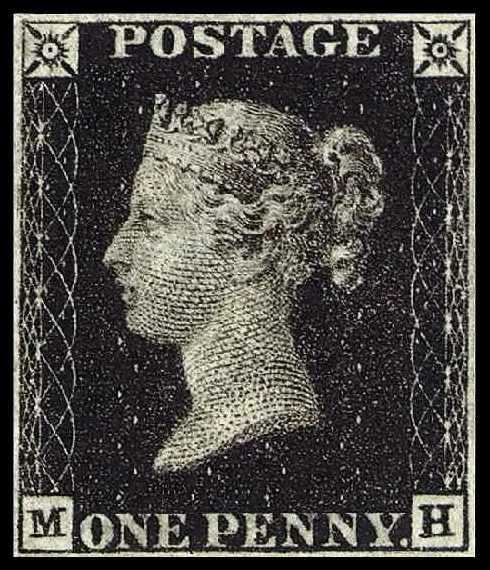
The Penny Black was issued on 1 May 1840 and became valid on 6 May. Recess-printed by Perkins, Bacon and Petch, imperforate, on wove paper with a Small Crown watermark. Below the portrait: POSTAGE, and ONE PENNY. In the two lower corners, a pair of letters.
The check letters are the detail worth understanding. Each sheet contained 240 stamps in twenty rows of twelve — 240 pence being one pound, so a full sheet cost exactly £1. Every stamp in the sheet carried a unique pair of corner letters denoting its position: the first letter its row (A to T), the second its column (A to L). The stamp at row 3, column 7 read "C G", and there was only one of it in the sheet.
This was an anti-forgery measure, and it had an unintended consequence that shaped the entire hobby. Because every position is identifiable, and because the printing plates each developed their own tiny characteristic flaws, it is possible to determine which of the eleven plates a given Penny Black came from and exactly where in the sheet it sat. Plating — reconstructing a complete sheet from 240 individual stamps — has occupied collectors for a hundred and eighty years and is the oldest continuous research tradition in philately.
The Twopenny Blue followed on 8 May 1840, for heavier letters, in the same design.
The Maltese Cross was the cancellation, applied in red ink. This was a mistake, discovered quickly: red ink could be washed off a black stamp without damaging it, allowing reuse. The Post Office switched to black cancelling ink — at which point the black stamp became difficult to cancel visibly. In February 1841 the stamp itself was changed to red-brown, and the Penny Red replaced the Penny Black after just ten months.
That short life is why Penny Blacks are more collectable than common, but it should be said clearly: the Penny Black is not rare. Around 68 million were printed and a great many survive. A worn, four-margin-less used example is an affordable purchase for a beginner. What is rare is a Penny Black in fine condition with four clear margins, and rarer still one on cover with a legible date in the first week of use.
3.4The idea spreads
What is astonishing is the speed. Britain issued the first stamp in 1840. Within twenty years there were stamps almost everywhere.
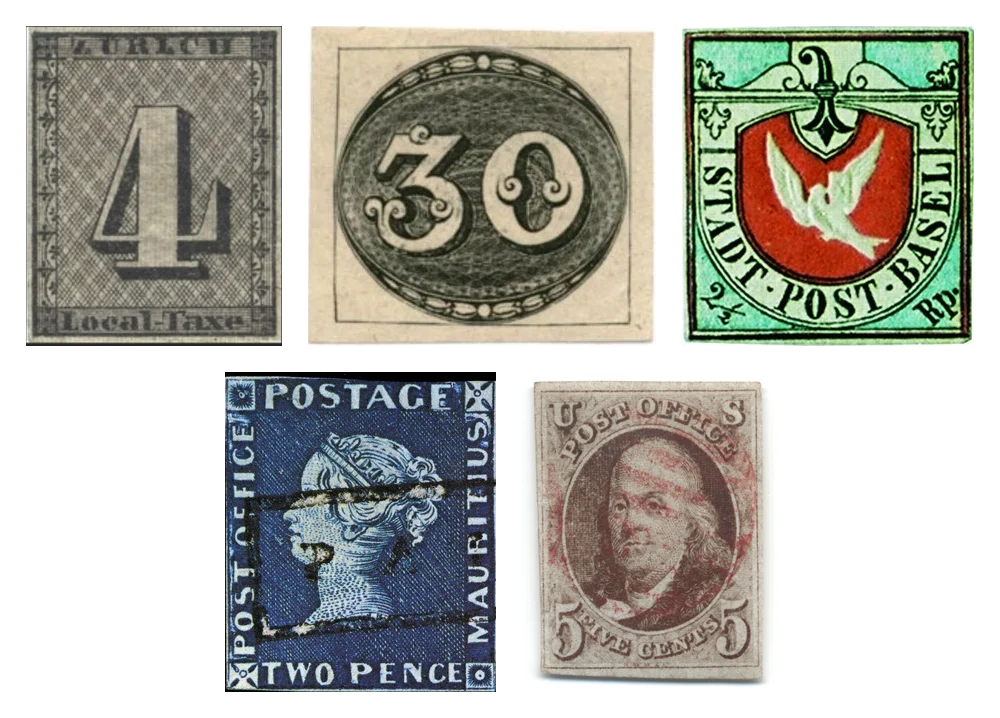
1843 — Zurich and Geneva. The Swiss cantons of Zurich (1 March) and Geneva (30 September) issued the world's second and third adhesive stamps. The Geneva issue, the "Double Geneva", was a se-tenant pair of 5-centime stamps that could be used together as a 10-centime local rate — arguably the first se-tenant design.
1843 — Brazil. The "Bull's Eyes" (Olho-de-boi), issued 1 August, in denominations of 30, 60 and 90 réis. Brazil was the first country outside Britain to issue stamps valid nationwide. The design is pure numeral, with no portrait — the Emperor's likeness was thought too sacred to be defaced by a cancel.
1845 — Basel. The "Basel Dove", the first stamp printed in three colours and one of the most attractive classics.
1847 — United States. Five cents Franklin and ten cents Washington. Before this, several American postmasters had issued their own local stamps — the Postmasters' Provisionals — of which the New York and Providence issues are the best known.
1847 — Mauritius. The "Post Office" issue, one penny orange and two pence blue, engraved locally by a jobbing watchmaker. Twenty-six examples are known to survive of the roughly 500 printed, and it is among the most celebrated rarities in the world.
1849–1852 — the flood. France, Belgium, Bavaria, Spain, Austria, Prussia, Saxony, Sardinia, Portugal, the Netherlands, Denmark, Chile, Canada, New South Wales, Victoria, Trinidad.
1852 — Sind. And in July 1852, in a province of British India, a local administrator named Bartle Frere issued a small circular half-anna stamp on his own initiative. It was the first adhesive postage stamp in Asia, and it is the subject of Stage 11.
3.5Perforation
For fourteen years, every stamp in the world was imperforate. Post office clerks cut sheets apart with scissors, which was slow, and customers received stamps with margins of wildly varying width, which is why condition and margins matter so much in classic material.
Henry Archer, an Irish landowner and railway promoter, built the first practical perforating machine and demonstrated it to the British Post Office in 1848. It took six years of trials, an official purchase of his patent, and considerable institutional foot-dragging before officially perforated stamps went on sale in Britain in 1854 — Archer's roulette trials and early perforation trials from 1850 onwards being among the most sought-after items in British philately.
Perforation spread as fast as the stamp itself had. Within a decade it was standard almost everywhere, and its absence became a dating tool: an imperforate stamp from a country that perforated is either early, an error, or a proof.
Stage summary. Before 1840 the recipient paid, by distance and by sheet, and most people could not afford to write letters. Rowland Hill's reform made postage uniform, cheap and prepaid; the adhesive stamp was the mechanism for showing prepayment. The Penny Black lasted ten months and was replaced because red cancellations could be washed off it. The idea crossed to Switzerland and Brazil in 1843, the United States in 1847, and reached Asia in 1852 in a corner of British India. Perforation arrived in 1854 and made the modern stamp.
Stage 4Types of Issues
Not every stamp is a postage stamp, and not every postage stamp does the same job. Catalogues are organised around these categories, so knowing them is the difference between finding a stamp in five seconds and not finding it at all.
4.1Definitives
The workhorses. Definitives are the everyday stamps: printed in large quantities, kept on sale for years, reprinted as needed, and designed to cover the full range of postal rates from the cheapest postcard to the heaviest parcel.
Because they run for years, definitives are where philately gets interesting. A single definitive design may exist across:
- multiple printings, on different paper
- multiple watermarks, as paper stocks changed
- multiple perforations, as machines were replaced
- multiple shades, as ink batches varied
- multiple printers, sometimes in different countries
Two stamps that look identical to a beginner can be forty years apart. This is why Stage 2 exists.
The great definitive series are among the longest-running printed objects in history. British India's King George V series ran from 1911 to 1936. India's post-independence Archaeological series, the Map series and their successors have kept the tradition going.
Recognising a definitive: small format, plain design, a portrait or emblem rather than a scene, a value that corresponds to a common rate, and — the strongest clue — the same design appearing in six or eight different denominations and colours.
4.2Commemoratives
Issued to mark an event, an anniversary or a person. Usually larger, usually more elaborate, printed in fixed quantities, on sale for a limited period.
Who was first? There is an argument, and it is a good illustration of how philatelic questions work.
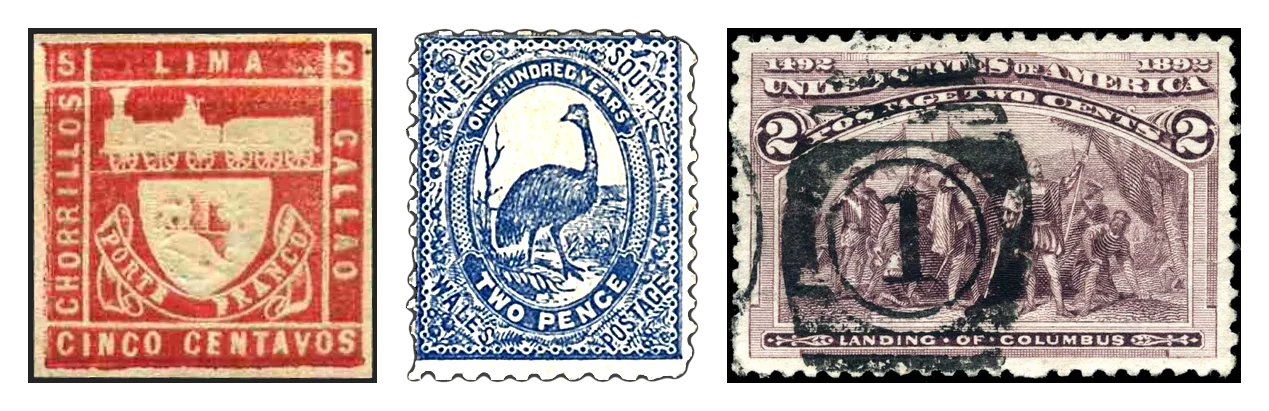
- Peru, 1871 issued a stamp for the twentieth anniversary of the Lima–Callao railway, the first in South America. It has the best claim chronologically, though it was also a functional postage stamp of an ordinary rate.
- New South Wales, 1888 issued a set for the centenary of the colony, inscribed "ONE HUNDRED YEARS". This is often cited as the first true commemorative series.
- United States, 1893 issued the sixteen-value Columbian Exposition set, which is the first commemorative issue that unmistakably behaved like one — big, pictorial, sold as a collectable, and running to a five-dollar top value that no ordinary correspondent would ever need.
The Columbians also established the modern business model, which some people find distasteful and which has funded a great many postal administrations ever since: issue attractive stamps that collectors will buy and never use, and the face value becomes pure profit.
India's first commemoratives came in 1931, for the inauguration of New Delhi, and are covered in Stage 13.
4.3Airmails, express and registration
Airmail stamps pay the surcharge for carriage by air. They are usually inscribed as such — Par Avion, Luftpost, "AIR MAIL" — and often depict aircraft. Many countries used them heavily between the 1920s and 1950s and then abandoned them when airmail became the default.
Express and special delivery stamps pay for expedited handling.
Registration stamps pay the registration fee, giving the sender a receipt and the item a tracked, signed-for journey. Several countries issued dedicated registration stamps; India generally used ordinary postage for the fee, but the registration labels and handstamps are collected as postal history.
Late fee stamps, a nineteenth-century speciality, paid a surcharge for posting after the mail had officially closed.
4.4Officials and Service stamps
Government departments send a lot of mail. Rather than have every department buy stamps, most administrations issued official stamps — either distinct designs, or ordinary stamps overprinted.
India used the overprint approach, and "SERVICE" and "ON H.M.S." overprints run through the whole of British Indian philately and into the Republic. They are catalogued separately, they exist in every printing variation the underlying stamp does, and — because an overprint is trivially easy to fake — they are a favourite target of forgers.
One of the most valuable single items in Indian philately is a Service overprint: the 1948 Gandhi ten-rupee with "SERVICE", of which very few genuine examples exist. Stage 16 tells that story.
4.5Postage dues
When a letter arrives underpaid or unpaid, the recipient owes the balance. Postage due stamps — sometimes called taxe stamps — are applied by the receiving office to record what was collected.
They are never sold to the public, which produces a curiosity: used postage dues are the normal state, and mint ones are often the scarcer item, reversing the usual rule. Better still, because they were applied at the destination and only on genuinely deficient mail, a postage due on cover is a real postal document, and worth far more than the stamp alone.
4.6Charity and semi-postal issues
Sold above face value, with the surplus going to a cause — war relief, tuberculosis, flood relief, the Red Cross. The value is written as "5c + 2c": five for the postage, two for the charity.
They are a European tradition more than a British or Indian one, though India has issued a number, and the Refugee Relief obligatory tax stamps of 1971 are a well-known Indian example of a related idea: a compulsory surcharge on all mail, funding relief for refugees from the Bangladesh Liberation War.
4.7Revenues and fiscals
Here is the largest and least collected field in the whole hobby.
Revenue stamps pay taxes, not postage: stamp duty on documents, court fees, share transfers, receipts, licences, tobacco and alcohol duty, insurance, entertainment tax. Every state that has ever taxed anything has probably issued them.
India is exceptionally rich in this material. Court fee stamps were issued by British India and by dozens of princely states, often in denominations and formats far more elaborate than their postage stamps. Many states that issued few or no postage stamps issued extensive revenues.
The field is undervalued for three reasons: catalogues are patchy, most collectors never encounter it, and the stamps were used on documents that were routinely destroyed. That combination — genuine scarcity, low prices, incomplete literature — is exactly what an ambitious collector should be looking for.
Watch for dual-purpose issues. Many stamps were valid for both postage and revenue, often inscribed "POSTAGE & REVENUE". A stamp with a pen cancel or a punch hole is usually fiscally used, and in most catalogues that makes it worth a fraction of a postally used example — but not always, and for some issues the fiscal use is the scarcer one.
4.8Postal stationery
Items where the stamp impression is printed as an integral part of the object, not stuck on:
- Postal cards — the single most important item in Indian postal history. India's quarter-anna postcard, introduced in 1879, was for generations the cheapest written communication available to any person on earth, and it carried an extraordinary volume of ordinary life: money requests, exam results, marriage negotiations, death notices.
- Envelopes and letter sheets
- Aerogrammes — lightweight fold-and-seal air letters
- Registration envelopes
- Wrappers for newspapers, at a reduced rate
Postal stationery is bulky, awkward to house, cheap to buy, and historically dense. It is also the area where an ordinary collector is most likely to own something genuinely unrecorded.
images/part-2/ch04-postal-stationery.jpg4.9Sheets, blocks and formats
Miniature sheet (MS) — a small sheet containing one or a few stamps, with decorative margins, issued as a unit. Souvenir sheet — much the same thing; the terms are used loosely and differently by different catalogues. Se-tenant — two or more different designs joined together, intended to be collected as a unit. Booklets — stamps bound in card covers, sold at post office counters. Booklet panes have distinctive perforation patterns, since the binding edge is imperforate or trimmed. Coils — long rolls for vending machines, perforated on two sides only. Gutter pairs — two stamps separated by a blank strip from the centre of the sheet. Tête-bêche — two stamps joined with one inverted relative to the other.
Formats matter for value because they make otherwise common stamps scarce in a particular configuration. A common stamp in a booklet pane with the correct perforations, or as a gutter pair, can be worth many times the loose single.
4.10Personalised and modern issues
From the 2000s onward, several administrations have offered personalised stamps — genuine postage carrying a customer's own photograph, usually in a fixed frame design. India Post's My Stamp service, launched in 2011, works this way.
They occupy an odd position. They are valid postage and technically collectable, but they exist in unlimited variety and near-zero demand, and no catalogue can list them meaningfully. Most serious collectors ignore them; a few collect the frame designs, which are finite.
The same era brought stamps printed on silk, on wood, on metal foil, with embossing, with scent, with thermochromic ink that changes colour in the hand. Stage 17 takes up the argument about whether any of this is philately or merchandising.
Stage summary. Definitives are the long-running workhorses and the richest ground for study. Commemoratives mark events and invented the modern business of selling stamps to collectors. Beyond these lie airmails, officials, dues, charities, revenues and postal stationery — the last two being the largest underexplored fields in the hobby, and both especially rich in India. Format matters: booklets, coils, gutters and miniature sheets make common stamps scarce. And for anything with a specialised function, the cover is worth more than the stamp.
Stage 5Errors, Freaks and Varieties
Every stamp is an industrial product, and industrial products go wrong. What makes philately unusual is that the failures are worth more than the successes.
5.1The EFO distinction
Collectors divide production faults into three grades, and the difference matters because it determines value.
An error is a complete, repeatable failure of the production process — a missing colour, an inverted centre, a wrong denomination, a stamp printed without perforations. Errors affect an entire sheet or run. They are catalogued, they are listed, and they carry the highest premiums.
A freak is a one-off accident — a paper fold, a crease that ran through the press, an ink smear, a misregistration. Freaks are not repeatable; the next sheet came out fine. They are collectable, sometimes spectacular, but rarely catalogued.
An oddity is anything strange that is not really either — a printing on the reverse offset from the sheet below, unusual perforation shifts, minor colour variation.
The rule of thumb: an error is something the printer did wrong to a whole sheet; a freak is something that happened to one piece of paper.
5.2Inverted centres
The most celebrated category, because they are visually unmistakable and they only occur on bi-coloured stamps that require two passes through the press.
The mechanism is always the same. Sheet goes through, gets the frame. Sheet is stacked, dried, and returned for the second colour. Somewhere in that handling, a sheet gets turned end for end. It goes back through the press upside down relative to the first impression, and every stamp on it comes out with the centre inverted.
The Inverted Jenny, United States 1918, twenty-four cents, showing a Curtiss JN-4 aeroplane upside down inside its frame. One sheet of one hundred reached the public, bought over a post office counter by a collector who had gone in specifically hoping for exactly this. It is the most famous stamp in the world after the Penny Black.
The Inverted Head Four Annas, India 1854, is the Jenny's older and rarer cousin, and Stage 12 gives it a full account. Twenty-eight are known, all postally used, and the error was not noticed by anybody for twenty years.
The Inverted Swan, Western Australia 1854–55, fourpence blue — where, counter-intuitively, it is the frame that is inverted, not the swan. The swan looks upside down but is not.
5.3Missing colours and colour errors
Missing colour errors happen when one printing unit fails or runs dry, or when a sheet misses one pass entirely. A modern six-colour stamp printed with five colours can look startlingly different from the issued version.
These need care, because they are the easiest error to fake. A fugitive ink can be chemically removed to simulate a missing colour, and the result is convincing to the eye. Two checks: a genuine missing colour shows no trace whatsoever of that ink anywhere on the stamp, including in the margins and perforation tips; and under UV, a chemically stripped stamp usually fluoresces differently where the treatment was applied.
Colour errors are different — a stamp printed in the wrong colour entirely, usually because the wrong ink was mixed or the wrong plate was mounted. The Spanish two-reales colour error of 1851 is the classic.
Colour shifts are freaks: the second colour lands off-register, so the portrait sits half outside its frame.
Colour changelings are not errors at all, and this trips up beginners constantly. Sunlight, damp, chemicals and sulphur in the atmosphere alter inks over time. An orange stamp that has faded to yellow is a damaged stamp, not a rarity. Anyone offering you a spectacular colour variety at a suspiciously reasonable price is probably selling a changeling.
5.4Perforation errors
Imperforate errors occur when a sheet skips the perforator. The whole sheet is affected, so genuine imperforate errors normally exist in blocks or pairs — and this is the key check. A single "imperforate" stamp with four straight edges is almost always a normal stamp with the perforations trimmed off. Insist on a pair with the imperforate edge between the two stamps, so the fault is proven internally.
Part-perforate errors have one or two sides missed. Double perforation occurs when a sheet passes through twice. Misplaced perforation cuts through the design, and if it is severe enough, one stamp's design appears divided across two.
5.5Plate flaws and constant varieties
This is the quiet, deep end of the subject, and it is where most real philatelic research happens.
A plate flaw is a defect in the printing plate itself: a scratch, a broken letter, a worn patch, a speck of dirt that got fixed into the transfer. Because the plate prints the same sheet over and over, the flaw appears on every sheet, always in the same position. This is what "constant variety" means.
Constant varieties are enormously useful. They let you determine which position in the sheet a stamp came from and, if a plate was repaired mid-run, roughly when it was printed. They allow the reconstruction of settings. They expose forgeries — a forger copying a stamp with a famous flaw will reproduce the flaw, but will not reproduce the other eleven position-specific characteristics that the genuine stamp must also carry.
For the 1854 Indian lithographs, where each stamp on the stone was transferred individually from a paper cut-out, the variations between positions are substantial, and this is the basis of everything in Stage 12.
Retouches are repairs made to a worn plate, and are themselves collectable varieties. Re-entries occur in recess printing when a worn transfer is re-laid slightly off the original, producing doubled lines in part of the design.
5.6Paper and gum freaks
Paper folds. A sheet folded before printing produces, when opened, a blank white streak through the design and a distorted image on either side. Dramatic and popular.
Foldovers. A corner folded over, printed, then opened out — producing part of the design on the reverse.
Offsets. Wet ink from one sheet transferring to the back of the next in the stack. The result is a mirror image of the design on the reverse of the stamp. Common, cheap, and often mistaken for something more exciting.
Miscuts and misperfs — sheets trimmed off-centre so the design runs off the edge.
Gum freaks — gum on the front, gum skips, gum ridges.
5.7When it is an error and when it is damage
The single most useful sentence in this stage: if the fault happened after the stamp left the printing works, it is damage, not an error.
Faded colour is damage. A torn perforation is damage. A stain, a thin, a crease, a pinhole — damage. A cancel that obliterates the design is not an error. A stamp cut down to fit an album space is not an imperforate.
The distinction is not always obvious to the eye, which is why serious error material should be bought with a certificate, and why the four-margin single with no accompanying pair should be treated with suspicion.
Stage 6Postal History
A stamp is a receipt. Postal history is the study of the transaction.
This is the branch of the hobby that rewards curiosity more than money, and it is the one place where an ordinary collector with a modest budget can still own things that nobody has properly studied.
6.1The stamp is evidence; the cover is the document
A traditional collector wants the two-anna green in fine condition. A postal historian wants an envelope carrying that stamp, posted at Madras on a datable day in 1856, addressed to Aden, with the correct rate for that route, transit marks on the reverse, and an arrival mark.
The second object tells you something the first cannot: that this rate existed, that this route ran, that mail took this long, that the office at this place was open on this date. It is a primary historical source. The first object is a nice stamp.
The prices do not reflect this. Most dealers price covers according to the catalogue value of the stamps on them, which means a great deal of genuinely interesting postal history sells for the price of its franking. This is the last obvious inefficiency in the hobby.
6.2The vocabulary
Cover — an envelope or wrapper that has been through the post. Entire — a letter sheet that folds to form its own envelope, with the message on the inside. Standard before the 1850s. Front — a cover with the back missing. Worth substantially less, because the back carries the transit and arrival marks, which is where much of the information lives. Always turn a cover over. Piece — a fragment cut from a cover, retaining stamp and cancel. Postal stationery — stamp printed as part of the item. Franking — the stamps applied, and by extension the total paid. Rate — what the service should have cost. Route — how it actually travelled.
6.3Cancellations
The cancel exists to stop reuse. It also, incidentally, records where and when — which makes it the most information-dense mark on the whole object.
Handstamps — applied by hand, one at a time. Includes the earliest types: the Maltese Cross, the diamond-of-dots, the barred oval. Numeral obliterators — a number identifying the office, inside a pattern of bars or dots. British India used these extensively, and the number is often the only way to identify where an item was posted. The identification of Indian numeral cancels is a substantial specialist literature in its own right, and it is what makes "India used abroad" collectable at all (Stage 15). Duplex — obliterator and datestamp combined in one instrument, so a single strike both kills the stamp and dates the item. A large improvement, and the reason nineteenth-century covers get easier to date after about 1860. Circular date stamps (CDS) — the modern standard. A clean, fully legible CDS on a stamp is called a socked-on-the-nose strike and carries a premium. Machine cancels — continuous wavy lines, from the 1890s. Slogan cancels — machine cancels carrying an advertising or public-information message. A field of their own. Manuscript cancels — pen strokes, used where no handstamp existed. Common in small Indian State offices and on early village mail.
6.4Rates and routes
Postal rates are the skeleton of the subject. A rate is a function of weight, distance or destination zone, and service class, and it changed frequently.
Reconstructing the route is the pleasure. A cover from Bombay to London in 1860 might have gone by P&O steamer to Suez, overland across the isthmus, by steamer again to Marseille or Southampton, and by rail. Each leg leaves a mark. A cover from Calcutta to a hill station might have gone by rail and then by runner, and the runner's leg will show in the timing.
Travelling Post Offices (TPOs) sorted mail on the move, on trains and on ships, and had their own cancellations. Indian railway TPO marks are richly collected.
Maritime mail carries its own vocabulary — packet letter, ship letter, paquebot — each denoting a different legal and financial arrangement between the ship and the postal administrations at either end.
6.5Censored and wartime mail
Both world wars produced enormous quantities of controlled mail, and India was a major theatre of it: mail to and from troops, internee mail, prisoner-of-war mail, and civil censorship of ordinary correspondence.
The markings — censor tapes with serial numbers, examiner handstamps, resealing labels, "opened by censor" — are systematically catalogued, and the numbers can often be traced to a specific censorship station.
Field Post Offices (FPOs) served units in the field and used numbered cancellations that concealed the location for security reasons. Working out which FPO number corresponds to which place and date is a well-developed research field, and Indian FPOs operated across the Middle East, East Africa and Southeast Asia.
6.6Airmail
The route networks of the 1920s and 1930s are the heart of aerophilately, and India sits at the centre of the map: the England–India–Australia trunk route ran through Karachi, Delhi, Calcutta and Rangoon, and almost every long-haul flight between Europe and the East touched Indian soil.
First flight covers were flown on an inaugural service and carry a commemorative cachet. Crash and wreck mail — items recovered from aviation and maritime disasters, usually damaged, usually accompanied by an official explanatory label or handstamp — is a small, macabre, and highly collected field.
The first officially recognised airmail flight anywhere in the world carrying post took place in India: on 18 February 1911, Henri Pequet flew mail from Allahabad across the Yamuna to Naini, a distance of about six miles, during an exhibition. Roughly 6,500 items were carried, each with a special cachet. Stage 13 returns to it.
6.7Building a postal history collection cheaply
Three principles.
Buy the cover, not the stamp. Look for interesting journeys with ordinary franking. A common stamp on a cover from a remote office to an unusual destination is worth more, intellectually, than a scarce stamp on a Calcutta-to-Bombay envelope.
Pick a narrow spine. One route, one office, one rate period, one conflict, one railway line. Postal history collections that try to cover a whole country become undifferentiated piles.
Read the literature first. The published rate tables and cancellation studies are what turn a box of old envelopes into a collection. Buying before reading is how people accumulate material they cannot interpret.
Stage 7Building a Collection
7.1Choosing a direction
The advice usually given — specialise early — is given to people who do not yet know what interests them, and it is wrong for them.
Better sequence: buy widely and cheaply for a year, handling as much material as possible. Mixed lots, kiloware, cheap job lots at club nights. You are not building a collection; you are finding out what you keep picking up.
Then specialise, and specialise narrowly. Not "India" — India is a fifty-year project even for a specialist. Something like:
- One issue in depth: the 1854 lithographs, all values, all printings, all varieties
- One state: Travancore, or Bhopal, or Soruth
- One reign: King George V British India, including officials and stationery
- One theme with a real argument behind it: the postal history of the Indian railways; medicine on stamps as a record of public health campaigns
- One route: the England–India airmail service, 1929–1939
- One office: everything ever posted from a single town
A narrow collection is more interesting to build, more interesting to look at, cheaper to complete, and worth more when sold, because a specialist buyer will pay for coherence.
7.2The catalogues
You need one. Which one depends on what you collect.
Stanley Gibbons — the British standard. Best for the Commonwealth, and the definitive reference for India and the Indian States. The Commonwealth & British Empire Stamps 1840–1970 volume is the single most useful book for anyone collecting India.
Scott — the American standard. Covers the world in multiple volumes. Different numbering, generally different valuations, and a somewhat different philosophy about what deserves listing.
Michel — the German standard, and the most technically detailed for many areas. Excellent for Europe.
Yvert et Tellier — the French standard.
They disagree. A stamp can be SG 43 and Scott 30 and Michel 25, and the three catalogues may not even agree on how many distinct stamps exist, because they take different views on what counts as a separate listing. A concordance for key Indian issues is in the back matter.
7.3Condition and grading
Condition drives value more than anything except rarity, and beginners systematically underrate it.
Centering. How evenly the design sits within the perforations.
- Superb — perfectly centred, even margins all round
- Very Fine (VF) — very slightly off, margins clearly clear on all sides
- Fine (F) — noticeably off-centre, design still clear of the perforations
- Average — perforations cut into or touch the design
- Poor — design badly cut
Gum state for mint material: MNH, MH/LH, MNG (see Stage 2).
Faults, all of which reduce value substantially: thins (paper removed from the back, usually by careless hinge removal — hold to a light), creases, tears, pinholes, stains, foxing, toning, short or missing perforations, clipped corners.
Cancellation quality for used material. A light, clean, dated cancel that leaves the design visible is worth more than a heavy smudge. On classic issues a legible dated cancel is worth a premium over a decorative one.
The rule that saves the most money: for any given budget, buy fewer stamps in better condition. A collection of thirty fine stamps is worth more, sells more easily, and is more pleasant to own than one of two hundred poor ones. The exception is genuine rarities, where the market accepts faults because the alternative is not owning one at all — Scinde Dawks and the 1854 inverts are graded on a different scale for exactly this reason.
7.4Where to buy
Dealers. The most expensive per item and by far the best value for a beginner, because a good dealer will tell you what you are looking at, will not sell you a fake, and will take material back. Find one and stay with them.
Auctions. Where serious material trades. Read the conditions of sale before bidding; understand the buyer's premium, which is typically 20–25% on top of the hammer price, plus taxes. Auction estimates are marketing; realised prices are data.
Bourses, fairs and club nights. Cheap, social, and the best place to buy cheap mixed material in the exploratory year.
Online marketplaces. Enormous supply, no quality control. Fine for common material where the downside is small; dangerous for anything expensive. Never buy a rarity from a photograph without a certificate.
Exchange packets and circuits. Run by societies: a sealed packet of members' duplicates circulates, each member removes what they want and pays. Slow, cheap, and an excellent way to fill gaps.
Post office philatelic bureaux for new issues. Stage 17 explains why this is usually a poor financial decision and sometimes a perfectly good one anyway.
7.5Budget
Decide an annual figure and stick to it. Then spend it in a shape:
- 60% on the specialisation, in the best condition you can afford
- 20% on postal history and covers within that specialisation, which is where the underpriced material is
- 10% on literature — catalogues, handbooks, society journals. This is the highest-return spend in the hobby and almost everybody underspends it
- 10% on nothing in particular, because that is where the next specialisation comes from
7.6Record-keeping
Keep an inventory. It should record, for each item: catalogue number, description, condition, what you paid, when and from whom, and whether a certificate exists.
This matters for three reasons: insurance, avoiding duplicate purchases, and the fact that whoever eventually disposes of your collection — you or somebody else — will need it. A collection with a good inventory sells for meaningfully more than the same collection without one.
Photograph everything above modest value. Front and back.
7.7Exhibiting
Competitive exhibiting is organised internationally under FIP (Fédération Internationale de Philatélie) rules, with recognised classes: Traditional, Postal History, Postal Stationery, Aerophilately, Astrophilately, Thematic, Revenue, Maximaphily, Youth, Literature, and Open Philately (which permits non-philatelic material alongside).
Exhibits are mounted in frames, each holding sixteen album pages. A full exhibit is five or eight frames. Judging weighs treatment and importance, philatelic knowledge and research, condition and rarity, and presentation.
The one-frame exhibit — sixteen pages on a single tightly defined subject — is the sensible entry point, and one-frame classes now exist at most national shows. It is also an excellent discipline even if you never enter: it forces you to decide what your collection is actually about.
Stage 8Care, Storage and Display
Everything in a collection is paper, ink and dried adhesive, roughly a tenth of a millimetre thick. It survives if you leave it alone in the right conditions and it does not if you do not.
8.1The five enemies
Humidity. The chief destroyer in South Asia. Above roughly 60% relative humidity, gum becomes tacky and stamps stick to each other and to album pages; above 70%, mould and foxing begin. Monsoon conditions can ruin a collection in a single season.
Light. Fades ink irreversibly. Aniline and fugitive inks — heavily used in the nineteenth century — go quickly. Never display in daylight; never store near a window.
Heat. Accelerates every chemical process in the paper and softens gum.
Acid. Paper made after about 1850 contains acid from the manufacturing process and slowly destroys itself. Worse, acid migrates: an acidic album page will attack the stamps on it. This is why "acid-free" and "archival" on album materials is not marketing.
Adhesive tape. Cellophane tape applied to a cover or a stamp is close to a death sentence. The adhesive migrates into the paper, stains it brown, and cannot be removed without specialist treatment. Never use it on anything, ever, for any reason.
To which add a sixth: sulphur, from urban air pollution and from certain papers and boards, which tarnishes stamps printed with lead- or silver-based pigments.
8.2Hinges and mounts
A hinge is a small piece of gummed, peelable paper folded to attach a stamp to a page. Hinges are cheap, traditional, and permanently reduce the value of a mint stamp, because removing one leaves a mark and often takes a thin layer of paper with it.
A mount (the Hawid type, and its equivalents) is a clear plastic sleeve, black- or clear-backed, gummed on the reverse, that holds the stamp without touching its gum. Mounts cost more, look better, and preserve value.
The rule: used stamps may be hinged without harm. Mint stamps should never be hinged. The difference between MNH and MH on a valuable modern stamp can be half the value.
If you inherit a hinged collection, do not remove the hinges dry. Moisten them slightly and peel with great care, or better, leave them alone. Dry removal is the single commonest cause of thins.
8.3Albums, stockbooks and plastics
Stockbooks — pages with horizontal glassine or card strips. The right place for everything you have not yet decided about. Buy ones with glassine or acid-free card strips, not black-backed board of unknown composition.
Printed albums with pre-marked spaces for every stamp of a country. Attractive, satisfying, and quietly harmful: they dictate what you collect, they push you to buy poor examples to fill holes, and they have no space for the varieties that make a collection interesting.
Blank leaves or quadrille-ruled album pages in a ring binder. What every serious collector eventually uses. You lay the collection out as you think it should be, with your own annotation.
On plastics. Avoid anything containing PVC. PVC plasticisers migrate, and over years they will fuse to a stamp's surface and lift the ink when separated. Look for polyester (Mylar), polypropylene or polyethylene on the packaging. If a plastic page smells strongly of anything, do not use it.
8.4Handling
Tongs, always. Skin deposits oils and salts that stain paper over years, and the damage does not show for a decade.
Spade-tipped or rounded tongs, not pointed ones. Pointed tongs puncture stamps, and the puncture is invisible until someone holds it up to a light.
Work on a clean, uncluttered surface with a soft mat. Never over an open drink. Never with a fan or an air conditioner blowing directly on the table.
8.5Repair and conservation
There is a line, and it is about disclosure.
Acceptable, if disclosed: flattening a crease under weight; removing surface dirt with a soft brush; supporting a fragile cover with an archival sleeve; professional deacidification.
Not acceptable: reperforating; regumming; adding margins; painting in a missing part of the design; chemically removing a cancellation; strengthening a thin from behind. All of these are alterations, and selling an altered stamp without declaring it is fraud, whether or not the seller knows the term.
The safest position for a private collector: do not repair anything. A sound-but-faulty stamp has a market. A badly repaired stamp does not, and a well-repaired one becomes a problem for whoever owns it next.
8.6Storage in a tropical climate
This section is for readers in India, and it is the most practically important part of the stage.
Target conditions: 45–55% relative humidity, 18–24°C, dark, stable. Stability matters more than the exact figure — cycling between wet and dry stresses paper far more than a constant moderate humidity.
What to do:
- Store albums vertically, like books, in a closed wooden or metal cabinet. Not in cardboard boxes on the floor, and never in a basement or against an external wall.
- Use silica gel in the cabinet. The rechargeable indicating type, which changes colour when saturated. Dry it in an oven or in the sun every few months and put it back.
- Buy a cheap hygrometer and put it in the cabinet. You cannot manage what you do not measure.
- Interleave mint material with acid-free tissue or glassine so stamps cannot stick to facing pages.
- Never store in the same room as a bathroom wall, a kitchen, or an unsealed window.
- If you run an air conditioner or a dehumidifier in the room, run it consistently. Intermittent dehumidification is worse than none.
- Before the monsoon, check everything. After the monsoon, check everything again.
If a stamp has stuck to a page or to another stamp: do not pull. Soak (Stage 1). You will lose the gum and any mint premium, but you will keep the stamp.
8.7Digitising
Scan at 1200 dpi for stamps, 600 dpi for covers, in colour, with a colour reference target in the frame if you can. Save a TIFF master, uncompressed, and work from JPEG copies.
Scan the back as well as the front. The back shows gum, hinges, thins, repairs and watermarks, and it is the half people forget.
Keep the files in at least two places, one of them not in your house. This is your insurance documentation and, if the worst happens, the only record that the collection existed.
Stage 9Value, Forgeries and Expertisation
9.1What determines value
Four factors, in this order.
Rarity — how many exist. Not how many were printed; how many survive, in collectable condition. A stamp printed in millions can be rare in mint condition, on cover, or with a particular cancel.
Demand — how many people want one. This is the factor beginners ignore and it dominates the market. There are stamps of which fewer than fifty exist and which sell for very little, because nobody collects that country. Indian material has strong and growing demand, which is one reason Indian prices have held up better than many comparable areas.
Condition — Stage 7. On common material, condition is nearly the whole of value.
Provenance — whose collection it was in. A stamp that has passed through a famous collection carries a premium, both because the association is desirable and because it constitutes evidence of authenticity going back decades.
9.2Reading catalogue prices honestly
A catalogue price is a dealer's guide for a sound example in the stated condition, and it is a starting point, not a valuation.
- Catalogue prices assume fine condition unless stated. A stamp below that grade is worth a fraction.
- Common stamps rarely sell anywhere near catalogue. Discounts of 70–90% on modest material are normal.
- Genuine rarities frequently sell above catalogue, because catalogues lag the market.
- Catalogue values for used stamps assume an ordinary cancel. Fiscal or pen cancels are worth much less; fine dated cancels of the right period may be worth more.
- A whole collection is worth far less than the sum of its catalogue values. Dealers buy collections at a small percentage, because they have to break them up and carry the stock.
The honest test: what have comparable examples actually realised at auction in the last two or three years? Auction archives are public, searchable, and the only real data.
9.3Forgeries: two kinds
Postal forgeries were made to defraud the post office — someone printing stamps to use rather than to sell to collectors. They are rare, contemporary with the genuine issue, and often worth more than the real thing, because they are historical curiosities in their own right.
Philatelic forgeries were made to defraud collectors. These are the problem, and they are everywhere.
Within philatelic forgeries, distinguish:
- Outright forgeries — the whole stamp is false.
- Faked overprints — a genuine common stamp with a false overprint added. The most profitable and easiest fraud in existence, and India is a prime target.
- Faked cancellations — a false cancel added to a mint stamp (where used is scarcer) or, more often, a false dated cancel of a desirable place or period added to a genuinely used stamp.
- Repairs sold as sound — reperforated, regummed, thins filled, margins added.
- Reprints — later printings from original plates, often official, often perfectly genuine as objects, but not the original issue. Jammu and Kashmir reprints are a standing problem (Stage 14).
9.4The great forgers
Jean de Sperati (1884–1957) is the one everybody names. An Italian working in France, he was a technically extraordinary printer who produced forgeries good enough to fool the leading experts of his day, on genuine period paper, with genuine period cancellations. He was eventually prosecuted, and the British Philatelic Association bought his entire remaining stock and reference material specifically to take it off the market. Sperati forgeries are now collected in their own right and catalogued — which produces the curious situation of forged Speratis.
Raoul de Thuin, a Belgian working in Mexico, specialised in Latin America and in faked cancellations, and worked in enormous volume. The American Philatelic Society bought out his operation in 1966.
François Fournier ran an "album weeds" business in Geneva in the early twentieth century, selling openly described "facsimiles" to collectors who could not afford originals. His products were often unmarked, and a century later they circulate as genuine. The Philatelic Society of Geneva acquired and destroyed most of the stock, keeping reference albums.
The Spiro brothers of Hamburg produced crude, cheerful forgeries in vast quantity in the 1860s and 1870s. They are easy to detect and turn up constantly in old collections.
The "Brighton" forgeries of Jammu and Kashmir are a specifically Indian problem and are discussed in Stage 14.
9.5Detection
You will not detect a Sperati. You can detect almost everything else, and most of what circulates is nowhere near that standard.
Method first. Stage 2. If a stamp should be recess-printed and is flat, it is wrong. If it should be lithographed and shows a photogravure screen, it is wrong. This single check eliminates the large majority of forgeries in under ten seconds.
Measure. Perforation gauge, and the physical dimensions of the design. Forgeries are frequently a fraction of a millimetre out, because the transfer process introduced scaling error. Compare against a known genuine example, not against a catalogue illustration.
Paper and watermark. Wrong paper for the period is conclusive. UV will show modern optical brighteners in paper that should predate them.
Colour. Compare side by side in daylight with a known example. Forgers work from photographs and get shades wrong more often than any other single thing.
Design detail at 10×. Every genuine stamp has specific, documented characteristics — the shape of a particular letter, the number of lines in a shaded area, a known plate flaw at a given position. Forgeries fail these. This is what the specialist handbooks are for, and why the literature budget in Stage 7 pays for itself.
Cancellation. A cancel should be the right type for the place and date, in the right ink, and it should sit on top of the stamp's ink, with the paper fibres disturbed correctly. Faked cancels often look painted on, which is precisely what they are.
9.6Expertisation
For anything of significant value, the answer is a certificate from a recognised body.
Royal Philatelic Society London (RPSL) — the oldest and most respected, particularly strong on classic Commonwealth material including India. British Philatelic Association (BPA) — long-established British expert committee. Philatelic Foundation (New York) and American Philatelic Society (APS) — the leading American bodies. Various national committees — Germany's BPP, France's, Switzerland's, and others, each strongest in their own area.
What a certificate is: an expert opinion, from named individuals, recorded with a photograph of the specific item, stating whether it is genuine and describing any faults or repairs. It is the market's standard of proof and it makes an item substantially easier to sell.
What a certificate is not: a guarantee, a valuation, or permanent. Opinions have been reversed. A certificate more than about twenty years old on a high-value item is often re-submitted, because techniques improve.
When to get one: before you sell anything valuable, and before you buy anything valuable that does not already have one. For expensive material, make the sale conditional on certification — a legitimate seller will agree.
9.7Insurance and disposal
Insurance. Household contents policies usually exclude or severely cap collectables. Specialist philatelic insurance exists and requires an inventory with valuations. Photographs and a written inventory (Stage 7) are the basis of any claim.
Disposal. Every collection is eventually sold, by its owner or by somebody else. Three routes:
- Auction — best realisation for good material, but takes months and costs 15–20% in seller's commission.
- Dealer sale — immediate, simple, and at a substantial discount to retail. Reasonable for modest collections.
- Private sale to a specialist collector — best price for a coherent specialised collection, hardest to arrange.
Leave instructions. The most avoidable loss in this hobby is a collection sold as a job lot by heirs who did not know what it was. Write down what you have, what it is worth, and who to call.
End of Part I. Part II — Indian Philately — follows in a separate document.
PART II — INDIAN PHILATELY
Stage 10Before Stamps: The Indian Post
The stamp arrived in India in 1852. The post had been running for at least two thousand years.
10.1The oldest network
Organised message-carrying in the subcontinent is documented from the Mauryan period. Kautilya's Arthashastra describes a system of couriers and intelligence-gatherers as an instrument of state. Ashoka's edicts, cut into rock across an empire that ran from Afghanistan to Karnataka, presuppose a functioning means of getting instructions to distant provinces.
What all these systems had in common, and what persisted for two millennia, was the relay runner. A man, on foot, carrying a bundle, running a stage of a few miles to the next station, where a fresh man took over. The chain moved continuously, day and night, and it moved faster than any horse could sustain over long distances.
10.2The Mughal dak
The word is dak — post, mail, relay — and it gives us "dawk" in the British spelling, and "bungalow" in the compound dak bungalow, the rest-house at a relay stage.
Sher Shah Suri (r. 1540–1545) built the system that the Mughals inherited and that the British eventually took over. He rebuilt the Grand Trunk Road, planted it with trees, dug wells along it, and established sarais — walled rest-houses — at regular intervals, each with horses and runners stationed. It was simultaneously a postal system, a military supply line and an intelligence network, which is what state postal systems have always been.
Akbar extended it substantially, and the Mughal dak chowki system at its height moved despatches between Agra, Lahore, Delhi and the provincial capitals with genuine reliability.
The men who ran it were the harkaras — a word that means, roughly, doer-of-business, and covered messenger, spy, and news-gatherer without much distinction. A harkara carried a spear and a bell. The bell was the important part: it announced him at a distance so the next runner could be ready, and it warned off animals and, with luck, robbers, since interfering with the royal post was a capital matter.
10.3The East India Company post
The Company began by running mail for itself. Company Dawk was an internal service between the trading settlements, and it was not available to the public.
The change came under Warren Hastings. In 1774 he opened the Company's post to private correspondence in Bengal, at published rates, with post offices at the presidency towns. It was, in practical terms, the beginning of a public postal service in India.
Bombay and Madras developed their own arrangements. For most of the late eighteenth and early nineteenth centuries, India had three separate presidency postal systems that did not fully interoperate — a fact that shows up constantly in the postal markings of the period.
Rates were charged by weight and distance, and by the tola — a traditional unit of about 11.7 grams — which is one of the small details that makes early Indian rate tables initially baffling to a European collector.
10.4The Acts
The Post Office Act of 1837 established a government monopoly on carrying letters and brought the presidency systems under a more unified framework. Postage was still paid in cash and marked by hand.
The Post Office Act of 1854 is the pivot. It created a single Indian postal service under a Director-General, introduced uniform rates independent of distance — the Rowland Hill principle, fourteen years after Britain — and provided for adhesive postage stamps. It also, quietly, made the post affordable for ordinary people for the first time.
The first Director-General was appointed, the Calcutta office was told to produce stamps, and the man who ended up doing it ran a map office. That is Stage 12.
10.5Pre-stamp markings
Before adhesives, prepayment and charges were recorded by handstamp and by pen. This is a rich and under-collected field.
Manuscript rates — the charge written in ink on the front, to be collected on delivery. "Bearing" marks — indicating unpaid mail, with the charge to be borne by the recipient. Post Office handstamps — town names, dates, and the distinctive early Indian types, including the well-known circular and oval marks of the presidency offices. "Post Paid" and "Bearing" straight-line handstamps. Ship letter and packet letter marks for maritime mail, which in India means an enormous volume, since virtually all correspondence with Europe went by sea.
The material survives in reasonable quantity, it is cheap relative to its interest, and much of it has never been systematically studied at the level of individual offices.
Stage 11Scinde Dawk, 1852
Asia's first adhesive postage stamp was issued not from Calcutta, the capital, nor from Bombay or Madras, but from a province annexed nine years earlier on the far north-western edge of British India, on the initiative of a local administrator who did not ask permission from anyone in particular.
11.1Sind, and Bartle Frere
The British annexed Sind in 1843, after the Battle of Miani. It was a difficult province: hot, thinly administered, strung out along the Indus, with its main artery running from the port of Karachi north through Kotri and Hyderabad to Sukkur.
Sir Henry Bartle Edward Frere was appointed Commissioner of Sind in 1850. He was an energetic and reforming administrator — he would later be Governor of Bombay — and one of the things he reformed was the post.
Frere had read about Rowland Hill. He wanted the same thing in Sind: prepayment, uniform rates, and a means of showing that a letter had been paid for. Working with Edward Lees Coffey, the Postmaster of Karachi, he introduced a half-anna uniform rate for the province and a stamp to go with it.
The stamps went on sale on 1 July 1852.
11.2The design
The design is the merchant's mark of the East India Company: a heart-shaped shield divided into three segments containing the letters E, I and C, surmounted by the "mystic sign of four" found at the head of merchants' marks across mediaeval and early-modern European commerce. Around it, a circular band.
The stamp is circular — the first round postage stamp anywhere in the world — and it is embossed rather than printed. There is no ink in the design at all; the image is a relief, pressed into the material.
This is the single most important physical fact about the Scinde Dawk and the one that gives it its character. It is a wax seal turned into a postage stamp: the direct descendant of the sealing method by which merchants, guilds and bishops had authenticated documents for six hundred years, transplanted into the age of the steamship and the uniform rate.
No other stamp of the pioneer era was made this way. The Penny Black was recess-printed. The Bull's Eyes were engraved. The 1847 Franklin was engraved. Only the Scinde Dawk was sealed.
11.3The three types
All are half anna. All are circular. All are imperforate, cut from sheets or wafers as required.
Type I — red sealing wax. The first. Individually embossed on round wafers of scarlet-vermilion sealing wax, applied to backing paper. Visually spectacular and structurally hopeless: the wax was brittle, and it cracked when a letter was opened, folded, or in many cases simply handled. It is the rarest of the three and, in intact condition, one of the great rarities of world philately.
Type II — white. The replacement. A colourless embossing on white to bluish wove paper. Durable, and almost invisible in poor light, which was the complaint that led to the third type. It is the commonest of the three, which in this context still means very scarce.
Type III — blue. Embossed in blue, on white and greyish paper. Introduced last and used until the end. Also a rarity.
Catalogued by Stanley Gibbons as S1, S2 and S3, with S2 (the blue) carrying a very substantial catalogue figure.
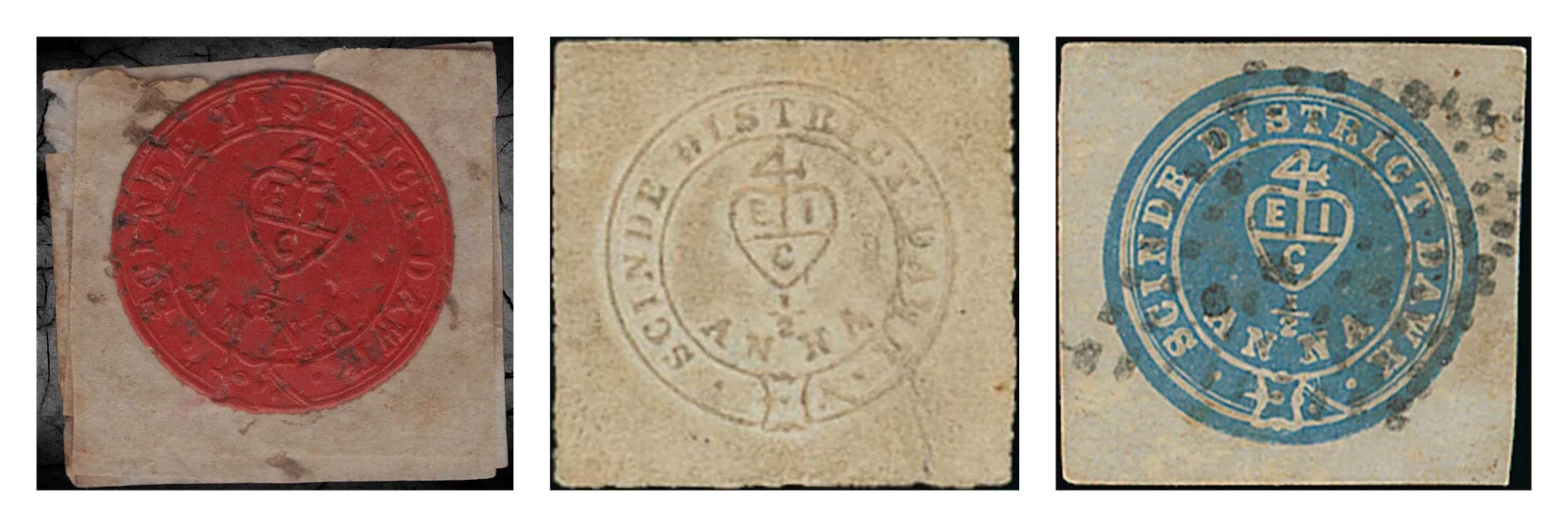
11.4Validity and withdrawal
The Scinde Dawk was valid only within Sind. It was never a stamp of India; it was a stamp of a province, issued under local authority.
That ended when India got national stamps. The all-India issues went on sale on 1 October 1854, and the Scinde Dawk was withdrawn — the standard account gives 30 September 1854 as the last day of validity, with remaining stocks destroyed shortly after. Some sources suggest stray usage continued slightly later. Either way, the working life was roughly two years and three months.
11.5Survival and census
Surviving examples are few. The commonly quoted figure is that fewer than a hundred are known across all three types, with the red the scarcest by a wide margin; a small group of unused red examples surfaced in the Burrus collection material in the 1960s, which is one of the few documented additions to the recorded population.
Condition is the defining problem. The red type cracked in use, and almost every surviving example has faults. The white type is faint on white paper and is frequently found damaged, toned, or with the embossing flattened by pressing.
This changes how the market grades them. For almost every other stamp in this book, faults destroy value. For the Scinde Dawk, faults are the norm and are priced in. A sound, well-margined, cleanly embossed example commands an enormous premium precisely because it contradicts the expected condition — and, for the same reason, should be scrutinised very carefully indeed.
11.6Forgeries
An embossed design without ink is, in principle, easier to imitate than a finely engraved one: no colour to match, no printing method to reproduce, no screen or line structure to get right. A forger needs a die and a press.
The consequence is that Scinde Dawk forgeries have circulated since the nineteenth century, and they range from crude to competent.
Stage 12The 1854 Lithographs
This is the flagship stage of Indian philately: the first stamps of British India, produced under difficulty by an army surveyor, using a printing process nobody in Calcutta had used before, in such haste that one of the results is now among the most famous errors in the world.
12.1The decision
The Post Office Act of 1854 provided for uniform rates and adhesive stamps. The Act was one thing; producing hundreds of thousands of stamps in Calcutta in 1854 was another.
The intention was always that De La Rue in London would print the permanent issue. But London was months away by sea, and the new rates were coming into force. Something was needed immediately.
12.2Thuillier and the Survey of India
The job went to Captain H. L. Thuillier, Deputy Surveyor-General, who ran the lithographic printing office of the Survey of India in Calcutta.
This is worth pausing on. The Survey of India existed to make maps. It had lithographic stones, presses, and men who understood transfer work, because that is how large-format maps were reproduced. It had no experience of security printing whatsoever. Thuillier was, by any reasonable measure, the wrong man with the wrong equipment — and he was the only man in India with any equipment at all.
He chose lithography, the process described in Stage 2: printing from a flat stone, relying on the mutual repulsion of grease and water.
The workflow was awkward in a way that matters enormously for what followed. The master designs were engraved on copper. From the copper, impressions were pulled onto specially prepared paper transfers. The paper transfers were then laid down onto the lithographic stone, one for each position on the sheet, and the design transferred.
Every one of those transfers was a separate, delicate, hand operation. Every one introduced small variations. This is why the 1854 stamps have such richly documented position characteristics, and why plating them is possible at all.
12.3The Queen's head
The portrait is the young Queen Victoria, in profile, and the essay work and die engraving for the heads went through several stages of re-engraving, producing the sequence of head dies that specialists distinguish today.
12.4The four values
Stamps went on sale on 1 October 1854.
Half anna, blue. Printed in sheets of 96. The most heavily used value, the most extensively studied, and the one with the famous die classification.
One anna, red. Also in sheets of 96.
Two annas, green.
Four annas, blue and red. The set-piece. Sheets of twelve, widely spaced, in the first printings.
Nine pies was added subsequently, and further Calcutta printings continued into 1855.
12.5The Four Annas
The four annas is one of the world's earliest multicoloured stamps — the Basel Dove of 1845 preceded it by nine years — and it was produced in two separate operations.
The sheet went through the press once to receive the red frames. It was then laid out to dry overnight. The next day it went through again to receive the blue heads, which had to land inside the frames already printed.
The First Printing began on 13 October 1854, using Head Die I and Frame Die I, in sheets of twelve widely spaced stamps bordered by blue wavy lines with rosettes in the corners. Something in the order of two hundred thousand stamps were produced from this first head die.
Specialists now recognise, across the whole four annas story, five printings, four head dies, two frame dies, and three different sheet setting and spacing types — which is why the four annas has a literature of its own, and why the standard reference on it is a book rather than a stage.
12.6The Inverted Head
On at least some sheets of that first printing, the paper carrying the dried red frames was fed back into the press the wrong way round — head to foot.
Every stamp on such a sheet came out with the Queen's head upside down inside its frame.
The error was not caught. The sheets were issued, sold, stuck on letters and posted. Nobody in the Calcutta office noticed, and — extraordinarily — nobody noticed for twenty years. The first recorded mention comes from a meeting of the Philatelic Society of London in 1874; the error is absent from the philatelic literature of the early 1870s entirely.
Twenty-eight examples are known. All of them are postally used — there is no unused example, because the error was only ever discovered after the fact, in already-cancelled material. Only two or three are cut square; the remaining twenty-five or so are cut to shape, trimmed by their nineteenth-century owners into the octagonal outline of the design, a practice that was normal at the time and that no modern collector would contemplate.
Research by Jatia established, by matching frame and head die positions, that at least six sheets must have been fed in inverted — one recorded example being the sixth known from Frame position 4 alone.
The Tapling Collection in the British Library holds what is believed to be the unique cover bearing two inverted head four annas.
Individual examples have sold at over a hundred thousand dollars, and rising; a Siegel sale in 2016 carried an estimate around $174,500.
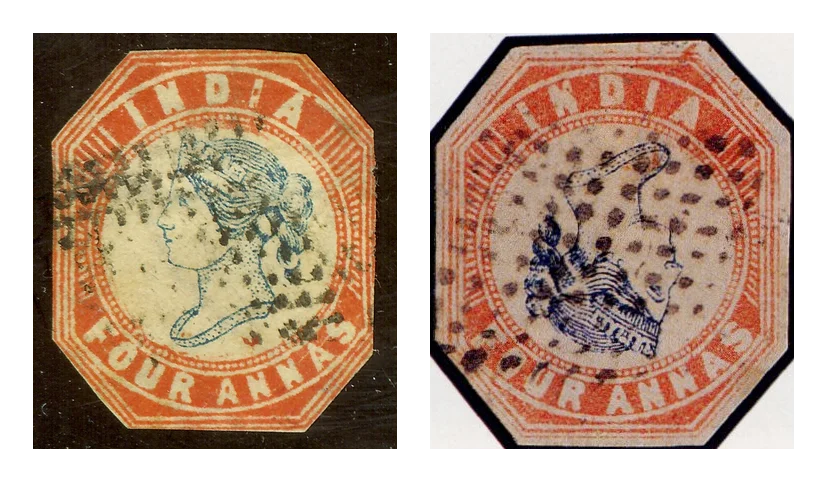
12.7The half anna die types
The half anna is the value most collectors will actually own, and it carries the classic die classification: Die I, Die II and Die III, distinguished by re-engraving of the head die between printings.
The distinctions turn on specific, small, documented differences in the engraving of the portrait and its surrounding detail — the treatment of the hair, the jewel, the band, and the fineness of the lines in particular areas. They are not visible without magnification and side-by-side comparison, and they cannot honestly be conveyed in prose. A photographic key is essential, and is the reason the images specified for this stage matter more than for any other.
12.8De La Rue, from 1855
The permanent issue arrived from London. De La Rue printings brought consistency of production, proper security papers, watermarks, and eventually perforation — everything the Calcutta lithographs lacked.
The lithographs remained in use for two or three years alongside them, and were reprinted in Calcutta in 1855. The 1891 reprints are a separate matter and are the first conclusive evidence that the inverted head error was known by then.
12.9Cancellations of the period
The 1854 stamps were killed by handstamp: the diamond of dots and, increasingly, numeral obliterators identifying the office. The numeral cancels of British India are a substantial study in themselves, and they are the mechanism by which the geography of Indian mail in this period can be reconstructed at all. Stage 15 uses the same system for a different purpose.
Stage 13The Crown Era, 1858–1947
Ninety years, five monarchs, and the bulk of what most people mean when they say "British India stamps".
13.1The transfer to the Crown
The Rebellion of 1857 ended the East India Company's rule. The Government of India Act 1858 transferred authority to the Crown, and India was governed from London through a Secretary of State and a Viceroy.
The stamps did not notice for twenty-four years. They continued to be inscribed "EAST INDIA POSTAGE" until 1882, long after the East India Company had ceased to exist in any meaningful sense. It is one of the small oddities of Indian philately and a useful reminder that stamp inscriptions record administrative inertia as faithfully as they record sovereignty.
13.2Queen Victoria
The long Victorian definitives are the foundation of any British India collection, and they are where Stage 2's tools earn their keep.
The material runs from the De La Rue printings of the mid-1850s through to the turn of the century, across:
- multiple watermarks — the Elephant's Head on the earliest, then Star
- multiple papers
- multiple perforations
- extensive shade variation, some of it catalogued and much of it not
- surface-printed and, later, other production methods
Two stamps of the same design and denomination can sit forty years apart. The only reliable way through this is watermark and perforation, in that order. The Victorian section of a Stanley Gibbons catalogue is essentially a decision tree, and using it is a skill worth acquiring early — it is the same skill that unlocks most of the rest of the Commonwealth.
1882 brings the change of inscription to "INDIA POSTAGE", and the new series that goes with it.
13.3Edward VII, 1902–1911
A short reign and a coherent set of definitives, in the same general format as the late Victorians. Less studied than the Victorian issues and correspondingly cheaper, which makes it a reasonable place for a collector to build depth without competing against established specialists.
13.4George V, 1911–1936
The longest and richest of the reigns for a collector.
The definitives run in two great series — 1911–1923 and 1926–1933 — the King Emperor designs that are, for many people, the visual signature of British India.
1926 is a production watershed: from that year the Security Printing Press at Nasik printed India's stamps. Printing moved from London to India, and stayed there. Everything issued from 1926 onwards is domestically produced, and Nasik's output — its papers, its inks, its methods — becomes a distinct study.
1929 — the airmail set. Six values, showing a de Havilland DH.66 Hercules, issued for the newly inaugurated airmail letter service. Chronologically this is India's first pictorial and, arguably, its first commemorative issue, though it is classed as an airmail. Finding each of the six values correctly used on a genuine airmail cover, paying the service it was issued for, is a well-known specialist challenge.
1931 — Inauguration of New Delhi. Six values, issued 9 February 1931, designed by W. Barr, printed by offset lithography at Nasik. This is standardly described as British India's first commemorative issue.
The six designs are the new imperial capital in portrait: George V overlaying the Secretariat; the Secretariat; the Council House; Viceroy's House; the War Memorial Arch; and Purana Qila. Three of those buildings are now the Parliament House, Rashtrapati Bhavan and India Gate — which makes the set a photograph of a city taken at the moment it was completed and eighteen years before it changed meaning entirely.
Print runs were small by definitive standards. The ½ anna is recorded at around 250,000. The set is catalogued SG 226–231 and, remarkably for something this significant, remains inexpensive.
By a coincidence worth noting, Jaipur (March 1931) and Travancore (November 1931) both issued commemoratives later the same year — the idea spread through the states almost immediately.
1935 — Silver Jubilee of King George V.
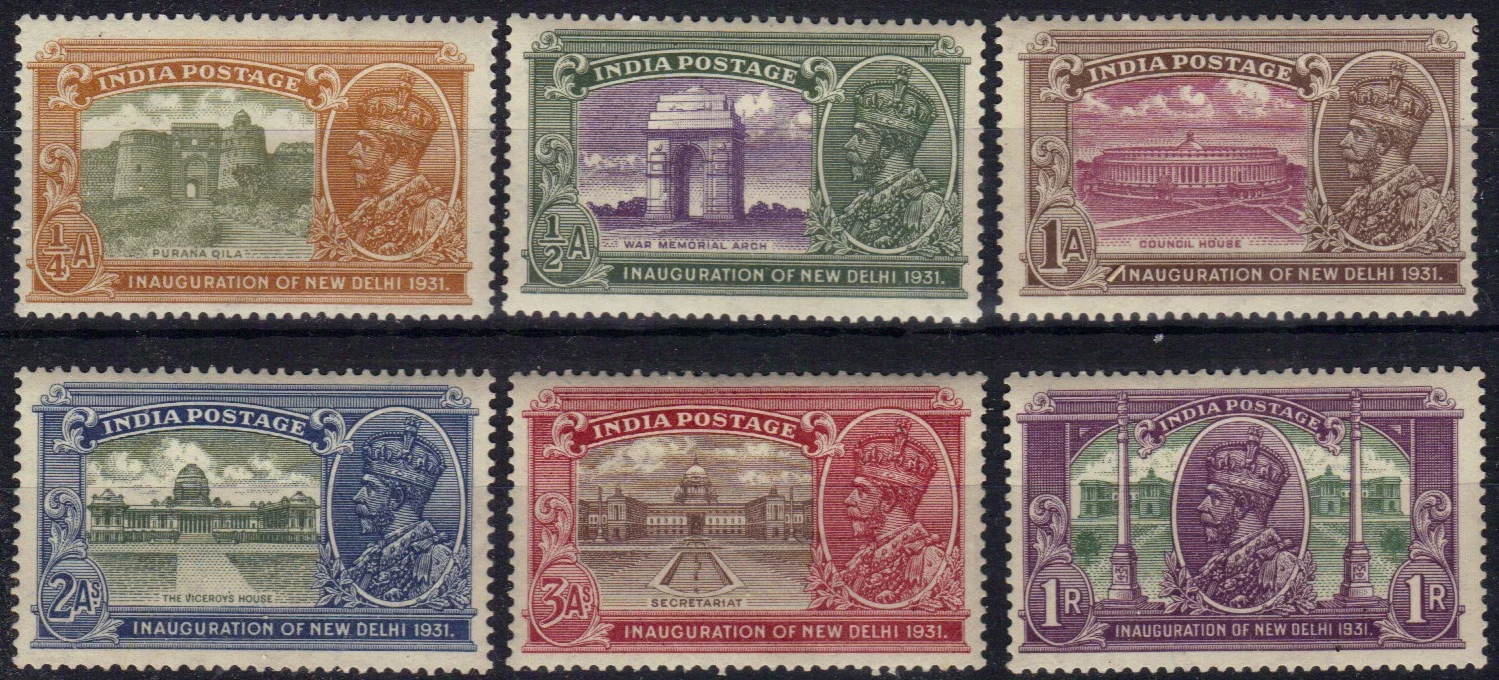
13.5George VI, 1937–1947
The 1937–1940 definitive issue is a departure. Where every previous series had been a portrait with a frame, this one included eight pictorial designs — transport, monuments, scenes — alongside the King's head. The 1931 experiment had evidently gone down well.
The reign covers the Second World War, and then the end.
1946 — the Victory issue.
13.6India at war
Both wars generated enormous specialist material.
Indian Expeditionary Force (I.E.F.) overprints of the First World War were applied to Indian stamps for use by Indian troops overseas — in Mesopotamia, East Africa, Egypt, and elsewhere. They are covered properly in Stage 15, because they belong to the "used abroad" story.
Field Post Offices operated across every theatre in which Indian forces served, using numbered cancellations that concealed location. Reconstructing the FPO number-to-location correspondence is one of the substantial research fields in twentieth-century Indian philately.
Censorship of civil and military mail, with tapes, resealing labels and examiner marks, is systematically catalogued.
Prisoner-of-war and internee mail, in both directions, is a small and historically weighty field.
The Azad Hind labels of 1943 — a set of nine, produced in Germany, promoting the vision of a free India — were never valid for postage and are not postage stamps in any technical sense. They are collected, and catalogued as cinderellas, and they are among the most historically charged pieces of paper in the whole of Indian philately. A book of this kind should say plainly what they are: propaganda labels, never postally valid, and forgeries and later reproductions are abundant.
13.7Officials, Service and stationery
Running underneath the whole ninety years: "SERVICE" and "ON H.M.S." overprints for government departmental mail, in every printing variation the underlying stamps exhibit.
And postal stationery — the quarter-anna postcard above all, which from 1879 carried an enormous share of India's ordinary correspondence and which is, for the social historian, the single most valuable philatelic artefact of the period.
13.8The Allahabad flight, 1911
On 18 February 1911, at the United Provinces Industrial and Agricultural Exhibition, a French pilot named Henri Pequet flew a Humber-Sommer biplane from Allahabad across the Yamuna to Naini, a distance of about six miles, carrying a sack of mail.
Roughly six and a half thousand items were carried. Each was struck with a special cachet reading, in effect, first aerial post.
It is generally recognised as the first official airmail flight in the world — the first occasion on which mail was carried by air under official postal sanction. That it happened in India, in a field outside Allahabad, three years before anything comparable elsewhere, is one of the facts that Indian philately deserves to be better known for.
Stage 14The Indian States
Here is where Indian philately stops resembling anywhere else.
For roughly eighty years, alongside the stamps of British India, dozens of princely states ran their own posts and issued their own stamps. Some were sophisticated productions ordered from London. Some were struck by hand on native paper in a palace outbuilding. Together they constitute a body of material that has no parallel anywhere in the world, and it ended, all at once, around 1950.
14.1Two categories
The distinction is administrative and it governs everything.
Convention States signed a postal convention with British India. Their postal systems merged with the imperial one, their mail could go anywhere in India, and their stamps were ordinary British Indian stamps overprinted with the state's name. Six states did this:
| State | Period | Note |
|---|---|---|
| Chamba | 1887–1948 | Himalayan; became independent of Kashmir in 1846 |
| Faridkot | Feudatory 1879–1887; convention 1887–1901 | The only state to move from one category to the other and then out of both |
| Gwalior | 1885–1948 | Central India; the largest |
| Jind | Feudatory 1874–1885; convention 1885–1948 | Feudatory-period stamps became postally invalid but continued as revenues |
| Nabha | 1885–1948 | Cis-Sutlej |
| Patiala | 1884–1947 | Cis-Sutlej, the senior Phulkian state |
Four of the six — Faridkot, Jind, Nabha and Patiala — are cis-Sutlej states of the eastern Punjab, and Jind, Nabha and Patiala are the Phulkian states, founded by descendants of Chaudhary Phul Singh of the Sidhu-Barar clan, with Faridkot founded by a related family. Their philately is as closely related as their politics.
Convention State issues are classical philately in the strict sense: plain, unembellished, produced to order for genuine postal use, under conditions controlled by the Government of India. They were replaced by ordinary Indian stamps around 1950 — Chamba's, for instance, on 1 April 1950, with validity continuing to 1 January 1951.
Feudatory States had no postal convention. They ran their own posts independently, issued their own designs, and their stamps were valid only within the state's own borders. Mail leaving the state needed British Indian postage as well, which produces the combination cover — state stamp and Indian stamp on the same envelope, one paying the internal leg and one the external. These are the most desirable single items in Indian States collecting.
14.2The Feudatory States, by region
Well over thirty states issued their own postage. The list below is a working guide; some issued for decades, some for a handful of years.
North and West Alwar, Bikaner, Bundi, Bussahir, Jaipur, Jasdan, Jhalawar, Kishangarh, Las Bela, Sirmoor.
Central India Bamra, Barwani, Bhopal, Bhor, Bijawar, Charkhari, Dhar, Duttia, Indore (Holkar), Nandgaon, Orchha, Rajpipla.
Kathiawar and Gujarat Idar, Morvi, Nowanuggur (Nawanagar), Soruth, Wadhwan.
South Cochin, Hyderabad, Travancore — and, after the merger, Travancore-Cochin.
North, separately: Jammu, Kashmir, Jammu and Kashmir, and Poonch.
A representative sample of issuing dates gives the shape of the thing: Hyderabad 1869–1950; Jammu and Kashmir 1866–1894; Nowanuggur 1877–1895; Indore 1886–1947; Kishangarh 1899–1947; Jaipur 1904–1949; Orchha 1913–1942; Morvi 1931–1948; Jasdan 1942–1948; Idar 1939–1944.
Note the two clusters. A wave of primitive local issues in the 1860s–1890s, and a second wave in the twentieth century of states that had not previously bothered, often with well-produced pictorials — Jaipur's 1931–1947 designs are genuinely beautiful, and Cochin, which issued over two hundred stamps mostly carrying the ruling Maharaja's portrait, produced the most common Indian States material of all.
14.3Jammu and Kashmir
The most beautiful, the most difficult, and the most forged.
The stamps fall into two broad families.
The Circulars (from 1866) — round or roughly round, hand-struck, printed in watercolour on native paper, in an extraordinary range of colours. The production was primitive in the literal sense: individual impressions, applied by hand, with inks that varied batch to batch and papers that varied sheet to sheet. The result is that almost no two are identical, which is exactly what makes them beautiful and exactly what makes them impossible.
The Rectangulars — the Old Rectangulars from the 1860s–70s, including the "Jammu reds", and the New Rectangulars from around 1902.
The problems, in order of seriousness:
Reprints. Official later printings from original dies. Genuine objects, not forgeries in the criminal sense, but not the original issues either, and frequently sold as such. Some guidelines that generally hold: reprints were not made on European laid paper; reprints were not made in watercolour, but in oil colour or printer's ink, whereas printer's ink was never used for the originals; reprints are usually more clearly printed than genuine stamps; reprints tend to be on thinner, smoother, better-quality paper; and multiples are suspect, since even pairs of many original issues are scarce.
Missing Die forgeries. A set of types that appeared during the circulars' own lifetime and were long supposed authentic. These are, by a wide margin, the commonest forgeries — more common than the genuine stamps.
The Brighton forgeries. A distinct group of J&K forgeries produced photographically, often found in watercolour impressions, with identifying characteristics documented in the specialist literature.
Catalogue instability. Even the standard catalogues have revised their J&K numbering, dates and prices substantially — Stanley Gibbons reshuffled the "Jammu reds" between the 2002 and 2003 editions, and long-standing footnotes about which circular denominations existed in forged types have themselves been corrected. Older auction literature uses superseded numbers.
../images/part-2/ch14-kashmir-circulars.jpg14.4Designs, scripts and languages
The Indian States are the only body of philatelic material anywhere that routinely carries Devanagari, Urdu, Malayalam, Telugu, Gujarati and Persian script — often on the same stamp as English, often not.
For a collector who reads none of them, this is initially a barrier and eventually the point. Identification frequently depends on recognising a script or a numeral form rather than reading it, and the Indian numeral systems used on state stamps are themselves a small field of study.
The designs range from the ruler's portrait (Cochin, Indore, Bhopal) through state emblems and religious symbols to, in the twentieth century, genuine pictorials.
14.5Primitive production
Many state issues were typeset, hand-struck, or lithographed locally, on hand-made paper, often imperforate or rouletted because no perforating machine was available.
The consequences for the collector are consistent across almost every primitive state:
- Setting varieties. Typeset stamps were set by hand, and every reset produces a new variety. Types, sub-types, and inverted or transposed characters abound.
- Paper variation. Native papers vary in thickness, colour and laid pattern within a single printing.
- Colour variation. Inks were mixed locally in small quantities.
- Condition. Hand-made paper, hand application, tropical storage. Faults are the norm.
14.6Combination covers
The single most collectable category in the whole field.
A letter from a feudatory state to anywhere outside it needed the state's own stamp for the internal carriage and British Indian postage for the rest. Both appear on the cover, usually cancelled by different offices with different instruments.
A combination cover is proof of exactly how the two-tier system worked, it is very difficult to fake convincingly, and it is worth a great deal more than the sum of its stamps. For most states these are genuinely scarce; for the smaller states they are rare.
14.7The end
Indian independence in 1947 and the integration of the princely states over the following three years brought the whole system to a close. State postal systems were absorbed, state stamps were replaced by Indian issues, and validity was extinguished — Convention State overprints being replaced from 1 April 1950, with postal validity ending 1 January 1951.
Eighty years of parallel philately stopped inside about eighteen months.
14.8Revenues and court fees
The states issued revenue and court fee stamps in profusion, frequently on a scale and in a variety far exceeding their postage issues, and several states that issued little or no postage issued extensive revenues.
The field is poorly catalogued, cheap, and enormous. See Stage 4.
Stage 15Indian Stamps Used Abroad
Open a dealer's box of covers from Aden, Bahrain, Zanzibar or Basra in the nineteenth century and you will find Indian stamps on them. This is not an accident of collecting; it is a record of how the British Empire was actually administered east of Suez.
15.1Why
For much of the nineteenth century and well into the twentieth, the Indian Post Office ran the postal services of a large part of the Indian Ocean world. Where Britain had a consular presence, a coaling station, a garrison or a treaty relationship but no established local postal administration, the Government of India frequently supplied one — because India was closer, cheaper, and already had the ships.
Those offices used ordinary Indian stamps, cancelled with Indian numeral obliterators. Which means that an Indian half anna posted at Muscat in 1875 looks, off cover, exactly like an Indian half anna posted at Madras — except for the number in the cancel.
15.2The network
Indian post offices operated, at various dates, in:
The Persian Gulf and Arabia — Aden, Muscat, Dubai, Bahrain, Kuwait, Qatar, Bushire and other Gulf ports. Aden in particular was administered from India until 1937 and is the largest single "used abroad" field.
East Africa — British East Africa, Zanzibar, Somaliland.
Southeast Asia — Burma (part of British India until 1937), and earlier the Straits Settlements, which were governed from India until 1867.
Tibet and China — Indian post offices operated at Gyantse, Yatung, Phari and Gartok in Tibet, and Indian stamps were used by Indian forces in China.
Mesopotamia, Persia and the Middle East, particularly during and after the First World War.
15.3The overprints
Where a distinct identity was needed, Indian stamps were overprinted.
I.E.F. — Indian Expeditionary Force. Applied to Indian stamps for use by Indian troops serving overseas in the First World War, across Mesopotamia, East Africa, Egypt and elsewhere. The commonest and most collected of the overprints, and — being a short overprint on a common stamp — heavily forged.
C.E.F. — China Expeditionary Force. For Indian troops in China, principally around the Boxer Rebellion period.
Various local and occupation overprints on Indian stamps in the Middle East, produced under wartime conditions, in small quantities, with the setting irregularities and errors that always follow.
Burma, 1937. When Burma was separated from India, Indian stamps overprinted "BURMA" were issued before Burma's own designs appeared. A clean, dated administrative divorce, visible on paper.
15.4Identification: the numeral cancel
This is the whole subject. A used Indian stamp is a used Indian stamp; what makes it "used abroad" — and worth many times more — is the cancellation.
British India used numeral obliterators, in which a number identifying the post office sits inside a pattern of bars, dots or a duplex frame. Each office had a number. The published concordances of Indian numeral cancels to offices are the reference works that make this field possible.
The practical procedure:
- Find and read the number in the obliterator. This often requires magnification and good raking light.
- Look it up in a numeral cancel concordance.
- If the number corresponds to an overseas office, you have a used-abroad item.
And the warning that follows from it: because the cancel carries all the value, faked cancels are the central risk in this field. A common Indian stamp with a desirable overseas numeral added is a profitable and easy fraud.
Stage 161947 and the Early Republic
16.1Partition
Independence on 15 August 1947 divided a postal system as well as a country.
Post offices found themselves on the wrong side of a line drawn weeks earlier. Stock had to be reallocated. Mail in transit had to be redirected. Pakistan, having no stamps of its own, continued to use British Indian stamps — initially unoverprinted, then overprinted "PAKISTAN" — while India moved to produce its own.
The philately of this period is postal history, not stamps: redirected mail, refugee correspondence, provisional handstamps, mail returned undeliverable because the destination was now in another country. It is difficult material to look at and it is the most historically important philately India has produced.
16.2The first three stamps
Independent India's first issues are collectively known as the Jai Hind series.
21 November 1947 — the National Flag, 3½ annas. The tricolour, with JAI HIND in the upper right. This is the first stamp of independent India. The denomination corresponded to the foreign letter rate.
15 December 1947 — the Ashokan Lion Capital, 1½ annas. The Sarnath capital, the newly adopted state emblem, with JAI HIND in Devanagari. Intended for domestic mail. The emblem had been adopted on 30 December 1947 — so the stamp preceded the formal adoption by a fortnight, which tells you how settled the decision already was.
15 December 1947 — the Douglas DC-4, 12 annas. An aircraft, for foreign airmail.
Three stamps, three statements: sovereignty (the flag), antiquity and legitimacy (Ashoka, at Sarnath, 250 BCE), and modernity and connection (a four-engined airliner). It is as compact a summary of what the new state wanted to say about itself as exists anywhere.
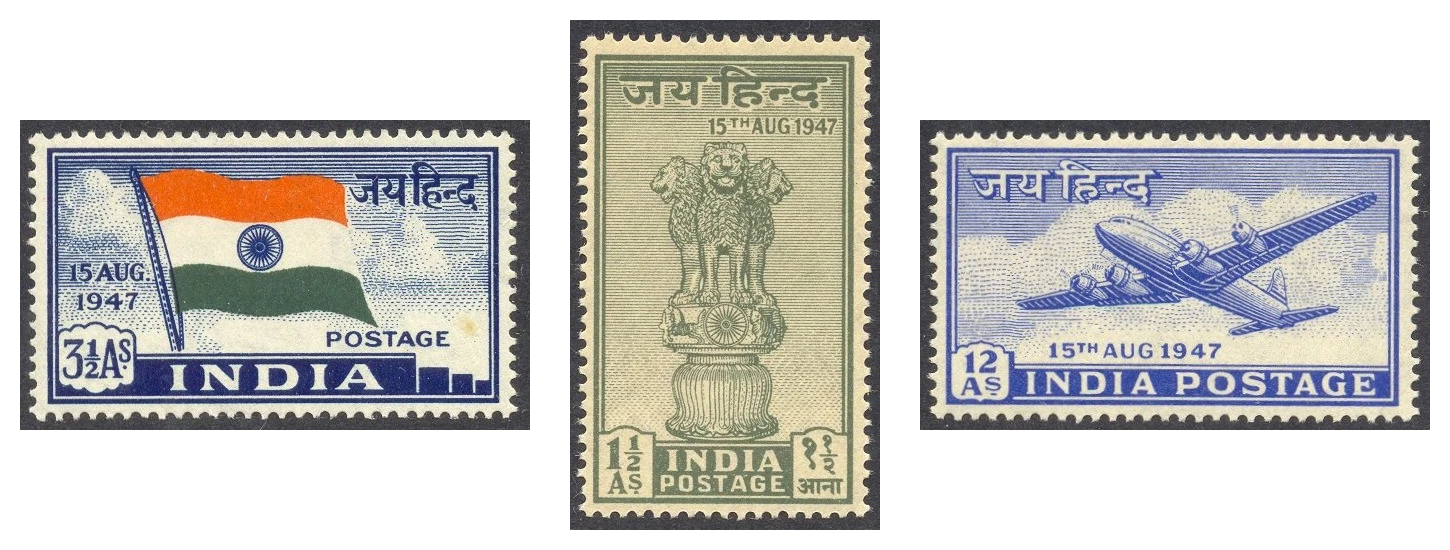
16.3The Gandhi memorial set, 1948
The original plan was a set of Gandhi stamps for January 1948, to be produced by the India Security Press at Nasik.
Gandhi was assassinated on 30 January 1948, before they were issued.
The government decided to produce them as a memorial instead, in photogravure — which Nasik could not do to the required standard — and the work went to the Swiss printers Hélio Courvoisier S.A., La Chaux-de-Fonds, on coated security paper with pulp and silk fibres.
The set of four was issued on 15 August 1948, the first anniversary of independence: 1½ annas, 3½ annas, 12 annas, and 10 rupees, each carrying a portrait of Gandhi. It was independent India's first commemorative set, and the first time an Indian appeared on an Indian stamp.
The 10 rupees is the one everybody knows. It was a very high face value — far beyond ordinary correspondence, intended for parcels, telegrams and airmail — and it was produced in a quantity of 250,000. Its initial three-month sale period was extended to December 1948, and then it was gone.
The 10 rupees "SERVICE" overprint is the rarity. A small number of the 10r were overprinted SERVICE for the exclusive official use of the Governor-General. Sources give the figure as approximately 100 to 200 overprinted. Around eleven examples are recorded in total, of which very few are unmounted mint.
It is, by any measure, one of the most valuable modern stamps in the world. Stanley Gibbons has catalogued it in the region of £160,000; an unmounted mint example sold in 2011 for €144,000, and a set including the rarity made headlines at half a million pounds in 2017.
16.4The Republic, 1950
26 January 1950 — India became a republic, and the occasion was marked with a set of four stamps.
16.5The Archaeological series, 1949
The first definitive series of independent India, showing India's monuments and sculpture. It is the visual counterpart to the Ashokan Lion Capital: a new state making the case that it is also a very old civilisation.
16.6Nation-building on paper
The design language of the early Republic is remarkably consistent, and it repays attention as a subject in its own right.
The recurring themes: antiquity (Ashoka, the monuments, the sculptures), development (dams, steel plants, the Five Year Plans), unity (the map, the national symbols), non-alignment and international engagement (the UN, international conferences), and the freedom movement (its leaders, its anniversaries).
Stamps were, in a country where literacy was low and radio ownership lower, one of the few pieces of state communication that reached every village with a post office. They were used deliberately.
16.7Service issues of the Republic
The overprint tradition continued. "SERVICE" and later "India Service" overprints ran on definitives and, occasionally, commemoratives. The Ashoka Pillar emblem series of the 1950s, in values from a few paise to a rupee, handled government franking.
16.8Postal stationery
The postcard continued, and continued to matter. The quarter-anna card became the paise card and remained the cheapest written communication available in India for another half century.
Stage 17Modern India, 1960s to Today
17.1The definitive series
India's definitives after the Archaeological series moved through a sequence of themes, each reflecting the preoccupation of its decade: maps and the Five Year Plans, development and industry, national figures, wildlife and heritage.
Decimal currency arrived on 1 April 1957 — 100 naye paise to the rupee, with naye ("new") dropped in 1964 — which produced a wave of new denominations and, briefly, surcharged provisionals. For a collector this is a hard dating line: anything in annas and pies is pre-1957.
17.2The commemorative programme
From the 1960s the commemorative programme expanded steadily and now runs to dozens of issues a year, covering:
- Personalities — freedom fighters, scientists, writers, saints, reformers, regional figures. This is by far the largest category and it is, cumulatively, a semi-official pantheon.
- Anniversaries — institutions, regiments, universities, companies, events.
- Wildlife and environment — a long and often beautifully designed strand.
- Monuments and heritage.
- Science, technology and space.
- International relations — joint issues with other countries, which are a small, tidy field of their own.
17.3Design and printing
The India Security Press at Nasik remains the principal printer. Techniques have moved through photogravure to modern offset and combination printing.
Design quality has been uneven and is worth discussing honestly. The wildlife issues and much of the heritage work are genuinely good. The personality issues — a portrait, a name, a date, a border — are frequently formulaic, because they are produced to a schedule and in volume.
17.4Miniature sheets and the market shift
From the 1970s onward, miniature sheets and se-tenant blocks became a routine part of the programme. They exist principally because collectors buy them, and they mark the point at which the commemorative programme became, in part, a revenue exercise directed at collectors rather than at postal users.
This is not a criticism unique to India — nearly every postal administration in the world did the same thing over the same period — but it changes how a collector should approach the material.
17.5Special formats and the gimmick question
Modern issues have appeared with embossing, foil, unusual substrates including silk and other materials, scented inks, and thermochromic inks that change colour with heat.
There is a real argument here and this book will state both sides.
Against: a stamp is a receipt for a postal service. Anything that cannot be used for postage in practice, and that exists only to be sold to collectors, is merchandising wearing a stamp's clothes. The proliferation devalues the whole programme and makes serious collecting of modern issues nearly impossible.
For: postal administrations have always sold to collectors; the Columbians of 1893 were doing exactly this. Novel formats are a legitimate part of design history, they attract new collectors, and the objection is largely aesthetic conservatism. And someone, eventually, will be glad they were collected.
The honest position is probably that both are true and the collector should simply decide which side of it they are on, and collect accordingly.
17.6My Stamp
My Stamp, India Post's personalised stamp service launched in 2011, produces genuine postage carrying a customer's photograph within a fixed frame design.
They are valid postage. They cannot be systematically collected, because the variety is unbounded and the demand is near zero. The frame designs, however, are finite and are collected by a small number of people, which is the sensible approach to the whole category.
17.7India Post today
Philatelic bureaux operate at major post offices and sell new issues, first-day covers, information brochures and annual packs. A philatelic deposit account allows a standing order for everything issued.
The National Philatelic Museum in New Delhi, at Dak Bhavan, holds the national collection, including archival and design material, and is the single most worthwhile visit for anybody serious about Indian philately.
Stage 18Collecting India Today
18.1Catalogues
*Stanley Gibbons, Commonwealth & British Empire Stamps 1840–1970.* The single most useful book for a collector of India. Comprehensive on British India, the Convention States and the Feudatory States, with the numbering that the international market uses. If you buy one reference, buy this.
Stanley Gibbons Part 1 (Commonwealth) for post-1970 material.
Scott Standard Postage Stamp Catalogue, Volume covering India. Different numbering, different valuations, an American market perspective, and occasionally different judgements about what constitutes a separate listing. Worth having as a cross-check, and necessary if you buy from American sources.
Indian domestic catalogues — several are published in India, updated more frequently for modern issues, priced in rupees, and generally more current on recent material than the international catalogues. They are the practical choice for anyone collecting post-1947 India.
Specialist handbooks are where the real work is. There are dedicated monographs on the 1854 lithographs, on the four annas specifically, on Jammu and Kashmir, on Indian numeral cancellations, on Indian States, and on Indian postal history by period. These cost more than catalogues and are worth more.
18.2Societies
The India Study Circle for Philately (ISC) — based in the UK, the leading specialist society for Indian philately anywhere. Publishes a journal, runs meetings and auctions, and its accumulated literature is the most important body of research on the subject.
The Philatelic Congress of India (PCI) — the national federation.
Regional and city philatelic societies across India, most of which run monthly meetings, exchange circuits and local exhibitions. These are the cheapest and best way into the hobby, and the surest way to find a dealer you can trust.
Specialist study groups exist for particular areas — Indian States, postal history, revenues — usually operating through the larger societies.
18.3Auctions and dealers
International auction houses with strong Indian sections handle the major rarities and the important collections. Auction archives are searchable and are the best available source of real market data.
Indian auction houses have expanded significantly, with dedicated philatelic and numismatic sales, and are now a serious route both to buy and to sell.
Dealers — a small number specialise in India, and they are worth finding. A specialist dealer's stock is pre-filtered, their descriptions are accurate, and their opinion on a doubtful item is free.
18.4Exhibitions
National and international exhibitions run regularly in India, and attending one is the fastest education available. You will see, in a day, more good material properly written up than in a year of reading. Talk to the exhibitors; philatelists are, almost universally, delighted to be asked.
18.5The National Philatelic Museum
New Delhi, at Dak Bhavan. Holds the national collection, including archival material, essays, proofs and design records that exist nowhere else. Go.
18.6Buying online without getting burned
Common material — fine. The downside is small, the supply is enormous, and it is a good way to fill gaps cheaply.
Anything expensive — apply the rules from Stage 9. Certificate or no purchase. Photographs front and back, high resolution, before you bid. Ask direct questions in writing and keep the answers. Understand the return policy before you pay, not after.
The specific Indian red flags: Jammu and Kashmir at attractive prices; any Scinde Dawk without a certificate; any 1854 four annas invert at all; Indian States overprints from general sellers; the Gandhi 10r SERVICE in any form whatsoever.
18.7Legal considerations for Indian collectors
Two practical points, both of which should be checked against current rules rather than taken from a book:
Antiquities and cultural property. India's laws on the export of cultural property are strict. The status of postage stamps as collectables is generally distinct from that of antiquities, but anyone exporting a significant collection or a major rarity should take proper advice first rather than assume.
Import, customs and valuation. Collectables imported into India attract duty and require accurate declaration. Undervaluing a philatelic import to reduce duty is both illegal and, as Sperati discovered from the opposite direction, a good way to end up in court arguing about what your stamps really are.
18.8Three collections, three budgets
Modest. British India, King George VI, complete. The 1937–40 pictorial definitives, the commemoratives, the Service overprints, and as many covers as you can find. Everything is available, nothing is expensive, the material is attractive, and identification is tractable. A complete, well-written-up collection of this is a genuinely respectable thing to own.
Middling. One Feudatory State in depth. Travancore, Bhopal or Soruth (Stage 14). All issues, all major varieties, postal stationery, revenues, and every combination cover you can find. This will take years, will cost a moderate amount spread over those years, and will end up being the reference collection for that state in your country — because very few people do this properly.
Ambitious. The 1854 lithographs. All values, all printings, all dies, plated as far as the material allows, with covers showing the issue in use and the cancellations of the period. You will not complete it — nobody completes it. The four annas alone has five printings, four head dies, two frame dies and three settings. You will spend a decade, read everything, contribute something, and own a collection that means something.
PART III — BEGINNER'S GUIDE
Stage 19Before You Begin
Start Collecting Stamps: The Complete Beginner's Guide to Philately
19.1How to use this guide
You do not need to read this cover to cover. Pick your path:
| If you are… | Start here | Then read |
|---|---|---|
| Totally new, just curious | 19.2 → 20.1 | 21.1 (first 90 days) |
| Ready to spend a little money | 24.1 (kits) → 24.3 (budgets) | 26.1 (where to buy) |
| Holding an inherited album | 25.7 (condition) → 25.9 (storage) | 26.4 (valuing), 28.1 (mistakes) |
| A parent or teacher | 19.3 → 27.3 (children) | 21.2 (30-day plan) |
| Unsure what to collect | Stage 23 | 23.3 decision guide |
| Confused by a word | Appendix A | — |
Markers used throughout:
- 💡 Tip — a shortcut or trick
- ⚠️ Warning — a common way beginners damage stamps or lose money
- ✅ Recommendation — what we would do in your shoes
- 🖼️ See it — a link to real photos on Wikimedia Commons (free to view)
- 🇮🇳 India note — something specific to collecting in India
19.2Is stamp collecting for me? A quick self-check
Tick the statements that sound like you:
- ☐ I enjoy colour, pictures and design.
- ☐ I like organising and arranging things neatly.
- ☐ I'm curious about other countries, history or nature.
- ☐ I'd enjoy a quiet, relaxing activity at home.
- ☐ I like puzzles and spotting small differences.
- ☐ I want a hobby that can start almost free.
- ☐ I have little space — a bookshelf is enough.
3 or more ticks? Stamps are a great fit. Stamp collecting rewards patience and curiosity far more than money.
19.3The seven golden rules
- Collect what you enjoy, not what you think will make money. Most collections are worth less than what was spent on them. The joy is the return.
- Never use bare fingers. Skin oils stain paper and bend perforations. Use tongs.
- Never tear a stamp off an envelope. Cut around it and soak it (or keep it on the envelope).
- Never "fix" a stamp — no erasing, ironing, trimming or re-gumming. Repairs destroy value and are treated as deception when selling.
- Store it right from day one. Damp, sunlight and sticky albums ruin stamps.
- Choose a focus within about 3 months. "Everything" becomes overwhelming. A focus makes the hobby satisfying.
- Learn before you spend. A catalogue or good book saves more money than any single stamp is worth.
Stage 20Understanding Stamps
20.1What is philately?
Philately (fi-LAT-uh-lee) is the collecting and study of postage stamps and anything connected to the mail — envelopes, postmarks, postcards, postal stationery and the history of how letters travelled.
A philatelist is a stamp collector who studies their stamps, not just gathers them. You become one the moment you start asking "why is this stamp different from that one?"
Why people love it:
- It's cheap to start. Used stamps off envelopes cost almost nothing.
- It teaches geography, history, art, science and languages without feeling like school.
- It's calm. Sorting and arranging is relaxing — many people use it to unwind.
- It scales. You can spend ₹0 or a fortune. Both are valid.
- It's social. Clubs, exhibitions, swaps and pen-pals worldwide.
- It lasts a lifetime. Many collectors start as children, pause, and return decades later.
20.2A very short history of stamps
| Year | What happened | Why it matters to you |
|---|---|---|
| Before 1840 | Letters were usually paid for by the receiver, based on distance and number of sheets | Explains why old letters have handwritten charges |
| 1840 | Great Britain issues the Penny Black — the world's first adhesive postage stamp — after Rowland Hill's postal reform | The start of everything |
| 1841 | The Penny Red replaces it (black made cancellations hard to see) | Early lesson: stamps change for practical reasons |
| 1840s–1850s | Other countries follow: Brazil, Swiss cantons, USA, France and more | "Classic" era of stamps — imperforate, hand-engraved |
| 1850s | Perforations are introduced so stamps tear apart easily | Perf measurement becomes a key identification tool |
| 1874 | The General Postal Union (later the Universal Postal Union, UPU) is founded | Countries agree to accept each other's mail — true international post |
| Late 1800s | Commemorative stamps become common; collecting becomes a craze | Stamps as art and propaganda |
| 1900s | Airmail, photogravure printing, pictorial and thematic stamps | The colourful stamps most beginners love |
| Late 1900s | Self-adhesives, miniature sheets, stamp booklets | Modern formats |
| 2000s onward | Personalised stamps, special shapes, scented or textured stamps, QR codes | New collecting areas are still appearing |
images/part-3/penny-black.jpg20.3India in ten milestones
🇮🇳 India has one of the world's richest stamp histories. Knowing these ten milestones will help you understand almost any Indian stamp you find.
| # | Year | Milestone |
|---|---|---|
| 1 | 1852 | The Scinde Dawk — the first adhesive stamps in Asia, issued for the Scinde (Sindh) district. Embossed circular designs; very rare today |
| 2 | 1854 | First all-India stamps of the East India Company, featuring Queen Victoria; lithographed, imperforate. Values in annas |
| 3 | 1855 onward | Perforated, typographed stamps printed in Britain by De La Rue — the start of long-running Victorian series |
| 4 | 1866 | "SERVICE" overprints and dedicated official stamps begin a long tradition of official mail |
| 5 | 1911 | Stamps of King George V; the world's first official airmail flight took place in India that year (Allahabad, 1911) |
| 6 | 1929–1931 | Airmail set (1929) and the New Delhi inauguration pictorial set (1931) — early Indian pictorials |
| 7 | 1947 | Independence: the "Jai Hind" stamps with the national flag, Ashoka Lion Capital and an aircraft |
| 8 | 1948 | Mahatma Gandhi mourning set — among the most loved Indian stamps |
| 9 | 1950s onward | Republic definitives, commemoratives and the start of the modern era |
| 10 | 1957 onward | Decimal currency (naya paise, later paise and rupees) appears on stamps — a quick way to date a stamp |
💡 Tip: Indian stamps before 1947 show a British monarch and values in annas, pies and rupees. After 1957, values are in naya paise / paise / ₹. The currency alone tells you the rough era.
🖼️ See it — search Wikimedia Commons for Scinde Dawk · 1854 India Queen Victoria stamps · Jai Hind 1947 stamps · Gandhi 1948 stamps.
images/part-3/india-milestones.jpg20.4Anatomy of a stamp
Knowing the parts of a stamp is the key that unlocks everything else.
| Part | What it is | Why it matters |
|---|---|---|
| Design / vignette | The central picture | Tells you the subject and often the theme |
| Frame | The border around the design | Helps tell similar issues apart |
| Denomination (face value) | The printed price, e.g. "₹5", "2 A" (annas) | Tells you the era and postal rate |
| Country name | e.g. INDIA / भारत | Some old British stamps have no country name — the monarch's head is the identifier |
| Inscriptions | Words like "POSTAGE", "AIR MAIL", "SERVICE", the year | Tell you the purpose |
| Perforations ("perfs") | Rows of small holes for tearing stamps apart | Measured with a gauge; different counts = different stamps |
| Imperforate ("imperf") | No holes — cut apart with scissors | Early stamps (1840s–1850s) were imperf |
| Rouletting | Small cuts or slits instead of holes | An older separation method; look closely |
| Margins | Blank paper around the design | Wide, even margins = better value |
| Gum | Glue on the back | Present on mint stamps; affects value |
| Watermark | A pattern pressed into the paper when it was made | Identifies printings and paper types |
| Paper | Wove, laid, chalk-surfaced, coloured, granite… | Specialists separate stamps by paper |
| Phosphor bands / fluorescence | Invisible markings for automatic sorting machines | Seen with a UV lamp |
| Cancellation / postmark | Ink mark showing the stamp was used | Clear, neat postmarks add value |
| Overprint | Extra printing added later | Changes the stamp's value, use or country |
| Printer's imprint / year | Small text at the bottom | Helps identify printings |
images/part-3/stamp-uk-penny-red-pl148.jpg🖼️ See it — search Wikimedia Commons for Perforation gauges · Stamp watermarks · Overprinted stamps.
images/part-3/stamp-anatomy.jpg20.5How stamps are printed (and why it matters)
You don't need to be an expert, but knowing the main printing methods helps you identify stamps and spot fakes.
| Method | How it works | How to recognise it | Common era |
|---|---|---|---|
| Recess / line engraving (intaglio) | Design cut into a metal plate; ink sits in the grooves | Ink feels raised; fine, sharp lines; very crisp under a magnifier | Classic era onward; prestige stamps today |
| Typography (letterpress / surface printing) | Raised parts of the plate take the ink | Ink may be pressed into the paper; slight "halo" at edges | Victorian & early 1900s definitives |
| Lithography | Flat plate; ink sticks to greasy image areas | Flat ink, slightly soft lines | Early India (1854), many small countries |
| Photogravure | Image made of tiny cells of different depths | Under magnification, a fine screen of dots even in solid colour | Colourful mid-1900s pictorials |
| Offset lithography | Modern lithography through a rubber blanket | Tiny dot patterns (rosettes) in colour areas | Most modern stamps |
| Embossing | Design pressed to stand up from the paper | Raised, sometimes colourless design | Scinde Dawk, postal stationery |
💡 Tip: Many forgeries of classic engraved stamps are made by lithography or modern printing. Under a 10× magnifier, the "flat" or "dotty" ink gives them away.
images/part-3/printing-methods.jpgStage 21Start Collecting
21.1Your first 90 days
Week 1 — Collect for free
- Save every stamp that arrives on your mail. Ask family, neighbours, office colleagues and friends abroad to do the same.
- Cut, don't tear. Cut the envelope leaving about 1 cm of paper around the stamp.
- Keep interesting whole envelopes intact — anything old, foreign, registered, airmail or with an unusual postmark.
- Put everything in one box marked "To sort".
💡 Tip: Offices, banks, lawyers, exporters, schools and religious institutions receive lots of mail. A polite request often gets you a bag of envelopes. Grandparents' cupboards are gold mines.
Week 2 — Get the three essential tools
Buy only stamp tongs, a magnifier and a small stockbook (see 24.1, Level 1). Total about ₹700–1,500.
Week 3 — Soak and sort
- Soak your cut stamps off paper (25.2).
- Sort into piles by country (use Appendix B if you can't read the name).
- Slide them into the stockbook, one country per strip or page.
Week 4 — Buy your first packet
Buy a mixed worldwide packet of 100–500 different stamps (about ₹200–600). This instantly gives you variety and shows you what you like.
Month 2 — Learn the language
- Read Stage 20 and Stage 22.
- Learn to tell mint vs used, perforated vs imperforate, definitive vs commemorative.
- Borrow or buy an older-edition catalogue for your country and learn to look stamps up (25.6).
- Visit a post office philately counter and look at current Indian issues.
Month 3 — Choose a focus and connect
- Pick one focus (Stage 23).
- 🇮🇳 Open a Philatelic Deposit Account (PDA) so new Indian issues are set aside for you (26.1).
- Join a local philatelic society. Visit one stamp exhibition if you can.
- Start a simple collection log (27.4).
✅ Recommendation: Don't buy an expensive printed album until month 3. You'll know your focus by then and won't waste money on pages you'll never fill.
21.2Your first 30 days, day by day
| Day | Task | Time |
|---|---|---|
| 1 | Ask 5 people to save stamps for you | 10 min |
| 2 | Search your home for old envelopes, postcards, letters | 30 min |
| 3 | Cut stamps with a 1 cm margin; set aside whole old covers | 30 min |
| 4 | Read 20.1–20.2 (what is philately, short history) | 20 min |
| 5 | Order tongs, magnifier and stockbook | 15 min |
| 6 | Read 20.4 anatomy; find each part on 5 of your stamps | 30 min |
| 7 | Rest day — just look through what you have | — |
| 8 | Read 25.2 and soak your first batch | 45 min |
| 9 | Dry and flatten your stamps | 15 min |
| 10 | Sort by country; use Appendix B for tricky ones | 45 min |
| 11 | Put stamps into the stockbook | 30 min |
| 12 | Read 22.1; find a definitive, a commemorative and an airmail | 30 min |
| 13 | Measure 10 stamps' perforations (25.4) | 30 min |
| 14 | Rest day | — |
| 15 | Buy a worldwide mixed packet | 15 min |
| 16 | Sort and identify 20 stamps from the packet | 45 min |
| 17 | Read 25.7 condition; grade your 10 best stamps | 30 min |
| 18 | Read 20.3 India milestones; sort your Indian stamps by era | 30 min |
| 19 | Visit the post office philately counter | 1 hour |
| 20 | Buy 1 new commemorative stamp or miniature sheet | 15 min |
| 21 | Rest day | — |
| 22 | Read Stage 23; shortlist 3 possible focuses | 30 min |
| 23 | Find a local philatelic society; note its meeting dates | 20 min |
| 24 | Read 28.1 mistakes | 15 min |
| 25 | Start your collection log | 30 min |
| 26 | Check storage: shelf, humidity, sunlight (25.9) | 20 min |
| 27 | Choose your focus | 15 min |
| 28 | Write a "want list" for your focus | 30 min |
| 29 | Set a monthly budget (24.3) | 15 min |
| 30 | 🎉 Count your collection and celebrate | — |
21.3Setting up your stamp desk
You don't need a special room — a corner of a table works. Aim for:
| Need | Why | Simple solution |
|---|---|---|
| Good light | True colours; see flaws | Daylight LED lamp (5000–6500 K) or a bright window without direct sun |
| Clean, flat surface | Stamps don't get bent or stained | A large sheet of white card or a desk mat |
| No breeze | Stamps fly away | Switch off fans while working |
| No food or drinks | Stains are permanent | Keep a separate table for tea |
| Tools within reach | Less handling | A small tray for tongs, magnifier, gauge |
| Storage nearby | Put things away quickly | Stockbooks on a shelf, upright |
💡 Tip: Work on a dark mat for light-coloured stamps and a white mat for dark ones — contrast makes perforations and flaws easier to see.
images/part-3/desk-setup.jpgStage 22Categories Explained
Each category below answers three questions: What is it? How do I spot it? Is it good for beginners?
22.1By purpose
| Category | What it is | How to spot it | Beginner-friendly? |
|---|---|---|---|
| Definitives | Everyday stamps printed in large numbers, often for years | Small, simple designs; a series of values (flowers, buildings, leaders, heritage) | ⭐⭐⭐⭐⭐ Cheap and everywhere |
| Commemoratives | Issued once to mark an event, person or anniversary | Larger, colourful; a name, date or occasion on the design; sold for a limited time | ⭐⭐⭐⭐⭐ The most popular kind |
| Airmail | Paid for mail sent by air | Aircraft, birds, "AIR MAIL", "PAR AVION" | ⭐⭐⭐⭐ |
| Official / Service | For government departments only | "SERVICE", "OFFICIAL", "On H.M.S." or overprints | ⭐⭐⭐ |
| Postage dues | Stuck on by the post office to collect unpaid postage from the receiver | Plain designs, "POSTAGE DUE", "TO PAY" | ⭐⭐⭐ |
| Express / special delivery | Paid for faster handling | "EXPRESS", "SPECIAL DELIVERY" | ⭐⭐ |
| Registration | Paid for registered (tracked, signed) mail | "REGISTERED" or R-labels | ⭐⭐ |
| Semi-postals / charity | Price includes a surcharge for a cause | Two values, e.g. "₹5 + 1"; children's day, Red Cross, welfare | ⭐⭐⭐ |
| Newspaper stamps | Paid for sending newspapers | "NEWSPAPERS", often plain | ⭐⭐ |
| Parcel post | For parcels | "PARCEL POST" | ⭐⭐ |
| Revenue / fiscal | Pay taxes & fees, not postage | "REVENUE", "COURT FEE", "STAMP DUTY", "RECEIPT" | ⭐⭐ A separate field — fun, but different |
| Military / field post | For armed forces mail | "F.P.O.", "A.P.O.", military emblems | ⭐⭐ |
| Telegraph stamps | Paid for telegrams | "TELEGRAPH" | ⭐⭐ Specialist but affordable |
| Local posts | Private or city posts, not national | Unusual names, small print runs | ⭐ Specialist |
🇮🇳 India note: Indian Princely States issued their own stamps — "Convention States" (e.g. Patiala, Nabha, Jind, Gwalior, Chamba, Faridkot) used overprinted Indian stamps, while "Feudatory States" (e.g. Hyderabad, Travancore, Cochin, Jammu & Kashmir, Bhopal) printed their own designs. They are a wonderful intermediate area.
images/part-3/definitive-vs-commemorative.jpg22.2By format
| Format | What it is | Beginner tip |
|---|---|---|
| Single | One stamp | Where everyone starts |
| Pair / strip | 2 or more joined in a line | Useful for showing perforation varieties |
| Block | 4 or more joined (2×2 and up) | Blocks of 4 look great on album pages |
| Se-tenant | Two or more different designs printed joined together | Keep them joined — splitting lowers value |
| Sheet / pane | The full printed sheet or a part of it | Big to store; beautiful for display |
| Sheetlet | Small sheet of a few stamps with decorative margins | Popular modern format |
| Miniature sheet (MS) | Small sheet with one or more stamps and a decorative border | 🇮🇳 Very popular with Indian collectors; affordable |
| Souvenir sheet | Similar to MS, often for exhibitions or events | Same as above |
| Booklet | Stamps sold in a folded cover | Collect complete booklets where possible |
| Booklet pane | A page of stamps from a booklet | Often has straight edges |
| Coil stamps | From a roll; straight edges on two opposite sides | Look for the two straight edges |
| Gutter pairs | Two stamps with the blank "gutter" between sheet panes | Intermediate |
| Plate / cylinder blocks | Corner blocks with the plate or cylinder number | Intermediate |
| Traffic lights | Sheet-margin colour check dots | Intermediate |
| Personalised stamps | Stamp with your own photo/label attached | 🇮🇳 India Post's My Stamp — a fun personal souvenir |
| Self-adhesive | Peel-and-stick, no licking | Don't soak — keep on neatly trimmed paper |
| Special shapes & materials | Round, triangular, scented, textured, embroidered, with foil | Fun themed collection on their own |
🖼️ See it — search Wikimedia Commons for Miniature sheets · Se-tenant stamps · Stamp booklets · Triangular stamps.
images/part-3/stamp-formats.jpg22.3Covers & postal items
A cover is any envelope, wrapper or card that went through the mail. Many experienced collectors say "the cover tells the story; the stamp is just the ticket."
| Category | What it is | Why beginners like it |
|---|---|---|
| First Day Cover (FDC) | Envelope with a new stamp, cancelled on its first day of issue, usually with a printed design (cachet) and special postmark | Colourful, easy to buy new |
| Special cover | Envelope with a special postmark for an event — festivals, exhibitions, anniversaries, local heritage | 🇮🇳 Hugely popular in India; cheap and local |
| Commercial cover | A real letter that travelled in normal mail | Genuine postal use; the heart of "postal history" |
| Registered / airmail / censored covers | Covers showing special services or wartime censorship | Each tells a story through its markings |
| Information brochure / folder | The leaflet India Post releases with each new stamp | Explains the story behind the stamp |
| Presentation pack | New stamps packed in a printed folder | Nice gift items |
| Postal stationery | Envelopes, postcards, inland letters, aerogrammes and letter cards with the postage printed on | Often overlooked, cheap, historically rich |
| Picture postcards | Postcards with photos, often collected with stamps | Crosses into deltiology (postcard collecting) |
| Maximum card (maxicard) | Postcard + matching stamp + matching postmark (all three agree in subject, and ideally place) | Stunning; perfect for thematic collectors |
| Postmarks / cancellations | The marks themselves — by town, date, design or type | Pictorial and permanent pictorial cancellations are very popular |
| Flown covers | Mail carried on special flights (first flights, rocket mail, balloon post) | Exciting history |
| Cinderellas | Stamp-like labels that aren't postage (charity seals, exhibition labels, fantasies) | Fun and cheap — just know they're not postage stamps |
🖼️ See it — search Wikimedia Commons for First Day Covers · Maximum cards · Postal stationery · Censored covers.
⚠️ Warning: Never soak stamps off an old cover. A 1940s letter with its stamps, postmarks and route markings can be worth far more — and tell far more — than the loose stamps.
images/part-3/postal-items.jpg22.4Special & unusual items
| Category | What it is | Beginner note |
|---|---|---|
| Overprints | Extra printing on an existing stamp — new use ("SERVICE"), new country, or event | Great history lessons; often faked — buy valuable ones only from trusted sources |
| Surcharges | Overprints that change the value | Usually due to rate changes or shortages |
| Errors | Production mistakes: missing colour, inverted centre, double print, imperf between | Genuine errors can be valuable; most "errors" beginners find are damage |
| Varieties / plate flaws | Small, repeating differences (a dot, broken letter) from one position on the plate | Great fun with a magnifier; the heart of specialist collecting |
| Shades | Colour differences between printings | Hard for beginners; needs a colour guide and experience |
| Perfins | Stamps with small holes punched as letters (company initials) to stop theft | Cheap, quirky, collectible |
| Precancels | Cancelled before sale for bulk mailers | Mostly USA, Canada, France, Belgium |
| Specimens | Samples overprinted or perforated "SPECIMEN" | Intermediate |
| Essays | Design ideas never issued | Advanced and expensive |
| Proofs | Trial printings of the final design | Advanced and expensive |
| Forgeries | Fakes made to cheat collectors or the post office | Learn to recognise; never pay "genuine" prices without a certificate |
| Facsimiles / replicas | Honest copies, often marked "FACSIMILE" | Fine as space-fillers if clearly labelled |
| Bogus / fantasy issues | Stamps for places that never issued stamps | A curiosity only |
The most famous error in the world is the USA's Inverted Jenny (1918), where the aeroplane was printed upside-down:
images/part-3/inverted-jenny.jpg🇮🇳 India note: India also has famous classic errors — including inverted-head varieties of the 1854 Four Annas stamp — which are among the most valuable Indian stamps. You won't find them in packets, but learning their stories is part of the fun.
💡 Tip: "Missing colours" are genuine errors only when proven — ideally with full original gum or real postal use and a certificate. Stamps left in sunlight or soaked in hot water can fade and look like errors. They aren't.
images/part-3/overprint-surcharge-perfin.jpg22.5Condition words you'll see on every listing
| Term | Meaning |
|---|---|
| MNH (Mint Never Hinged) / U/M (Unmounted Mint) | Unused, full original gum, never hinged — highest value for modern stamps |
| MLH (Mint Lightly Hinged) | Unused; a hinge was once attached and carefully removed |
| MH / M (Mint Hinged) | Unused with hinge marks or remnants |
| OG | Original gum |
| (*) / MNG / NG | Mint, no gum |
| Used / FU (Fine Used) | Postally used with a cancellation |
| CTO (Cancelled To Order) | Cancelled by the post office without being mailed; often still has gum |
| On piece | Still stuck on part of the envelope |
| On cover | On a whole envelope |
| SON ("Socked On the Nose") | A used stamp with a perfect, centred circular postmark — collectors love these |
| Faulty / space filler | Damaged; fine for filling gaps cheaply |
| Regummed | New gum added — worth much less than original gum, and deceptive if not disclosed |
Stage 23Choosing a Focus
23.1Collecting styles compared
| Style | What you do | Cost | Difficulty | Best for |
|---|---|---|---|---|
| General worldwide | Any stamp from anywhere | Very low | Easy | First 1–3 months |
| One-per-country | One stamp from every stamp-issuing entity (600+ past and present) | Low | Medium | Geography lovers; a great challenge |
| Single country | Everything from one country | Low → high | Easy → hard | Most popular long-term path |
| Country + period | e.g. India 1947–1970 | Low → medium | Medium | Balanced, achievable goal |
| Thematic / topical | Stamps showing a subject | Low → medium | Easy | Kids and people with a passion outside stamps |
| Period | One era, e.g. British India 1854–1947 | Medium → high | Medium → hard | History buffs |
| Postal history | Covers showing routes, rates, markings | Medium → high | Hard | Detectives and storytellers |
| Postmarks | Cancellations by town, event or design | Low | Medium | Local-history lovers |
| FDCs / special covers | New issue covers and event covers | Low → medium | Easy | Those who enjoy buying new |
| Postal stationery | Printed envelopes, cards, aerogrammes | Low → medium | Medium | Collectors wanting an overlooked area |
| Specialist study | Deep dive into one issue — printings, shades, flaws | Medium → high | Hard | Detail lovers |
✅ Recommendation for most beginners: Your own country + one theme. 🇮🇳 For Indian collectors, "India since 1947" is affordable, easy to buy, well documented and supported by India Post. Add a theme you love (e.g. birds) to collect from the whole world.
23.2Theme ideas
Nature: Birds · Butterflies · Insects · Wild animals · Big cats · Elephants · Marine life · Sea shells · Dinosaurs · Flowers · Orchids · Trees · Fruits · Mushrooms · National parks · Mountains · Rivers · Waterfalls Transport: Trains · Steam locomotives · Ships · Sailing ships · Lighthouses · Aircraft · Airships · Cars · Motorcycles · Bicycles · Bridges · Space exploration · Rockets · Satellites People & society: Famous scientists · Freedom fighters · Writers & poets · Women achievers · Children · Scouts & Guides · Red Cross · Doctors & medicine · Teachers · Professions Culture: Festivals · Dance forms · Musical instruments · Paintings · Sculpture · Textiles & handlooms · Handicrafts · Cuisine · Costumes · Jewellery · Folk art · Cinema · Photography Heritage: Monuments · Forts & palaces · Temples, mosques, churches & gurdwaras · UNESCO World Heritage sites · Archaeology · Ancient coins on stamps · Maps · Flags Science & ideas: Astronomy · Chemistry · Inventions · Mathematics · Computers · Telecommunication · Energy · Environment · Climate Sport: Cricket · Football · Hockey · Olympics · Chess · Tennis · Athletics · Wrestling · Yoga · Mountaineering Stamp-lovers' themes: Stamps on stamps · Philatelic exhibitions · Postal services · Postboxes · Postmen · Letters & writing Fun themes: Cats · Dogs · Horses · Cartoons (original, not trademarked characters) · Christmas · Round stamps · Tiny stamps · Scented stamps · Stamps with errors in the design
23.3How to choose: a decision guide
Ask yourself these five questions:
- What do I already love? (A sport, animals, history, a place?) → That's probably your theme.
- How much can I spend per month? Under ₹500 → modern country or theme. Over ₹2,000 → you can add a classic period.
- How much space do I have? Little → stamps in stockbooks. More → covers, sheets and exhibits.
- Do I enjoy details or variety? Details → specialist study. Variety → thematic or worldwide.
- Do I want to meet people? Yes → pick something your local society collects so you can swap.
✅ Recommendation: Pick a main focus and a fun side-collection. When the main one gets slow or expensive, the side one keeps the hobby enjoyable.
Stage 24Kits & Budgets
24.1Beginner kits
Buy in levels. Only move up when you've used what you have.
images/part-3/starter-kit-flatlay.jpg🟢 Level 0 — The ₹0 kit ("Try it free")
| Item | Where | Cost |
|---|---|---|
| Stamps from family & office mail | Everyone you know | ₹0 |
| Scissors | Home | ₹0 |
| Two bowls, clean water, kitchen paper | Home | ₹0 |
| An old notebook and paper envelopes | Home | ₹0 |
| A heavy book (for flattening) | Home | ₹0 |
| A library catalogue or hobby book | Public library | ₹0 |
Good for: trying the hobby for 2–4 weeks before spending anything.
🔵 Level 1 — Starter Kit (≈ ₹1,000–1,800 · about US$12–20)
| # | Item | Why you need it | Approx. price |
|---|---|---|---|
| 1 | Stamp tongs (spade tip, 12–15 cm) | Pick up stamps without damage — the #1 essential | ₹150–400 |
| 2 | Magnifier (5×–10× hand lens) | See details, flaws, perforations | ₹150–500 |
| 3 | Stockbook, 8–16 pages, black or white, clear strips | Store without hinges; easy to rearrange | ₹350–900 |
| 4 | Worldwide mixed packet (100–300 different) | Instant variety | ₹150–500 |
| 5 | Perforation gauge (card or plastic) | Measure perforations | ₹50–200 |
🖼️ See it — search Wikimedia Commons for Stamp tongs · Stockbooks · Stamp magnifiers.
💡 Tip: Many dealers sell a ready "beginner's philately kit". Compare its parts list with the table above — sometimes buying separately gets you better tongs, which you'll use every day for years.
🟣 Level 2 — Enthusiast Kit (≈ ₹3,000–7,000 · about US$35–80)
Everything in Level 1, plus:
| Item | Why | Approx. price |
|---|---|---|
| Larger stockbook (32–64 pages) | Room to grow | ₹800–2,500 |
| Watermark tray (black glass or plastic) | Detect watermarks and thins | ₹150–500 |
| Hinges (pack of 1,000) | Mount used and inexpensive stamps on pages | ₹150–300 |
| Stamp mounts (clear sleeves, assorted sizes or strips to cut) | Mount MNH stamps without damage | ₹400–1,200 per pack |
| Loose-leaf album with blank or quadrille pages | Design your own pages by country/theme | ₹800–2,500 |
| Glassine envelopes (small, see-through paper) | Store duplicates and unsorted stamps | ₹100–300 per 100 |
| Stamp catalogue (your country, or a used older edition) | Identify and roughly value stamps | ₹500–2,500 |
| Daylight LED lamp | See true colours | ₹400–1,200 |
| Stock cards (single cards with 2–5 strips) | Keep sets together; easy to show dealers | ₹10–40 each |
🔴 Level 3 — Serious Collector Kit (≈ ₹10,000–25,000+ · about US$120–300+)
Everything above, plus:
| Item | Why | Approx. price |
|---|---|---|
| Printed country album (pre-printed spaces) | A space for every stamp — satisfying to fill | ₹3,000–12,000+ |
| UV lamp (long-wave & short-wave) | Detect repairs, paper types, phosphor bands, fakes | ₹600–3,000 |
| Watermark fluid + detector | See faint watermarks | ₹800–2,500 |
| Colour guide | Name shades consistently | ₹500–1,500 |
| Precision perf gauge (fine-reading) | Tell very close perforations apart | ₹500–2,000 |
| Digital (USB) microscope | Study flaws; photograph stamps | ₹1,500–5,000 |
| Cover albums / FDC albums | Store covers flat and safe | ₹800–2,500 each |
| Acid-free interleaving sheets | Protect pages from rubbing | ₹300–800 |
| Silica gel packets & a closed cabinet | Control humidity (vital in monsoon) | ₹200–800 |
| Hygrometer | Measure humidity where you store your albums | ₹200–600 |
⚠️ Warning: Avoid magnetic photo albums, self-stick pages and cheap PVC plastic sleeves. Their glue and chemicals permanently damage stamps and covers.
24.2Buying tools wisely
| Tool | Good sign | Bad sign |
|---|---|---|
| Tongs | Smooth, polished tips; gentle spring; no sharp edges | Sharp points, rough edges, stiff spring |
| Stockbook | Glassine or clear polyester strips; stitched binding; interleaves between pages | Soft sticky plastic; glued binding that cracks |
| Mounts | Labelled "archival" / "polyester" / "PVC-free" | Cloudy, soft or smelly plastic |
| Hinges | "Peelable", pre-folded, glassine | Thick, heavily gummed paper |
| Magnifier | Glass lens, clear to the edges | Plastic lens with blurry edges |
| Album pages | Acid-free, heavy paper | Thin, yellowing paper |
✅ Recommendation: Spend a little extra on tongs, stockbook and mounts — they touch your stamps every day. Save money on albums and accessories.
24.3Starter budgets
Plan 1 — "Pocket money" (≈ ₹300/month)
| Month | Spend on | Running total |
|---|---|---|
| 1 | Tongs + small stockbook | ≈ ₹550 |
| 2 | Magnifier + perf gauge | ≈ ₹800 |
| 3 | Worldwide packet (100 different) | ≈ ₹1,100 |
| 4 onward | One thematic packet or 2–3 new commemoratives from the post office | +₹300/month |
After 1 year: about ₹3,500 spent; several hundred to 1,000+ stamps; all basic tools.
Plan 2 — "Steady hobby" (≈ ₹1,000/month)
| Share | What | ₹ |
|---|---|---|
| 30% | New issues of your country (PDA or post office) | 300 |
| 40% | Packets, lots or single stamps to fill gaps | 400 |
| 20% | Supplies (mounts, pages, glassines) | 200 |
| 10% | Club membership, exhibition entry, magazine | 100 |
Plan 3 — "Serious start" (≈ ₹3,000–5,000/month)
| Share | What |
|---|---|
| 20% | New issues + FDCs + miniature sheets |
| 50% | Better single stamps and sets from dealers and auctions |
| 15% | Catalogues, handbooks, album pages |
| 15% | Storage upgrades, society memberships, expert certificates for important stamps |
Plan 4 — "Lump sum" (one-time ₹5,000–10,000)
| Share | What |
|---|---|
| 25% | Level 2 kit |
| 20% | A catalogue and a beginner handbook |
| 40% | One good "starter collection" or a large mixed lot to sort |
| 15% | Kept aside for fairs and swaps over the next 6 months |
✅ Recommendations for every budget:
- Spend on knowledge early. A catalogue or handbook saves more money than any stamp.
- Buy better, not more. One stamp in fine condition beats five damaged ones.
- Set a monthly cap and write purchases down (date, item, source, price, condition).
- Keep 10% aside for the day you find something special.
- Avoid impulse buys at fairs. Walk the whole fair first, then buy.
Stage 25Practical Skills
25.1Handling
- Always use tongs. Clean, dry hands if you must touch.
- Pick stamps up by the margin or a corner, never by the design.
- Work over a clean, flat surface, away from fans, windows and food.
- Never use tape, glue, staples, paper clips or rubber bands near stamps.
- Don't lick or breathe on mint stamps — moisture disturbs the gum.
- Close albums gently; don't let stamps slide between pages.
25.2Soaking stamps off paper
images/part-3/soaking-steps.jpgBefore you soak — sort first
| Put aside | Why |
|---|---|
| Stamps on coloured or brown envelopes | Dye can run — soak separately in cold water |
| Self-adhesive stamps | Often won't come off; trim neatly and keep on paper |
| Stamps with red, violet or purple postmarks | Ink may spread |
| Anything on an old or interesting cover | Don't soak — keep the whole cover |
| Photogravure / fugitive-ink stamps (some modern issues) | Colours can run; test one first |
| Mint stamps | Never soak — you'll wash off the gum |
Step by step
- Fill a bowl with cool or lukewarm (never hot) clean water.
- Float stamps face up. Don't crowd them.
- Wait 10–20 minutes. The stamp slides off by itself — never pull.
- Lift with tongs into a second bowl of clean water to rinse off leftover gum.
- Lay face down on clean kitchen paper, blotting paper or a drying book.
- When nearly dry (starting to curl), place between sheets of paper under a heavy book overnight.
- Check the back — if still sticky, rinse again.
💡 Tip: A stamp drying book (pages of blotting paper with non-stick interleaves) makes this much easier and costs a few hundred rupees.
⚠️ Warning: Never dry stamps in sunlight, on a heater or with a hairdryer — they curl, fade or cockle.
25.3Sorting & identifying
The three-pass method:
- Pass 1 — Country. Sort everything into country piles (use Appendix B).
- Pass 2 — Era. Within each country, sort by ruler, currency or style (e.g. India: Victoria → Edward VII → George V → George VI → Republic; annas → naya paise → paise/₹).
- Pass 3 — Set. Put stamps of the same design series together, lowest value first.
Clues that date a stamp:
- The currency on it (annas vs paise).
- The ruler shown.
- A year printed in the design (common on modern stamps).
- The country name (e.g. "INDIA POSTAGE" vs "भारत INDIA").
- The printing method and paper.
- The postmark date (for used stamps).
✅ Recommendation: Keep a small "Unknown" envelope. Take it to your club meeting — experienced collectors love identifying tricky stamps.
25.4Measuring perforations & finding watermarks
images/part-3/perforation-gauge.jpgimages/part-3/watermark-tray.jpgPerforations (30 seconds)
- Place the stamp on the gauge.
- Slide it until the holes line up exactly with the dots on one row.
- Read the number (e.g. 14) — 14 holes per 2 cm.
- Check the top and the side separately — they can differ (written "14 × 13½", top first).
| Result | What it tells you |
|---|---|
| Same perf all round | "Perf 14" |
| Different top/side | "Perf 14 × 13½" |
| Different on one side | Could be a coil, booklet or special printing |
| No holes | Imperforate — or trimmed! Check margins carefully |
⚠️ Warning: Perforated stamps are sometimes trimmed to fake a rare imperforate. Genuine imperfs usually have wide margins or come in pairs.
Watermarks
- Place the stamp face down in a black watermark tray (or on black paper).
- Look at it under good light at a low angle.
- Still can't see it? A few drops of watermark fluid make it appear briefly and evaporate.
🇮🇳 India note: Many British India stamps have watermarks such as the Elephant's Head, Star, or multiple stars; later Indian stamps used an Ashoka Lion Capital or "multiple Ashoka" watermark. These help separate otherwise identical stamps.
⚠️ Warning: Never use lighter fluid, petrol, or unknown solvents as watermark fluid — they are dangerous and can damage some inks.
25.5Reading postmarks
A postmark tells you where and when a letter was posted — and sometimes how it travelled.
| Postmark type | What it looks like | Why it's interesting |
|---|---|---|
| Circular datestamp (CDS) | Circle with town name and date | The standard; perfect for town-collecting |
| Duplex | Circle + separate "killer" bars joined together | Common in British India |
| Numeral cancel | Bars or ovals with a number identifying the office | British India numerals can be traced to towns |
| Slogan cancel | Wavy lines with a message | Social history in miniature |
| Special / event cancel | One-time pictorial cancel for an event | 🇮🇳 India issues many |
| Permanent pictorial cancellation | Fixed pictorial postmark showing a local landmark | 🇮🇳 A popular Indian collecting area |
| Machine cancel | Continuous wavy lines | Modern mail |
| Manuscript cancel | Pen marks | Early or remote offices |
| Transit / arrival marks | Extra datestamps (often on the back) | Show the letter's route |
💡 Tip: A used stamp with a clear, readable town and date ("socked on the nose") is always more desirable than a heavily smudged one.
images/part-3/postmark-types.jpg25.6Reading a catalogue entry
A stamp catalogue lists every stamp of a country with a number, description and price. Numbers let collectors talk precisely ("SG 283", "Scott 205").
A typical entry looks like this:
1948 (15 Aug). First Anniversary of Independence. Mahatma Gandhi.
Photo. W 69. P 11½ × 12.

305    1½ a.  brown  .........................   ₹▲▲   ₹▲
306    3½ a.  violet ..........................   ₹▲▲   ₹▲
          ↑        ↑                              ↑      ↑
     catalogue  value &                         mint   used
number colour price price| Part | Meaning |
|---|---|
| Date & title | When and why issued |
| Printing method | "Photo" = photogravure, "Recess", "Litho", "Typo" |
| W | Watermark type (refers to a watermark illustration) |
| P | Perforation measurement |
| Number | The catalogue number — used in all dealer lists |
| Columns | Usually mint then used price |
(The example is a layout guide only; always use your catalogue's actual numbers and prices.)
⚠️ Warning — catalogue value is not selling price. Catalogue prices are a dealer's retail guide for fine stamps. Common stamps often sell for a fraction of catalogue value, and there is usually a minimum price per stamp that has nothing to do with rarity.
Major catalogues:
| Catalogue | Numbering | Strong for |
|---|---|---|
| Stanley Gibbons (UK) | "SG" numbers | British Commonwealth incl. India |
| Scott (USA) | Scott numbers | Worldwide, USA |
| Michel (Germany) | Michel numbers | Europe and worldwide, very detailed |
| Yvert et Tellier (France) | Yvert numbers | France and French areas |
| 🇮🇳 Indian specialised catalogues | Local numbering | Indian stamps, covers and postal stationery in detail |
💡 Tip: A catalogue that is 5–10 years old is perfectly fine for identification and can often be bought second-hand cheaply. Only prices go out of date.
25.7Condition & grading
Two copies of the same stamp can differ in value by 10× or more because of condition.
images/part-3/centering-grades.jpgimages/part-3/common-faults.jpgThe six-point check
| Check | Good | Bad |
|---|---|---|
| 1. Centering | Even margins all round | Design touching or cut by perfs |
| 2. Perforations | All teeth complete | Short, missing, pulled or clipped perfs |
| 3. Paper | Clean, bright, flat | Thins, tears, creases, stains, toning (brown "foxing" spots) |
| 4. Colour | Fresh, as issued | Faded by sun, changed by chemicals |
| 5. Gum (mint) | Full, undisturbed original gum | Hinge marks, disturbed, regummed, toned |
| 6. Cancel (used) | Light, neat, clear | Heavy, smudged, pen-cancelled (unless expected) |
Simple grade scale
| Grade | Description |
|---|---|
| Superb | Perfectly centred, flawless, fresh |
| Extremely Fine (XF) | Almost perfectly centred, no faults |
| Very Fine (VF) | Slightly off-centre, no faults |
| Fine (F) | Noticeably off-centre but design clear of perfs; no faults |
| Average / Very Good | Design touches perfs; no damage |
| Poor / Space filler | Has faults — fine to fill a gap until you find better |
How to find hidden faults
| Fault | How to find it |
|---|---|
| Thin | Face down on a watermark tray — thin spots look darker; or hold up to light |
| Crease | Tilt under light — creases catch the light as a line |
| Repaired perfs | Look at the back under magnification; added paper looks different |
| Filled thin / repair | UV lamp — repairs often glow differently |
| Regumming | Gum too even, too shiny, or gum on the perforation tips |
| Toning | Brown spots, especially on perforation tips — common in humid climates |
25.8Mounting & laying out album pages
images/part-3/hinging-steps.jpgimages/part-3/album-page.jpgHinge or mount?
| Use a hinge for | Use a mount for |
|---|---|
| Used stamps | MNH stamps |
| Inexpensive hinged mint stamps | Valuable mint stamps |
| Stamps you won't move often | Miniature sheets, blocks and covers (use larger mounts/sleeves) |
How to hinge a stamp (the right way)
- Fold the hinge about one-third of the way, gummed side out.
- Lightly moisten the short part and attach it near the top of the stamp's back, just below the perforations.
- Lightly moisten the lower part of the long side and place the stamp on the page.
- Let it dry before closing the album. You should be able to lift the stamp like a page to see the back.
⚠️ Warning: Too much moisture = the hinge won't peel off later and may thin the stamp. Use as little as possible.
Designing a simple album page
- Title at the top: country, period or theme.
- Arrange stamps in rows, centred, with even spacing.
- Short write-up under each set: year, occasion, catalogue number.
- Leave empty spaces for stamps you still need — it motivates you.
- Use a pencil for layout first, then fine pen or printed labels.
┌───────────────────────────────────────────┐
│          INDIA — 1948 GANDHI ISSUE        │
│                                           │
│     [stamp]   [stamp]   [stamp]  [stamp]  │
│      1½a       3½a       12a      10r     │
│                                           │
│  Issued 15 Aug 1948 on the first          │
│  anniversary of Independence.             │
│                                           │
│     ┌──────── space for FDC ───────┐      │
│     └──────────────────────────────┘      │
└───────────────────────────────────────────┘25.9Storing safely in the Indian climate
🇮🇳 India's heat, humidity and monsoon are the biggest threats to stamps. Brown spots ("foxing" or "toning"), stuck-down stamps and mould are all caused by moisture.
| Do | Don't |
|---|---|
| Keep albums upright on a shelf, like books | Stack albums flat under heavy weights (stamps stick) |
| Keep in a closed cupboard with silica gel during monsoon | Store in bathrooms, kitchens, basements, attics or against outer walls |
| Aim for a cool room with humidity around 40–55% | Keep near air-conditioner drips or windows |
| Recharge silica gel (dry it in low heat) when it changes colour | Use naphthalene balls near stamps |
| Keep away from direct sunlight | Frame valuable stamps in bright rooms |
| Air your albums on dry days a few times a year | Leave albums closed and forgotten for years |
| Use acid-free pages and interleaves | Use newspaper, cardboard boxes or magnetic albums |
| Check for insects (silverfish love paper and gum) | Spray insecticide directly on albums |
✅ Recommendation: Put a cheap hygrometer in your stamp cupboard. If humidity stays above 60%, add more silica gel or move the collection to a drier room.
images/part-3/toning-damage.jpgStage 26Buying, Swapping & Selling
26.1Where to get stamps
| Source | What you get | Cost level | Tips |
|---|---|---|---|
| Your own mail & friends | Current used stamps | Free | Ask offices and businesses too |
| Post office counter / philatelic bureau | New mint stamps, FDCs, miniature sheets, special covers, brochures | Face value | Many head post offices have a philately counter |
| 🇮🇳 Philatelic Deposit Account (PDA) | New Indian issues set aside and sent/reserved for you | Face value + small deposit | Opened at a philatelic bureau or head post office; choose stamps, FDCs, miniature sheets, brochures |
| 🇮🇳 India Post online philately shop | New and recent issues | Face value + postage | Check India Post's official website |
| Mixed packets | Hundreds of different stamps | Very low | Best first purchase |
| Kiloware | Stamps on paper, sold by weight | Very low | The best "treasure hunt" for beginners |
| Dealers (shops & online) | Sets, singles, supplies | Low → high | Ask about returns; build a relationship |
| Stamp fairs & exhibitions | Everything, plus advice | Low → high | Carry a want list; bargain politely |
| Club packets / circuit books | Members' stamps for sale in booklets | Low → medium | Great prices, trusted sellers |
| Online marketplaces | Almost anything | Low → high | Check seller feedback; beware "rare error" claims |
| Auctions | Lots, collections, better items | Medium → high | Add buyer's premium, taxes and shipping to your maximum |
| Estate / old collections | Whole albums | Varies | Can be excellent value — or full of damaged stamps |
🇮🇳 Students in India: India Post runs the Deen Dayal SPARSH scholarship for school students with an interest in philately (selection is through a philately quiz and project). Ask your school or head post office when applications open. India Post also celebrates philately during National Postal Week each October — look out for events and special covers.
⚠️ Warning: "Investment packs" of new stamps sold at big premiums rarely go up in value. Modern stamps are printed in large numbers.
26.2Buying safely: fakes, repairs & scams
Red flags
- A "rare" stamp at a fraction of its usual price.
- Only front photos; no back or close-ups.
- Seller refuses returns.
- Words like "possible error", "looks rare", "unchecked".
- Very bright colours on a supposedly old stamp.
- Overprints that look too crisp or sit in slightly different positions.
- Perfect gum on stamps that are usually found hinged.
Commonly faked or altered
| Item | What's done |
|---|---|
| Overprints (especially valuable ones) | Forged overprints added to cheap stamps |
| Imperforates | Perforated stamps trimmed |
| Mint with gum | Used stamps cleaned and regummed |
| Errors | Colours removed chemically; inverts created by forgery |
| Rare cancels | Fake postmarks added |
| Covers | Stamps added to genuine old envelopes ("made-up covers") |
How to protect yourself
- Learn the genuine stamp first — printing method, perf, watermark, colour.
- Buy valuable items with an expert certificate from a recognised expert committee.
- Buy from members of a dealers' association or well-known auction houses.
- Ask your society before spending big.
- Keep all receipts and correspondence.
26.3Swapping
Swapping is free, social and a great way to fill gaps.
| Tip | Why |
|---|---|
| Swap like for like — similar value and condition | Keeps both sides happy |
| Keep duplicates in glassines or stock cards, organised by country | Easy to show others |
| Describe condition honestly | Trust = more swaps |
| Use catalogue numbers in lists | No confusion |
| Start with club members or known pen-pals | Safer than strangers |
26.4Valuing & selling
Rough value guide:
| What you have | Typical reality |
|---|---|
| Mixed modern used stamps | Very low per stamp — sold by the hundred or by weight |
| Modern mint at face value | Often sells below face value in bulk |
| Classic stamps in fine condition | Can be valuable — depends on catalogue number and condition |
| Covers with interesting routes or markings | Can surprise you — get an expert view |
| Complete, well-kept collections of one country | Usually more valuable than scattered stamps |
If you (or your family) want to sell:
- Don't take stamps out of albums or split sets yet.
- Make a simple inventory — countries, rough counts, anything that looks special.
- Get two or three opinions: a society, a reputable dealer, an auction house.
- Decide: sell to a dealer (quick, lower price), auction (slower, often better for good items, fees apply), or sell to collectors (more work, best for mid-range).
- Get everything in writing.
✅ Recommendation: Write a short "note for my family" inside your main album: what the collection is, where receipts are, which items are important, and who to contact. It saves heartache later.
Stage 27Growing in the Hobby
27.1Clubs, societies & exhibitions
| Option | What you get |
|---|---|
| Local philatelic society | Meetings, talks, swaps, club auctions, advice |
| National society / federation | Journals, exhibitions, expert committees |
| Specialist study circles | Deep knowledge of one country or theme |
| Online groups | Quick answers, worldwide swaps (be careful with sales) |
| Stamp exhibitions | See the best collections, buy from many dealers, attend talks |
| Postal museums | Learn history, see rarities up close |
💡 Tip: At your first meeting, bring one interesting stamp or cover and ask about it. It's the easiest way to start a conversation.
27.2Your first exhibit
Exhibiting sounds grand, but many exhibitions have one-frame or youth classes that welcome beginners.
What an exhibit is: a set of album pages (usually 16 pages per frame) that tells a story with stamps and covers.
Steps:
- Pick a small subject you know well (e.g. "Birds of India on stamps", "My town's postmarks").
- Write a title page — what the exhibit shows and how it's arranged.
- Plan a storyline — a beginning, middle and end.
- Choose your best material — quality over quantity.
- Write short, clear captions.
- Ask a club member to review it before entering.
How exhibits are usually judged: treatment (how the story is organised), knowledge, condition, rarity and presentation.
27.3Stamp collecting with children
Stamps are one of the best "learning hobbies" for children aged about 6 and up.
| Age | Activities |
|---|---|
| 6–8 | Sort by colour or animal; stick favourite used stamps in a scrapbook (not valuable ones!); find countries on a map |
| 9–12 | Choose a theme; use tongs and a stockbook; write captions; visit a post office counter |
| 13–16 | Soak, identify with a catalogue, design album pages, enter a youth exhibition, apply for scholarships |
Fun family ideas:
- 🗺️ Map challenge — pin a world map and mark every country you have a stamp from.
- 🔍 Spot the difference — find two "same" stamps with different perfs or shades.
- ✉️ Pen-pals — letters to friends abroad bring new stamps and friendships.
- 🎂 Birthday stamps — find a stamp issued in each family member's birth year.
- 🏆 Theme race — who can collect 20 bird stamps first?
✅ Recommendation: Give children their own cheap tools (tongs, magnifier, small stockbook) and a mixed packet. Ownership keeps them interested.
27.4Recording & insuring your collection
Your collection log (a simple spreadsheet or notebook)
| Column | Example |
|---|---|
| Item ID | IND-1948-01 |
| Country | India |
| Year | 1948 |
| Description | Gandhi 1½a brown |
| Catalogue no. | (your catalogue's number) |
| Condition | MNH, VF |
| Where kept | Album 2, page 14 |
| Bought from | Club auction |
| Date bought | 12 Mar 2026 |
| Price paid | ₹___ |
| Notes | Certificate no., flaws, etc. |
Protecting value
- Photograph important pages and valuable items.
- Keep receipts and certificates separately from the collection.
- For valuable collections, ask your home insurer about collectibles cover, or look for specialist insurance.
- Store very valuable items in a safe or bank locker (with silica gel!).
Stage 28Help
28.1Common beginner mistakes
| # | Mistake | Result | Do this instead |
|---|---|---|---|
| 1 | Tearing stamps off envelopes | Torn, thinned stamps | Cut and soak |
| 2 | Using fingers | Stains, bent perfs | Use tongs |
| 3 | Hinging MNH stamps | Loss of value | Use mounts for mint |
| 4 | Soaking mint stamps | Gum washed away | Never soak mint |
| 5 | Soaking old covers | Postal history destroyed | Keep covers whole |
| 6 | Buying an expensive album on day one | Unused pages | Stockbook first |
| 7 | Believing every "error" is valuable | Wasted money | Learn what damage and fading look like |
| 8 | Buying rare stamps without a certificate | Fakes and repairs | Certificate for anything expensive |
| 9 | Collecting everything forever | Burnout | Choose a focus by month 3 |
| 10 | Not recording purchases | Overpaying twice | Keep a log |
| 11 | Storing in damp places | Toning, mould, stuck stamps | Silica gel, closed cupboard, upright storage |
| 12 | Using magnetic or sticky albums | Permanent damage | Acid-free pages, archival mounts |
| 13 | Treating catalogue value as selling price | Disappointment | Expect much less for common stamps |
| 14 | Buying "investment" packs | Money lost | Buy for enjoyment |
| 15 | Never joining a club | Slower learning, missed bargains | Go to one meeting |
28.2FAQ
Q: Is my stamp worth anything? Most stamps are worth a few rupees. Value depends on rarity, demand and condition. Being "old" doesn't make a stamp valuable by itself.
Q: How do I find which country a stamp is from? Look for the country name (sometimes in local script or Latin). See Appendix B. A monarch's head with no country name is usually Great Britain.
Q: Hinges or mounts? Hinges for used and inexpensive stamps; mounts for MNH stamps.
Q: Should I collect mint or used? Both are fine. Used stamps are cheaper and show real postal use; mint stamps look fresher. Many beginners collect used worldwide and mint of their own country.
Q: Are new stamps a good investment? Generally no. Buy them because you enjoy them.
Q: I inherited a collection. What now? Don't remove anything from albums yet. Keep it dry, photograph a few pages, and show it to a local philatelic society or a reputable dealer for an opinion before selling.
Q: How many stamps exist? Hundreds of thousands of different designs — which is exactly why a focus helps.
Q: What's the most valuable stamp in the world? Often cited: the British Guiana 1c Magenta — a unique stamp that has sold for millions of US dollars. Rarities like this are extremely unusual.
Q: Can I still use old Indian stamps for postage? Stamps denominated in the current currency (paise/rupees) are generally accepted; check with your post office. Pre-decimal stamps (annas) cannot be used. Using collectible stamps for postage is usually a waste of their collector value.
Q: How long does it take to become "good" at this? You'll know the basics within 3 months and feel confident within about a year. The learning never really stops — that's the fun.
Appendix A — Glossary
| Term | Meaning |
|---|---|
| Adhesive | A stamp with gum, as opposed to one printed on stationery |
| Aerogramme | Lightweight folded airmail letter sheet with printed postage |
| Block | Four or more stamps joined |
| Booklet | Stamps sold in a folded cover |
| Cachet | Printed design on a cover, usually an FDC |
| Cancellation / cancel | Mark applied to show a stamp has been used |
| CDS | Circular datestamp |
| Centering | Position of the design within the margins |
| Certificate | Expert opinion confirming a stamp is genuine |
| Cinderella | Stamp-like label that isn't postage |
| Coil | Stamp from a roll; two straight edges |
| Commemorative | Stamp issued once for an event or anniversary |
| Cover | An envelope or wrapper that went through the mail |
| CTO | Cancelled to order |
| Definitive | Everyday stamp printed in large numbers |
| Die | Master engraving used to create printing plates |
| Duplex | Postmark combining datestamp and "killer" |
| Error | Production mistake |
| Essay | An unadopted design |
| Face value | The printed value |
| FDC | First Day Cover |
| Foxing / toning | Brown spots caused by damp |
| Glassine | Thin, semi-transparent paper |
| Gum | Adhesive on the back |
| Gutter | Blank space between sheet panes |
| Hinge | Small folded gummed paper for mounting |
| Imperforate | No perforations |
| Intaglio / recess | Engraved printing with raised ink |
| Kiloware | Stamps on paper sold by weight |
| Local | Stamp valid only in a small area or private post |
| Maxicard | Postcard + matching stamp + matching postmark |
| Miniature sheet (MS) | Small sheet with stamps and decorative border |
| MNH / MLH / MH | Mint never hinged / lightly hinged / hinged |
| Mount | Clear sleeve for mint stamps |
| OG | Original gum |
| Overprint | Printing added on top of a stamp |
| Pane | Part of a sheet or a booklet page |
| Perfin | Stamp with punched initials |
| Perforation | Holes between stamps |
| Philately | Collecting and study of stamps and postal items |
| Photogravure | Printing with tiny ink cells |
| Plate | Printing surface carrying many stamp images |
| Postal history | Study of how mail moved |
| Postal stationery | Envelopes/cards with printed postage |
| Precancel | Cancelled before sale |
| Proof | Trial printing |
| Regummed | New gum added |
| Rouletting | Slits instead of perforation holes |
| Se-tenant | Different stamps printed joined |
| Set | All values of one issue |
| Shade | Colour variation between printings |
| SON | "Socked on the nose" — perfectly centred postmark |
| Souvenir sheet | Special sheet for an event |
| Specimen | Sample stamp marked "SPECIMEN" |
| Stockbook | Book with strips for holding stamps |
| Surcharge | Overprint changing the value |
| Thematic / topical | Collecting by subject |
| Thin | Area where paper has been thinned |
| Tongs | Stamp tweezers |
| Typography | Surface (letterpress) printing |
| UPU | Universal Postal Union |
| Variety | Consistent small difference from the normal stamp |
| Vignette | Central picture of a stamp |
| Watermark | Design in the paper |
Appendix B — Country identifier
Stamps don't always use English. Here are common inscriptions:
| Inscription | Country |
|---|---|
| Helvetia | Switzerland |
| Magyar / Magyarország | Hungary |
| Nippon / 日本 | Japan |
| Sverige | Sweden |
| Norge / Noreg | Norway |
| Danmark | Denmark |
| Suomi / Finland | Finland |
| España / Correos | Spain |
| Portugal / Correio | Portugal |
| Deutsches Reich | Germany (to 1945) |
| Deutsche Bundespost | West Germany |
| DDR | East Germany |
| Deutschland | Germany (modern) |
| Österreich | Austria |
| République Française / RF | France |
| Belgique / België | Belgium |
| Nederland | Netherlands |
| Poste Italiane / Italia | Italy |
| Polska | Poland |
| Česko / Československo | Czech Republic / Czechoslovakia |
| Hrvatska | Croatia |
| Slovensko | Slovakia |
| România | Romania |
| България | Bulgaria |
| Ελλάς / Hellas | Greece |
| Türkiye | Turkey |
| Éire | Ireland |
| Россия / CCCP (СССР) | Russia / USSR |
| 中国 / 中华人民共和国 | China |
| 中華民國 | Taiwan (Republic of China) |
| 대한민국 | South Korea |
| ประเทศไทย / Thailand | Thailand |
| Nepal / नेपाल | Nepal |
| ශ්රී ලංකා / Sri Lanka / Ceylon | Sri Lanka |
| Pakistan / پاکستان | Pakistan |
| Bangladesh / বাংলাদেশ | Bangladesh |
| Burma / Myanmar | Myanmar |
| Iran / ایران | Iran |
| Misr / Egypt / مصر | Egypt |
| Magyar Posta | Hungary |
| Brasil | Brazil |
| Rep. Argentina | Argentina |
| E.U. Mexicanos / México | Mexico |
| U.S. Postage / USA | United States |
| Monarch's head, no country | Great Britain |
| भारत / India | India |
| Hyderabad, Travancore, Cochin, Jaipur, etc. | Indian Princely States |
💡 Tip: Currency names are clues too: kopek/ruble (Russia), pfennig/mark (Germany), centimes/francs (France, Belgium, Switzerland), fils/dinar (Middle East), sen/yen (Japan), anna/pie (British India and states).
Appendix C — Printable checklists
✅ Getting started
- ☐ Told family, friends and office to save stamps
- ☐ Bought tongs
- ☐ Bought a magnifier
- ☐ Bought a stockbook
- ☐ Bought a perforation gauge
- ☐ Bought a mixed packet
- ☐ Soaked my first batch safely
- ☐ Sorted stamps by country
- ☐ Learnt: MNH, used, definitive, commemorative, FDC, miniature sheet
- ☐ Identified 10 stamps using a catalogue
- ☐ Chose my focus
- ☐ Opened a PDA / visited a philatelic bureau
- ☐ Joined a society
- ☐ Started a collection log
✅ Before buying anything over ₹1,000
- ☐ I know what this item is and its catalogue number
- ☐ I've compared 2–3 other prices
- ☐ I've seen clear photos of the front and back
- ☐ There's a return policy
- ☐ The seller is known and well reviewed
- ☐ For valuable items: there's an expert certificate
- ☐ It fits my focus
✅ Storage check (every 3 months)
- ☐ Albums upright, not squeezed
- ☐ Silica gel dry / recharged
- ☐ Humidity under ~55%
- ☐ No brown spots or mould
- ☐ No insects
- ☐ No direct sunlight
Appendix D — Resources
| Resource | What it's for |
|---|---|
| 🇮🇳 India Post (indiapost.gov.in) | New issue calendar, philatelic bureaus, PDA, SPARSH scholarship |
| Stanley Gibbons catalogues | Standard catalogues (SG numbers) for Commonwealth countries including India |
| Scott catalogues | Standard worldwide catalogues (Scott numbers) |
| Michel catalogues | Detailed European and worldwide catalogues |
| 🇮🇳 Indian specialised catalogues & handbooks | Detailed Indian stamps, postal stationery and postal history |
| Universal Postal Union (upu.int) | Information on member countries and international mail |
| Postal museums | Rarities and postal history on display |
| Local philatelic societies | Meetings, swaps, club auctions, expert help |
| National philatelic federations | Exhibitions, youth programmes, expert committees |
| Public libraries | Catalogues and hobby books to borrow |
| Wikimedia Commons (commons.wikimedia.org) | Free images of stamps for learning |
Appendix E — Image reference list
Images embedded in this guide (public domain, via Wikimedia Commons):
| Image | Section | Source file |
|---|---|---|
| Penny Black (GB, 1840) | 20.2 | commons.wikimedia.org/wiki/File:Penny_black.jpg |
| Penny Red, plate 148 (GB) | 20.4 | commons.wikimedia.org/wiki/File:Stamp_UK_Penny_Red_pl148.jpg |
| Inverted Jenny (USA, 1918) | 22.4 | commons.wikimedia.org/wiki/File:Inverted_Jenny.jpg |
Suggested images to add (take your own photos, or check each file's licence before publishing):
| # | Image | Section | Why it helps |
|---|---|---|---|
| 1 | Annotated stamp with every part labelled | 20.4 | The single most useful beginner image |
| 2 | Scinde Dawk, 1854 India, 1947 Jai Hind, 1948 Gandhi | 20.3 | India milestones at a glance |
| 3 | Printing methods under magnification (4 panels) | 20.5 | Shows engraved vs litho vs photogravure vs offset |
| 4 | Stamp desk setup | 21.3 | Makes it feel achievable |
| 5 | Definitive vs commemorative side by side | 22.1 | Instant visual difference |
| 6 | MS, se-tenant pair, booklet, coil | 22.2 | Formats explained in one glance |
| 7 | FDC, special cover, maxicard, postal stationery | 22.3 | Postal items at a glance |
| 8 | Overprint, surcharge, perfin | 22.4 | Hard to picture from words |
| 9 | Starter kit flat-lay | 24.1 | "What to buy" made concrete |
| 10 | Soaking steps (4 panels) | 25.2 | Step-by-step demo |
| 11 | Perforation gauge in use | 25.4 | Shows how to line up holes |
| 12 | Watermark in a tray (e.g. Elephant's Head) | 25.4 | Hard to understand without seeing |
| 13 | Postmark types (CDS, duplex, numeral, pictorial) | 25.5 | Visual reference |
| 14 | Centering comparison: Superb → Poor | 25.7 | Grading in one image |
| 15 | Common faults: thin, crease, short perf, toning | 25.7 | Teaches inspection |
| 16 | How to hinge a stamp (3 panels) | 25.8 | Step-by-step demo |
| 17 | A finished beginner album page | 25.8 | Shows the goal |
| 18 | Toning/foxing damage from humidity | 25.9 | Shows why storage matters |
End of guide. Happy collecting! 📮
BACK MATTER
Glossary
Aerogramme — A lightweight letter sheet that folds and seals to form its own envelope, sold at a reduced air rate.
Aerophilately — The collecting and study of airmail.
Anna — Pre-decimal Indian currency unit. 16 annas = 1 rupee; 1 anna = 12 pies.
Astrophilately — The collecting of space-related mail.
Bearing — A marking indicating mail on which postage is to be collected from the recipient.
Cachet — A commemorative marking applied to a cover, not a postal cancellation.
Cancellation — A marking applied to a stamp to prevent reuse. Also called an obliterator or, loosely, a postmark.
CDS — Circular date stamp.
Chalky paper — Paper with a chalk surface coating, used as a security measure. Detected with a silver test.
Changeling — A stamp whose colour has altered through light, damp or chemical exposure. Damage, not a variety.
Cinderella — A stamp-like label that is not valid postage.
Combination cover — A cover bearing the stamps of two postal administrations, each paying its own leg of the journey. In India, a Feudatory State stamp plus British Indian postage.
Comb perforation — Perforation applied three sides at a time.
Constant variety — A flaw present on every impression from a given plate position.
Convention State — An Indian princely state that signed a postal convention with British India and used overprinted Indian stamps. Six existed.
Cover — An envelope or wrapper that has passed through the post.
Dak / Dawk — The Indian post; the traditional relay postal system.
Definitive — An everyday stamp, issued in quantity over a long period.
Die — The master engraving from which printing plates or stones are produced.
Duplex — A cancelling instrument combining obliterator and datestamp.
EFO — Errors, Freaks and Oddities.
Entire — A complete letter sheet that folds to form its own envelope.
Expertisation — Formal examination and certification of authenticity by a recognised body.
Feudatory State — An Indian princely state that ran its own post and issued its own stamps, valid only within the state.
FDC — First Day Cover.
FPO — Field Post Office.
Franking — The postage applied to an item.
Freak — A one-off production accident, not repeatable.
Gum arabic — The traditional stamp adhesive; glossy, brittle, hygroscopic.
Gutter pair — Two stamps separated by the blank central strip of a sheet.
Harkara — A traditional Indian messenger and news-carrier.
Harrow perforation — Perforation of an entire sheet in a single stroke.
Hinge — A small folded gummed paper used to mount stamps. Reduces the value of mint material.
I.E.F. — Indian Expeditionary Force; an overprint on Indian stamps for troops serving abroad in WWI.
Imperforate — Without perforations.
Intaglio — See recess printing.
Invert — An error in which one printing operation is applied upside down relative to the other.
Laid paper — Paper showing parallel lines when held to light.
Line perforation — Perforation applied one row at a time; irregular corners.
Lithography — Planographic printing from a flat stone or plate, using the repulsion of grease and water. Produces flat, textureless ink.
Miniature sheet (MS) — A small sheet containing one or a few stamps with decorative margins.
MNH / MH / MNG — Mint never hinged / mint hinged / mint no gum.
Mount — A clear plastic sleeve for housing stamps without touching the gum.
Numeral obliterator — A cancellation containing a number identifying the post office. Central to identifying Indian used-abroad material.
Obliterator — A cancelling device.
Offset — (1) A modern lithographic printing method. (2) A freak in which wet ink transfers to the back of the next sheet.
Overprint — Additional printing applied to a finished stamp.
Perforation gauge — A tool measuring holes per 2 cm.
Photogravure — Printing from an etched cell structure; produces a visible screen of dots.
Pie — Pre-decimal Indian currency unit. 12 pies = 1 anna.
Plating — Reconstructing a printing plate or setting from individual stamps using position characteristics.
Postal history — The study of the transmission of mail, as distinct from the stamps themselves.
Postal stationery — Items with the stamp impression printed as part of the object.
Postage due — A stamp applied at the destination to record postage collected on underpaid mail.
Provenance — The ownership history of an item.
PVA — Polyvinyl alcohol; the modern matt stamp gum.
Recess printing — Printing from an engraved plate, where ink is lifted from incised lines. Produces raised, tactile ink.
Re-entry — A doubled impression caused by re-laying a transfer slightly off register.
Regumming — Applying fresh gum to simulate original gum. Fraudulent if undisclosed.
Reprint — A later printing from original plates, often official, but not the original issue.
Retouch — A repair made to a printing plate, producing a collectable variety.
Revenue / fiscal — A stamp used to pay a tax or duty rather than postage.
Roulette — Separation by cutting rather than punching; no paper removed.
Se-tenant — Two or more different designs joined together.
Scinde Dawk — The half-anna embossed stamp of Sind, 1852; Asia's first adhesive postage stamp.
SERVICE — Overprint denoting official government use on Indian stamps.
Socked on the nose — A cancellation struck neatly and legibly in the centre of a stamp.
Surcharge — An overprint that alters the face value.
Tête-bêche — Two joined stamps, one inverted relative to the other.
Thin — Paper loss from the back of a stamp, usually from hinge removal. A serious fault.
Tola — Traditional Indian weight unit, about 11.7 g, used in early postal rate tables.
TPO — Travelling Post Office; mail sorted in transit, with its own cancellations.
Typography — Letterpress printing from a raised surface; ink pressed into the paper.
Vignette — The central pictorial element of a stamp design.
Watermark — A deliberate thinning of paper made during manufacture, visible by transmitted light. The most reliable identification tool in philately.
Wove paper — Paper of uniform appearance when held to light. The normal stamp paper.
Currency and Weight Conversion
Pre-decimal Indian currency
| Unit | Equals |
|---|---|
| 1 pie | — |
| 1 anna | 12 pies |
| 1 rupee | 16 annas = 192 pies |
Common denominations on stamps: 3 pies, 6 pies, 9 pies, ½ anna, 1 anna, 1½ annas, 2 annas, 2½ annas, 3 annas, 3½ annas, 4 annas, 6 annas, 8 annas, 12 annas, 1 rupee, 2 rupees, 5 rupees, 10 rupees, 15 rupees, 25 rupees.
Decimalisation
1 April 1957 — 1 rupee = 100 naye paise. The word naye ("new") was dropped in 1964.
Practical dating rule: any Indian stamp denominated in annas or pies is pre-1957. Any stamp in paise is post-1957.
Weight
1 tola ≈ 11.66 g. Used in Indian postal rate tables of the nineteenth century. 1 tola ≈ 0.4 oz, so the common half-tola and one-tola letter steps map roughly onto the British quarter-ounce and half-ounce steps.
Catalogue Concordance — Key Indian Issues
Numbering systems differ. This table covers the landmark issues discussed in Part II. Verify against a current edition before relying on it for a purchase; catalogue numbers, particularly for the Indian States, are revised more often than collectors expect.
| Issue | Stanley Gibbons | Note |
|---|---|---|
| Scinde Dawk ½a, three types | S1–S3 | S2 (blue) carries a very high catalogue figure |
| 1854 lithographs, four values | Early India listings | Half anna sub-listed by Die I, II, III |
| 1854 4a inverted head | Listed as an error under the 4a | 28 recorded |
| 1931 Inauguration of New Delhi, six values | SG 226–231 | Watermark varieties exist on ¼a, 3a and 1r |
| 1947 Jai Hind, three values | Post-independence listings begin here | Flag 3½a; Ashokan Capital 1½a; DC-4 12a |
| 1948 Gandhi memorial, four values | — | 1½a, 3½a, 12a, 10r |
| 1948 Gandhi 10r SERVICE | Official listings | SG catalogue in the region of £160,000 |
Indian States are listed by Stanley Gibbons under the state name in the Commonwealth volume. Always cite state plus number — "Travancore SG 1", never "SG 1" alone. Note that Junagadh is listed by both Gibbons and Scott under Soruth, by long tradition.
Timeline
| Date | Event |
|---|---|
| c. 1540–45 | Sher Shah Suri rebuilds the Grand Trunk Road with sarais and relay runners |
| 1774 | Warren Hastings opens the Company post to the public in Bengal |
| 1837 | Post Office Act: government monopoly on carrying letters |
| 1840 | Penny Black issued in Britain (1 May; valid 6 May) |
| 1843 | Annexation of Sind after the Battle of Miani |
| 1850 | Bartle Frere appointed Commissioner of Sind |
| 1 July 1852 | Scinde Dawk issued — Asia's first adhesive postage stamp |
| 1854 | Post Office Act: uniform rates, a Director-General, adhesive stamps |
| 30 September 1854 | Scinde Dawk withdrawn |
| 1 October 1854 | First all-India stamps issued — the Calcutta lithographs |
| 13 October 1854 | First Printing of the Four Annas begins; at least six sheets inverted |
| 1855 | De La Rue printings begin arriving from London |
| 1858 | Crown rule replaces the East India Company |
| 1866 | Jammu and Kashmir begins issuing |
| 1869 | Hyderabad begins issuing |
| 1874 | Inverted Head Four Annas first noted, at the Philatelic Society of London |
| 1879 | Indian quarter-anna postcard introduced |
| 1882 | Inscription changes from "EAST INDIA POSTAGE" to "INDIA POSTAGE" |
| 1884–87 | The six Convention States join, one by one |
| 18 February 1911 | Henri Pequet flies mail from Allahabad to Naini — the first official airmail flight |
| 1926 | Stamp printing moves to the Security Printing Press, Nasik |
| 1929 | Airmail set, DH.66 Hercules — India's first pictorial issue |
| 9 February 1931 | Inauguration of New Delhi — British India's first commemorative set |
| 1937 | Burma separated from India; Aden ceases to be administered from India |
| 1937–40 | George VI pictorial definitives |
| 15 August 1947 | Independence and Partition |
| 21 November 1947 | First stamp of independent India — the National Flag, 3½ annas |
| 15 December 1947 | Ashokan Capital and Douglas DC-4 issued |
| 30 January 1948 | Gandhi assassinated |
| 15 August 1948 | Gandhi memorial set, four values, including the 10r |
| 1949 | Archaeological definitive series |
| 26 January 1950 | Republic Day set |
| 1 April 1950 | Convention State overprints replaced by Indian stamps |
| 1 January 1951 | Convention State issues cease to be postally valid |
| 1 April 1957 | Decimal currency: 100 naye paise to the rupee |
| 1964 | "Naye" dropped from paise |
| 2011 | My Stamp personalised service launched |
Resources
Societies
- India Study Circle for Philately (ISC) — the leading specialist society, UK-based, with a long-running journal and the deepest accumulated research on Indian philately.
- Philatelic Congress of India (PCI) — the national federation.
- Royal Philatelic Society London (RPSL) — expertisation and a major library.
- Regional and city philatelic societies across India.
Institutions
- National Philatelic Museum, Dak Bhavan, New Delhi.
- The British Library, London — India Office Records, and the Tapling Collection, which holds the unique cover bearing two 1854 inverted head four annas.
- Smithsonian National Postal Museum, Washington — extensive online collections with open-access imagery.
Reference works to acquire, in order
- A current or recent *Stanley Gibbons Commonwealth & British Empire Stamps 1840–1970***.
- A numeral cancellation concordance for British India, if you touch postal history or used-abroad material at all.
- The specialist monograph for whatever you decide to specialise in — on the 1854 lithographs, the four annas, Jammu and Kashmir, the Indian States, or the postal history of your chosen period.
- Back runs of the ISC journal, which contain a great deal of research that appears nowhere else.
Online
- Auction house archives, for realised prices — the only real market data.
- Wikimedia Commons and the Smithsonian's open-access collections, for reference imagery.
- Specialist websites on Jammu and Kashmir and on the Indian Feudatory States, several of which maintain forgery reference material.
A Note on Images and Rights
Indian government works pass into the public domain sixty years after publication. In practical terms this means essentially every Indian stamp issued before 1966 may be reproduced freely — which covers the Scinde Dawk, the 1854 lithographs, the whole of the Crown era, the Indian States, the Jai Hind issues, the Gandhi set, and the early Republic. That is the entirety of Part II's core material.
Modern India Post issues require clearance.
Never reuse catalogue scans. A catalogue's photographs carry the publisher's own rights regardless of the age of the stamp depicted. Photograph or scan the stamp yourself, or take the image from a public-domain or open-access source.
Recommended sources: Wikimedia Commons; the Smithsonian National Postal Museum's open-access archive; the British Library's India Office collections (licence per image); and your own scans, at 1200 dpi for stamps and 600 dpi for covers, TIFF master plus JPEG working copy.
Every image in the finished book needs a credit line. Build the credits file as you source, not afterwards.
Bibliography
To be completed during production. The following categories should be represented:
- Standard catalogues (Stanley Gibbons, Scott, and Indian domestic catalogues), cited by edition and year.
- Specialist monographs on the 1854 lithographs and on the Four Annas.
- Specialist literature on Jammu and Kashmir, including forgery reference works.
- Handbooks on the Indian Convention and Feudatory States.
- Numeral cancellation concordances for British India.
- Works on Indian postal history by period, including pre-stamp, wartime and airmail.
- Histories of the Indian Post Office and of the Survey of India.
- Journal runs: the India Study Circle journal; the Philatelic Journal of India; Stanley Gibbons' monthly journals for the period contemporary with the issues discussed.
- General works on forgery and expertisation, including the standard reference on Sperati.
End of the book.
Converted from the author’s manuscript. Sixteen image slots and the production notes are the author’s own, retained so the book shows where pictures belong; the images themselves have still to be sourced.
Back to Collecting.