Karshapana · Rupee · Reserve Bank
COINS AND NOTES
A Complete Guide, with the Story of Indian Money
PART I — THE STUDY OF MONEY
Stage 1What Numismatics Is
The word
Numismatics comes from the Greek nomisma, meaning a coin or, more precisely, a thing established by custom or law. The root is the same as in nomos, law. That etymology is doing real work: a coin is not valuable because of what it is made of. It is valuable because an authority declared it so and enough people believed the declaration.
That distinction is the foundation of everything in this book. A lump of silver is worth its silver. A coin is worth its silver plus the credibility of whoever stamped it. When the credibility fails — as it did for Muhammad bin Tughlaq in the fourteenth century, and for the German mark in 1923 — the coin becomes worth only its metal again, and sometimes not even that.
Numismatics, then, is the study of money as a physical object and as a historical document at the same time.
What counts as numismatics
In practice the field has split into four related hobbies, and collectors move freely between them.
Numismatics in the narrow sense is coins: struck or cast pieces of metal issued as money by an authority.
Notaphily is paper money — banknotes, government notes, emergency issues, and their modern polymer descendants. It is a young field. Serious collecting of banknotes barely existed before the 1960s, which is one reason a great deal of interesting paper money is still affordable.
Exonumia covers everything coin-like that is not a coin: tokens, medals, medallions, badges, counters, jetons. A temple token from a Tamil Nadu shrine, a nineteenth-century trade token from a Bombay mill, a service medal — all exonumia.
Scripophily is the collecting of share certificates, bonds and debentures, valued mostly for their engraving and for the companies they represent.
This book concentrates on the first two, which is where the great mass of Indian material sits, but Stage 7 covers the others properly. In the field these lines blur constantly. A princely state's "coin" that never circulated is arguably a medal. A hundi is not a banknote but it did the same job. The categories are useful, not sacred.
Suggested source: own photography; museum open-access collections for the Gupta piece.Why money is worth studying
A historian working on the fourth century CE has a small number of texts, most of them written by and about elites, most of them copied and recopied for a thousand years before reaching us. That historian also has, potentially, tens of thousands of coins — objects made in the period, buried in the period, and recovered unaltered.
Coins carry an unusual density of information for their size.
Political. A coin states who claims authority. When a new name appears on the coinage of a region, something happened there. When the Satavahanas restruck Kshatrapa coins with their own dies, they were announcing a conquest in the most public medium available. When the East India Company struck rupees in the name of a Mughal emperor who no longer ruled anything, that too was a statement — about what legitimacy still required.
Economic. Weight and fineness are measurable. A run of coins that gets steadily lighter or more debased is a state in trouble, and the coins will show it before the chronicles admit it. The late Gupta gold tells this story clearly.
Religious. Kanishka put Buddha, Shiva, a Zoroastrian fire god and an Iranian moon god on his coinage. Akbar issued gold showing Rama and Sita. Aurangzeb removed the Islamic declaration of faith from his coins — not out of impiety, but so that it would not be handled by unbelievers or trodden underfoot. Each of these is a deliberate religious act performed on a mass-produced object.
Artistic. Coin dies were cut by some of the finest engravers of their day, working at a scale of a few millimetres. The portraits of the Indo-Greek kings stand comparison with anything from the Hellenistic world.
Technological. How a coin was made tells you what the mint could do. The shift from hammering to machine striking, in India as elsewhere, marks an industrial change with political consequences — it made counterfeiting harder and centralisation easier.
Geographic. Where coins are found matters as much as what they say. Roman gold in Tamil Nadu, Kushan copper in Central Asia, Gujarati silver in East Africa: hoard distribution maps trade routes that no document records.
What a coin cannot tell you
It is easy to overclaim. A few honest limits:
A coin tells you what the issuing authority wanted people to believe, which is not the same as what was true. Titles on coins are frequently aspirational. A ruler styling himself Maharajadhiraja — great king of kings — may have controlled two districts.
Coins survive selectively. Gold survives because it was hoarded and does not corrode; copper small change was used to destruction and is under-represented relative to how much of it existed. Any conclusion drawn from surviving proportions has to account for this.
And a coin without a findspot has lost most of its evidential value. This is why Stage 12 spends time on provenance and why unprovenanced material, however beautiful, is a diminished thing.
The numismatist's habits of mind
Three attitudes separate people who get good at this from people who stay frustrated.
Look before you read. The temptation with an unfamiliar coin is to search for it immediately. Resist it for two minutes. Note the metal, the weight, the diameter, the shape, whether it was struck or cast, what is on each side, what script the legend is in, how worn it is and where. This forces you to actually see the object. Search afterwards, and the search will be better because you will know what you are looking for.
Distrust certainty, including your own. Attribution in Indian numismatics is genuinely unsettled in places. Reasonable specialists disagree about the dating of the earliest punch-marked coins by two centuries. If a source presents a contested question as closed, that is a reason to check it, not to relax.
Assume it might be fake. Not paranoia — procedure. The rate of forgery in high-value Indian series is high enough that "is this genuine?" should be the first question, not the last. Stage 11 gives you the tools. Applying them habitually costs nothing and saves a great deal.
How the rest of Part I works
The next five stages are physical: what coins and notes are made of and how they are made. Stage 2 goes back before coins existed, to explain what problem coinage solved. Stages 3 and 4 cover the anatomy and manufacture of coins; Stages 5 and 6 do the same for banknotes. Stage 7 takes in tokens, medals and the other adjacent fields.
Stages 8 to 11 are the skills: grading coins, grading notes, identification, and detecting fakes. These are the stages to return to, and the ones that most directly affect what you spend.
Stages 12 to 14 are about collecting itself — choosing a direction, buying safely and legally, storing properly, and knowing where to go for more.
Then Part II, and India.
Stage 2Before Coins
The problem with barter
The story every schoolbook tells goes like this: people bartered, barter was inconvenient, so they invented money. The inconvenience is usually explained with the double coincidence of wants — for a trade to happen, you must want what I have and I must want what you have, at the same moment, in compatible quantities. The potter who needs grain must find a farmer who needs pots.
The story is not wrong, but it is incomplete in a way worth knowing. Anthropologists studying societies without money have generally not found them running pure barter economies. What they find instead is credit: obligations remembered, debts tracked socially, settled later or never. Barter tends to appear between strangers, or when a monetary system collapses, rather than as a primordial stage that money replaced.
What money actually solved was not the awkwardness of swapping goods. It was the problem of transacting with strangers — people outside your web of remembered obligations, whom you would never see again, and whose word meant nothing to you.
Three things are needed for that. A medium of exchange everyone will accept. A store of value that holds up over time. And a unit of account — a common yardstick, so that a cow and a length of cloth can be compared without haggling from first principles every time.
Commodity money
Long before coins, many societies settled on particular goods that did these jobs well. The pattern is consistent: the goods chosen are durable, portable, divisible, hard to fake, and in limited supply.
Cowrie shells (Cypraea moneta) are the most widespread money in human history by geography. Harvested mainly from the Maldives, they circulated across India, China, West Africa and the Pacific for well over two thousand years. They are small, tough, almost impossible to counterfeit, and naturally limited in supply. Cowries were still being used for small transactions in parts of India into the nineteenth century, long after coinage was universal — because for very small sums, a coin was too much value.
Cattle were wealth across Indo-European societies. The Latin pecunia, money, comes from pecus, cattle. Sanskrit sources reckon wealth in cows. Cattle are a poor medium of exchange — you cannot make change from a cow — but an excellent store of value, since they reproduce.
Grain functioned as money wherever there were granaries and scribes: Mesopotamia, Egypt, and much of the ancient Near East. The silver shekel began life as a weight of barley.
Salt, cloth, cocoa beans, tea bricks, iron bars, copper rings, whale teeth, dog teeth, feather coils — the list of things used as money is long and locally sensible. Compressed tea bricks circulated in Central Asia and Siberia into the twentieth century; they could be traded, and if trade failed, drunk.
Suggested source: British Museum open access; Pitt Rivers Museum.* ### Box 2.1 — Cowries in India Cowries were not a curiosity in India. They were the working small change of everyday life for centuries, especially in Bengal and Odisha. Exchange rates were real and quoted. In eighteenth-century Bengal, rates in the region of 2,000 to 5,000 cowries to the silver rupee are recorded, fluctuating with Maldivian supply and with the season. Land revenue in some districts was assessed partly in cowries. For a collector, cowries are worth knowing about because they explain a gap: Indian copper small change is often scarce for periods where you would expect it to be plentiful. Frequently the answer is that cowries were doing that job.Metal by weight
Metal has the qualities commodity money needs, and one more: it can be divided and recombined without loss. Melt two lumps together, you have one lump of the same total value. No other commodity behaves like this.
So across the ancient world, metal circulated by weight, checked on a balance at each transaction. Archaeologists call the cut fragments of silver used this way Hacksilber — literally chopped silver: broken jewellery, ingot pieces, scrap, all valued purely for mass and purity.
This is genuinely money. It is not coinage. The difference is the entire subject of this book.
Weighing metal at every transaction has two costs. It is slow — you need scales, weights, and time. And it is risky — you must satisfy yourself that the metal is what it appears to be, because a silvered copper lump weighs about the same and looks identical.
The Indus Valley civilisation illustrates the point. Its cities produced a beautifully standardised system of stone cube weights, in a consistent binary and decimal progression, found from Harappa to the Persian Gulf. Someone was weighing valuables with great precision across a huge area for centuries. But no Indus coinage has ever been found. They had the metrology and the trade and simply did not take the next step.
The leap
A coin is a piece of metal of standardised weight and purity, carrying a mark of authority that guarantees both.
That mark is the invention. It converts a transaction that requires scales, expertise and suspicion into one that requires only counting. The buyer no longer verifies the metal; they verify the stamp, which is far easier, and they trust the issuer to have got the metal right.
This is why the etymology in Stage 1 matters. The stamp is a legal act. Its value depends on an institution being believed. And it introduces a possibility that pure metal-by-weight never had: the issuer can put slightly less silver in than the stamp implies, and pocket the difference. Every debasement in history rests on that gap, and Part II of this book contains many of them.
Three independent inventions
Coinage was invented at least three times, apparently independently, within roughly the same window — the seventh to sixth centuries BCE. The near-simultaneity is one of the genuine puzzles of economic history.
Lydia
In western Anatolia, in the kingdom of Lydia, small standardised lumps of electrum — a naturally occurring alloy of gold and silver — were stamped with designs and issued as money, conventionally dated to around 630–600 BCE. The early types show a lion's head, associated with the Lydian royal house.
Electrum was an inspired choice and also a problem. It occurs naturally in the river Pactolus, and its gold-to-silver ratio varies, which makes valuing a lump by eye impossible — precisely the situation where a state guarantee is most useful. Under Croesus, around the mid-sixth century BCE, Lydia moved to separate coinages of refined gold and silver, creating the first bimetallic system. Croesus's proverbial wealth is a memory of this.
From Lydia the idea passed to the Greek cities of Ionia and then across the Greek world, where it produced the first great tradition of coin art.
China
Chinese coinage developed on entirely different principles. Rather than lumps of precious metal, early Chinese money took the shape of miniature tools cast in bronze — spade money (bu) imitating an agricultural blade, and knife money (dao). Bronze cowrie imitations were also cast, a nice case of one money copying another.
These are cast, not struck: molten bronze poured into moulds, often in trees of many coins joined by sprues. The technology stayed dominant in China for two thousand years.
Under the Qin unification in the late third century BCE, the round bronze coin with a square central hole — the ban liang, and later the wu zhu — became standard. The hole let coins be strung in thousands, which is how Chinese money was actually handled. The form barely changed until the twentieth century.
India
India's coinage is the punch-marked tradition, and it is unlike either of the others.
Flat pieces of silver were cut to a standard weight from sheet metal or cast blanks, then struck with several small individual punches, each carrying a single symbol — a sun, a six-armed figure, a hill, a tree in a railing, an animal. Multiple punches on one coin, arranged without much concern for composition.
Nobody is certain what the symbols mean. The leading interpretations treat them as marks of issuing authority, of the region, and of successive officials. Stage 16 goes into this at length.
Dating is contested. Some scholars place the earliest Indian coinage as early as the seventh century BCE, others in the fifth or fourth. The archaeological contexts are often imprecise and the debate is live. This book uses "sixth century BCE or somewhat later" and flags the uncertainty wherever it matters — which is a genuinely honest position rather than a hedge.
There are also the bent bars of Gandhara: long silver strips, punched at each end, that look like nothing else in the ancient world.
Suggested source: British Museum open access; American Numismatic Society.Why then, and why in three places?
No explanation is fully agreed, but the plausible factors overlap in all three regions during the same centuries.
Cities and strangers. All three areas were urbanising, which multiplied transactions between people with no social relationship.
Standing armies. Soldiers are the classic case of people who must be paid regularly, in something they can spend anywhere, by a state that does not want to negotiate with each of them. Coinage suits this exactly.
Taxation. A state that taxes in coin forces its subjects to acquire coin, which forces them to sell goods for coin, which creates a monetised economy. This is one of the more persuasive arguments: coinage may have spread less because merchants wanted it than because states did.
Long-distance trade. Persia, the Achaemenid empire in particular, links all three regions in this period, and may have carried the idea even if not the specific forms.
Metallurgy. Reliable refining and assaying had to exist first. You cannot guarantee purity you cannot measure.
India's case has a further factor: the Arthashastra, though later than the earliest coins, describes an elaborate state mint with a superintendent, an examiner of coins, testing procedures and penalties for counterfeiting. Whatever its date, it describes an administrative culture in which state-guaranteed coinage makes obvious sense.
Next: having established what a coin is and what problem it solved, Stage 3 takes one apart and names every part of it.
Stage 3Anatomy of a Coin
This stage is a vocabulary lesson, and it is the most useful twenty pages in Part I. Every catalogue entry, every dealer's description, every auction lot you will ever read uses these terms. Learn them once and the entire literature opens up.
Read it with a coin in your hand — any coin, including the change in your pocket.
The two faces
Obverse is the front. Reverse is the back. Collectors abbreviate them Obv. and Rev., and in casual speech say "heads" and "tails".
Which side is the obverse is not always obvious, and the rule has changed over time. The working conventions:
- If there is a portrait, that side is the obverse.
- If not, the side with the issuing authority's name or principal emblem is the obverse.
- On modern coins, the side showing the state emblem — for India, the Ashoka Lion Capital — is the obverse, and the side showing the denomination is the reverse. This trips people up constantly, because the denomination side feels like the "front".
- For punch-marked coins, the side with the main group of symbols is treated as the obverse; the back often carries only later merchants' marks.
Where a genuine dispute exists, catalogues simply pick one and are consistent. Follow whichever catalogue you are using.
Suggested source: own photography.What is on the faces
Type or device is the main design — the portrait, the animal, the deity, the emblem. When a catalogue says "Archer type" for a Gupta coin, it is describing the device.
Legend is the text. Legends run around the edge, across the field, or both. On Islamic coinage the legend often is the design, with no figural device at all.
Field is the flat blank area around the device. Marks placed in the field — small symbols, letters, dots — are frequently the key to attribution. They are easy to miss and worth hunting for.
Exergue is the section at the bottom of the design, usually cut off by a horizontal line. Dates, mint marks and denominations commonly sit here.
Portrait deserves its own note. The portrait arrives in India with the Indo-Greeks in the second century BCE and is one of the sharpest breaks in Indian coin design — Stage 18. Before that, Indian coinage is symbolic; after, in some regions, it is personal.
Border or beading is the ring of dots, lines or teeth around the edge of the design. Denticles are the tooth-like version. Borders are not decoration only: on hammered coinage they show whether a coin has been clipped, because a clipped coin loses its border first.
The edge
The edge is the third surface, and it is the one collectors examine first when checking authenticity.
Plain — smooth. Standard on ancient and hammered coinage, and on many modern low-value coins.
Reeded (also called milled) — the fine vertical grooves on a modern coin. This exists for a reason worth knowing. When coins contained real precious metal, people clipped them: shaved slivers off the edge, spent the coin at face value, and melted the shavings. Reeding makes clipping instantly visible. It was introduced in Europe in the seventeenth century and is now purely a habit, retained on coins with no precious metal at all — though it does help visually impaired users distinguish denominations.
Lettered — text on the edge itself, either incuse or raised. Used on high-value coins as an additional anti-clipping and anti-counterfeiting measure.
Security edge — modern variants: interrupted reeding, alternating plain and reeded segments, edge inscriptions with variable spacing.
Marks
Mint mark identifies where the coin was struck. It may be a letter, a symbol, or a word in the legend. For independent India these are:
| Mint | Mark under the date |
|---|---|
| Mumbai | Diamond |
| Kolkata | No mark |
| Hyderabad | Star, or split diamond |
| Noida | Dot |
| Foreign mints (contract issues) | Various — see Ch. 41 |
Mint marks matter disproportionately to value. Two coins identical in every other respect can differ tenfold in price on the basis of a symbol under the date.
Privy mark is a small secret or semi-secret mark, historically used to identify a mint official responsible for a batch — a form of quality control and accountability. If the coins went wrong, the mark showed whose fault it was.
Engraver's initials appear on many modern and colonial coins, usually tucked at the base of a portrait or below the design. On British India coinage these are worth looking for.
Countermark is a stamp applied to a coin after it was struck, usually by a different authority — to revalidate it, to revalue it, or to claim it. Countermarked coins are common in India and often historically interesting.
Shroff marks (also banker's marks or test marks) are small punches applied by money-changers to test or endorse a coin. They are everywhere on Indian silver, from punch-marked coins through the Mughal period. Collectors sometimes see them as damage; they are better understood as evidence of circulation and, on ancient coins, as a point in favour of authenticity.
Orientation: die axis
Hold a coin by its edges, obverse facing you, and rotate it vertically like turning a page. If the reverse comes up upright, the coin has medallic alignment, written ↑↑ or 0°. If the reverse comes up upside down, it has coin alignment, written ↑↓ or 180°.
Indian and British coins generally use medallic alignment; American coins use coin alignment. Hammered and hand-struck coinage has no consistent axis at all — the dies were oriented however the striker happened to hold them, and axis is recorded in degrees as a variety marker.
Die axis is recorded in catalogue entries and occasionally distinguishes an official issue from a contemporary counterfeit.
Physical measurements
Four numbers describe a coin, and every proper catalogue entry gives them.
Weight, in grams, to two decimal places. This is the single most informative measurement. It reveals the intended standard, tells you about wear and clipping, and is often the first thing that exposes a fake. A jeweller's scale accurate to 0.01 g is inexpensive and is the most useful tool a collector can buy.
Diameter, in millimetres. Measure at the widest point on irregular ancient coins, and say so.
Thickness, in millimetres. Less often recorded, but relevant for cast coins and for detecting fakes struck on wrong blanks.
Fineness — the proportion of precious metal, expressed as parts per thousand or as a percentage. Sterling silver is 925 fine; 22-carat gold is 916.7 fine. Historical fineness is often estimated rather than measured, and estimates from different sources vary.
Metals and how they are abbreviated
Catalogues use Latin-derived abbreviations, which look cryptic until you know them.
| Abbreviation | Metal | Latin root |
|---|---|---|
| AV | Gold | aurum |
| AR | Silver | argentum |
| AE | Copper, bronze, brass | aes |
| EL | Electrum (natural gold-silver alloy) | — |
| BI | Billon (heavily debased silver) | — |
| PB | Lead | plumbum |
| PT | Platinum | — |
| Potin | High-tin bronze/lead alloy, common in the Deccan | — |
Note that AE covers all the copper-based alloys together. Catalogues frequently do not distinguish copper from bronze from brass, because visual identification is unreliable and analysis is rarely done.
Shape
Not all coins are round.
Round is the norm but is a manufacturing achievement, not a given. Perfectly circular coins require a collar die — Stage 4.
Irregular describes most hammered and punch-marked coinage: roughly circular, oval, or frankly lumpy. Punch-marked coins are often rectangular or trapezoidal, cut from sheet.
Square and rectangular coins are an Indian speciality. Akbar issued square gold and silver; several princely states struck square copper; independent India has issued square and scalloped coins.
Scalloped, wavy-edged, holed — modern shapes chosen for tactile identification. The holed pice of British India was cheaper to make and easier to string.
Bent bars — the Gandharan silver strips of Stage 16, unlike anything else.
Suggested source: own photography; museum open access for the bent bar.Denomination
The stated value. Sometimes written on the coin, often not — most ancient and medieval coinage carries no denomination at all, and its value was known from its size and metal.
Where the denomination is unstated, catalogues assign one based on weight relative to the known standard of the series. This is why the weight standards in Stage 45 matter: they are how a nameless piece of silver becomes "a half karshapana".
Next: Stage 4 takes this vocabulary into the mint and shows how each of these features is physically produced — from a cast Chinese spade coin to a modern proof strike.
Stage 4How Coins Are Made
Every feature named in Stage 3 exists because of a manufacturing decision. A coin is off-round because it was hammered. It is perfectly round because it was struck in a collar. It has a seam because it was cast. Learn the processes and you can often date and place a coin before reading a word of its legend.
There are only four ways to make a coin, and three of them are ancient.
The metals
Before the process, the material. Coin metal is almost never pure — alloys are stronger, cheaper and harder to counterfeit.
Gold (AV) is the prestige metal: it does not corrode, so Gupta and Kushan gold emerges from the ground looking almost new. Pure gold is too soft for circulation, so coin gold is alloyed with silver or copper. Indian gold coinage historically ran high in fineness — Gupta dinaras started near-pure and were progressively debased, which is how numismatists date the empire's decline.
Silver (AR) is the workhorse of Indian coinage from the punch-marked karshapana to the 1940 rupee. It tarnishes to a dark grey or black toning which, unlike corrosion, sits on the surface and can actually protect the coin.
Electrum (EL) is a natural gold-silver alloy, important for Lydia and rare in India.
Copper and its alloys (AE) carried everyday small change everywhere. Bronze is copper and tin; brass is copper and zinc; potin is a high-tin, often leaded bronze used extensively by the Satavahanas. Catalogues usually lump all of these as AE because telling them apart by eye is unreliable.
Billon (BI) is silver so debased that it looks like copper — typically under 50% silver. Billon coinage is a symptom. States issue it when they cannot afford silver but will not admit it.
Lead (PB) was used seriously only in a few places, the Deccan being the main one. Lead coins survive badly, corroding to a white powdery carbonate.
Modern base metals — nickel, cupro-nickel, aluminium, aluminium-bronze, steel, ferritic stainless steel. India's shift from cupro-nickel to stainless steel in the 1980s was driven by metal cost, and the same logic explains why the smallest denominations disappeared.
Method 1 — Casting
Molten metal poured into a mould.
The mould may be of stone, clay or sand, cut with the design and with channels connecting several coin cavities. When the metal cools, the whole thing lifts out as a coin tree — coins joined by rods of waste metal called sprues, then snapped or cut apart.
Casting was the dominant Chinese method for two thousand years and was used in India for a great deal of copper coinage, particularly the uninscribed local issues of Stage 17.
How to recognise a cast coin:
- A seam running around the edge where the mould halves met, often filed but rarely gone
- A sprue stub or file marks at one point on the edge
- Porosity — small round pits from gas bubbles, especially in the fields
- Soft, rounded detail, because molten metal does not fill fine lines the way struck metal flows into them
- Both faces equally soft; a struck coin often has one sharper face
These are also the signs of a cast forgery of a struck coin, which is why the list matters. The difference is context: a cast copper coin of a type that was genuinely cast is fine. A cast "Gupta gold dinara" is a fake, because the Guptas struck.
Suggested source: British Museum open access (Chinese material); IIRNS for Indian cast copper.Method 2 — Punch-marking
The Indian method, and worth understanding properly because it is unlike anything else in the ancient world.
The blank. Silver was beaten into a sheet, cut into pieces, and the pieces adjusted to weight — literally by clipping metal off until the balance was satisfied. This is why punch-marked coins are irregular polygons rather than discs, and why many have a clipped corner.
The punching. The blank was laid on a hard surface and struck with a series of small individual punches, each carrying one symbol. Five is a common number on the standard karshapana. The punches were applied one at a time, so they overlap, run off the edge, and land at whatever angle the striker chose. There is no attempt at composition.
The reverse. Usually left blank at the mint, then progressively covered with small shroff marks as the coin passed through the hands of money-changers, each testing it and endorsing it with their own tiny punch. A heavily marked reverse means a coin that circulated for a long time.
This system is administratively clever. Different punches could be controlled by different authorities — a regional mark, a dynastic mark, an official's mark — combined on one coin. Stage 16 works through what is known of the symbol system.
Method 3 — Hand-hammering
The dominant method worldwide from the Greeks until the seventeenth century, and in India until the nineteenth. It produced the Sultanate tanka, the Mughal rupee, and the Maratha shivrai.
Making the dies. Two dies are needed. The anvil die (or lower, or obverse die) is set into a block. The trussel die (upper, or reverse die) is a punch held in the hand. Each is cut in incuse — sunk into the surface — so that the coin comes out in relief. Cutting them was skilled work, done with gravers and small punches, sometimes using a hub — a master positive from which multiple working dies could be raised, ensuring consistency.
Striking. The blank is placed on the anvil die, the trussel die placed on top, and the trussel struck with a hammer. One good blow, sometimes two.
Why hammered coins look the way they do:
- Off-round, because the blank was never perfectly circular and spread unevenly
- Off-centre, because positioning was by eye and the dies could shift
- Weak in places, where the blow did not deliver enough force to fill the die
- Random die axis, because the trussel was held however was convenient
- Double-struck, when the blank moved between blows
None of these is a defect. They are the signature of the process. A "Mughal rupee" that is perfectly round, perfectly centred and evenly struck should be looked at very hard.
Die life and die studies. Dies wear out and crack. The anvil die lasts longer than the hand-held trussel, which takes the direct hammer blow — a ratio of roughly two or three trussel dies per anvil die is often assumed. Because each die is individually cut, every die is identifiable, and matching coins to dies (a die study) lets researchers estimate how many coins were struck and in what order. This is one of the more powerful techniques in the field.
Suggested source: own diagram; own photography.Method 4 — Machine striking
Three inventions, roughly two centuries apart, turned coining from a craft into an industry.
The screw press (Europe, from the mid-sixteenth century) uses a heavy horizontal bar with weights on the ends, spun by hand, driving a threaded screw down onto the die. It delivers far more force than a hammer, and delivers it identically every time. Coins become fully struck and consistent.
The roller press passes a strip of metal between two engraved cylinders, impressing repeated designs, which are then punched out. Faster, but the coins come out slightly curved.
The collar die is the quiet revolution. A ring placed around the blank confines the metal as it spreads under pressure. The result: every coin is exactly the same diameter, perfectly round, with a clean sharp edge. Cut the inside of the collar with grooves and you get reeding in the same operation. Perfect circularity in a coin is not an aesthetic achievement — it is evidence of a collar.
Steam power (Boulton's Soho Mint, from 1786) and then electric presses removed the human from the force equation entirely. Modern presses strike several hundred coins a minute.
Inside a modern mint
The sequence at Mumbai, Kolkata, Hyderabad or Noida today:
- Alloying and casting — metal melted to specification and cast into bars, or bought in as ready-made strip
- Rolling — reduced to precise thickness; thickness controls weight
- Blanking — discs punched from the strip; the leftover webbing is recycled
- Annealing — blanks heated to soften them, so they take an impression cleanly
- Washing and drying — removing oxide from annealing
- Upsetting — blanks rolled through a groove that raises a rim; this is what forms the rim, and it protects the design from wear for decades
- Striking — obverse die, reverse die and collar, in one blow
- Inspection — automated and manual; rejects go back to melt
- Counting, bagging, dispatch
Strike quality
The same dies can produce coins of very different quality depending on how carefully they are made.
Circulation strike — normal production, one blow, high speed, coins allowed to knock against each other in bags. Minor marks are expected.
Uncirculated (UNC) — a circulation strike that never entered circulation. Still has bag marks. "Uncirculated" describes history, not perfection.
Proof — a deliberate collector product. Polished dies, polished blanks, struck twice or more at lower speed, handled individually. Proofs typically show a mirror field with a frosted device. A proof is a manufacturing method, not a grade — this confuses people constantly.
Proof-like — a circulation coin struck from fresh, highly polished dies, which looks proof-ish without being one.
Mint errors
Things go wrong, and collectors pay for it.
Off-centre strike — blank not properly positioned; part of the design missing. Value rises with the percentage off-centre, provided the date remains visible.
Broadstrike — struck without the collar; the coin spreads wider and thinner than normal, and is round but oversized with no reeding.
Brockage — a struck coin sticks to a die and impresses the next blank. The result has the normal design on one side and a mirror-image incuse version on the other. Distinctive and hard to fake convincingly.
Double strike — the coin was struck twice with movement in between, producing overlapping images. Different from machine doubling, which is a slight flat shelf on the design caused by die bounce and is worth little.
Clipped planchet — the blank was punched overlapping a hole or the edge of the strip, so the coin has a curved or straight bite out of it.
Die crack and cud — a cracked die leaves a raised line on every coin it strikes. When a piece of the die breaks away entirely, the coin shows a raised blob: a cud.
Mule — obverse and reverse dies from two different coins paired by mistake. Rare and valuable.
Wrong planchet — a coin struck on a blank meant for a different denomination or country.
Next: Stage 5 turns to paper. A banknote is a more complicated object than a coin, and almost every part of it exists to defeat a forger.
Stage 5Anatomy of a Banknote
Take a banknote out of your wallet and look at it properly. Almost nothing on it is decoration. The swirling background patterns, the odd little shapes in the corners, the strip of colour that only appears at an angle — these are engineering, and every one of them is there because somebody once tried to copy the note and had to be stopped.
A coin defends itself with metal. A note has no intrinsic value at all, so it must defend itself entirely with features that are hard to reproduce. That is what this stage is about.
Read it with a note in your hand and a light source behind you.
The parts
Denomination. The stated value, usually printed several times in several sizes and often in several scripts. Indian notes carry the value in Hindi and English prominently, plus a language panel giving it in fifteen other Indian languages — a design decision with a political history, taken up in Stage 38.
Portrait or principal vignette. The main image on the front. Portraits are used worldwide because human faces are the thing the human eye judges most harshly. A slightly wrong nose is noticed instantly, whereas a slightly wrong building is not. This is a deliberate security choice, not just a matter of honouring someone.
Vignette. Any pictorial scene, especially on the reverse. Indian notes have used Ashokan capitals, the Konark wheel, the Gateway of India, agricultural and industrial scenes, the Mangalyaan orbiter, and a great deal else.
Serial number. Unique to each note. Almost always printed in a different process and often a different colour from everything else, because it is applied last. The prefix — the letters and leading digits before the number proper — identifies the batch, the press and the series. On Indian notes the prefix is where a great deal of collector interest lives (Stage 39).
Signature. Notes are promises, and a promise needs a signatory. On Indian notes this is the Governor of the Reserve Bank of India for most denominations, and the Finance Secretary for the one rupee note, which is issued by the Government of India rather than the RBI — a distinction that surprises most people. The signature is the single most useful thing on a modern Indian note for dating it.
Promissory clause. The formal promise: on Indian notes, that the Reserve Bank promises to pay the bearer the stated sum, guaranteed by the central government. It is a survival from the era when the promise meant metal. It means nothing redeemable now, and it is still printed, because the legal architecture was never rewritten.
Guilloche and lathework. Those fine interlaced curved line patterns, generated mathematically and cut by a geometric lathe. A guilloche is easy to look at and extremely hard to redraw. Photocopy one and the fine lines break up or moiré.
Date, series letters, plate numbers, and small marks in corners and margins, most of which identify the press and the print run.
Suggested source: own photography. Note: reproduction of currency has legal limits — see the note on this at the end of the stage.Substrates: what the note is made of
Cotton rag paper is the traditional and still dominant substrate. Banknote paper is not wood pulp paper — it is made from cotton and sometimes linen fibres, which is why a banknote survives a washing machine and a newspaper does not. It has a distinctive crackle and a slightly springy feel that experienced tellers recognise instantly and forgers rarely match.
India's banknote paper comes from the Security Paper Mill at Hoshangabad and from imported sources; the presses are covered in Stage 6.
Polymer — a thin, flexible plastic film — was pioneered by Australia and is now used by dozens of countries. It lasts several times longer than paper, survives water completely, and permits a genuinely transparent window, which paper cannot do. It is harder to fold, feels different, and does not take intaglio in quite the same way. India has trialled polymer notes but has not adopted them at scale.
Hybrid substrates laminate a polymer core between paper layers, aiming for the durability of one and the feel of the other.
The security features, one by one
This is the heart of the stage. Each feature is described as: what it is, how to check it, why it is hard to fake.
Watermark
What: An image formed in the paper itself by varying its thickness, visible when held to light. Thin areas appear light, thick areas dark.
How to check: Hold to a light source and look through. On Indian notes the watermark is in the blank panel on the right of the front, showing the Mahatma Gandhi portrait plus an electrotype numeral of the denomination.
Why it is hard: A real watermark is created when the paper is still wet pulp, by a raised and recessed pattern on the cylinder mould. It is inside the sheet. Forgers print a pale grey image instead, which is visible in reflected light as well as transmitted light — a genuine watermark is invisible in reflected light. That single check catches most fakes.
Security thread
What: A narrow strip embedded in the paper during manufacture, running vertically. Modern threads are windowed — they surface at intervals, so they appear as a dashed line on the front but a continuous line when held to light.
How to check: Look at it flat (dashed), then hold to light (solid). Indian threads carry microtext and colour-shift on higher denominations.
Why it is hard: It is embedded, not printed. Forgers print a grey dashed line, or glue a strip to the surface where it can be picked at with a fingernail.
See-through register
What: Part of a design printed on the front and the complementary part on the back, positioned so precisely that they combine into a complete image when held to light. On Indian notes this forms the denomination numeral.
Why it is hard: It demands front-to-back registration accurate to a fraction of a millimetre, achievable with simultaneous-printing presses and essentially not achievable on office equipment.
Latent image
What: An image, usually the denomination numeral, hidden in an intaglio-printed panel. Invisible head-on; appears when the note is tilted to eye level.
How to check: Hold the note flat at eye level, tilt, and look along the surface. On Indian notes it sits in the vertical band beside the portrait.
Why it is hard: It is created by the direction of engraved lines in the intaglio plate, so it depends on physical relief. A flat print cannot produce it at any resolution.
Microtext / microlettering
What: Text so small it reads as a line or a shaded area to the naked eye. Indian notes carry "RBI", "भारत", "India" and the denomination as microtext.
How to check: Magnifying glass.
Why it is hard: Scanners and consumer printers lack the resolution. On fakes microtext is usually a blur or a row of dots.
Intaglio relief
What: Raised, tangible printing. Run a fingernail across the portrait, the emblem, the denomination, and the bleed lines at the edges — you can feel the ridges.
How to check: Touch. This is the fastest single test of a note.
Why it is hard: It requires enormous pressure to force paper into engraved recesses in a plate. No consumer process produces it. Forgers sometimes simulate the feel by embossing after printing, which produces relief on the back as a corresponding hollow — a real intaglio note is flat behind.
Indian notes carry tactile marks — raised geometric shapes (a triangle, a square, a circle and so on, varying by denomination) placed specifically so that visually impaired users can identify the value by touch. On the Mahatma Gandhi New Series these appear alongside the denomination as raised bleed lines.
Optically variable ink (OVI) and colour shift
What: Ink that changes colour as the viewing angle changes — typically green to blue on higher Indian denominations, seen on the denomination numeral.
How to check: Tilt the note and watch the numeral.
Why it is hard: OVI contains microscopic multi-layer interference flakes. It is manufactured by a very small number of suppliers and is not commercially available.
Fluorescence and UV features
What: Elements visible only under ultraviolet light. Indian notes fluoresce with the number panel and fibres embedded in the paper glowing.
Why it is hard: Ordinary paper is treated with optical brighteners and glows bright blue-white all over under UV. Genuine banknote paper does not — it stays dull, with only the intended elements glowing. A note that lights up uniformly under UV is almost certainly on ordinary paper.
Other features
Perfect register, anti-copy patterns that break up on scanning, serial number logic (checksums built into the numbering), fibres visible in the paper, iridescent bands, and increasingly machine-readable features invisible to any human check.
Suggested source: own photography under controlled lighting.What the features are actually defending against
It helps to know the opponent. There are three quite different threats, and different features address each.
The casual forger with a scanner and an inkjet printer. Defeated by intaglio feel, watermark, thread, microtext — almost everything. This is most counterfeiting by volume.
The professional forger with offset printing capability. Can reproduce colour and fine line work convincingly. Defeated by the features requiring specialised materials and equipment: OVI, embedded thread, genuine watermark, latent image.
The state-level forger, historically real — several countries have counterfeited enemy currency in wartime as economic warfare. Defeated by nothing much, which is why detection at this level relies on machine-readable features that are not publicly documented.
A note on reproducing currency
Photographing or reproducing banknotes is regulated in most countries, India included, and the rules exist to prevent images being used as counterfeits. For a book, the safe practice is to follow the conventions used by museums and auction houses: reproduce at a clearly different size from the original, print "SPECIMEN" or a diagonal overprint where appropriate for whole-note images of current issues, and prefer demonetised or historical notes for full-note illustrations wherever the point can still be made.
This is flagged here because it directly affects the image programme for Section D. Historical notes are unproblematic; current legal-tender notes need care, and the image credits sheet should record the basis on which each was reproduced.
Next: Stage 6 goes into the press hall and shows how each of these features is physically manufactured — and why the order of the printing steps is itself a security measure.
Stage 6How Notes Are Made
A banknote is made in a sequence, and the sequence itself is a security measure. Features go in at the stage where they are hardest to imitate: the watermark and the thread go into the paper, before any printing happens at all. A forger starting with blank paper has already lost.
This stage follows a note from cotton to bundle.
Stage 1 — The paper
Banknote paper is not paper as most people know it. Ordinary paper is wood pulp; banknote paper is cotton fibre, sometimes with linen or other fibres added. Cotton fibres are long and interlock strongly, which is why a note survives a wash cycle, and why it makes a particular sharp crackle when flexed.
The pulp is beaten to a slurry and then formed into a sheet on a cylinder mould — a rotating wire-covered drum partly submerged in the slurry. Water drains through the mesh, leaving fibres behind, and a continuous wet web comes off the drum.
Three things happen in this one step, and all three are the reason the paper is the strongest security feature on the note.
The watermark
The mould's surface is not flat. It carries a raised and recessed relief — the watermark image, made as an electrotype or dandy-roll pattern.
Where the mould is raised, less pulp collects, the paper is thinner, and light passes through more easily: that area appears light. Where the mould is recessed, more pulp collects, the paper is thicker, and that area appears dark.
Vary the depth continuously and you get a shaded, tonal watermark capable of rendering a portrait — this is a multi-tone or cylinder mould watermark. Use a sharp-edged electrotype and you get a crisp shape, typically a numeral. Indian notes use both: the Gandhi portrait watermark is multi-tone, the denomination numeral beside it is an electrotype.
The critical consequence: the image is a variation in thickness, not ink. It exists only in transmitted light. This is why the check in Stage 5 works, and why no printing process can imitate it — a printed "watermark" reflects light like any other ink.
The security thread
While the web is still wet and forming, a narrow thread is fed in and becomes embedded between the fibres. For a windowed thread, the mould is shaped so that the thread surfaces at intervals along its run.
Because it goes in during formation, the thread is genuinely inside the sheet. Nothing applied afterwards behaves the same way. Modern threads carry their own features: microtext, magnetic or machine-readable coding, colour shift, and demetallised text that reads clearly against light.
Fibres and planchettes
Coloured or fluorescent fibres are mixed into the pulp and end up randomly distributed through the sheet. Because they are in the paper at random, they cannot be printed convincingly.
The paper is then pressed, dried, sized (surface-treated for printability and durability), and cut into large sheets. Crucially, banknote paper is not treated with optical brighteners, which is why it stays dull under UV while ordinary paper glows.
Suggested source: own diagram.Stage 2 — Printing, in order
Three different printing processes are used on one note, in a fixed sequence. Each does something the others cannot.
First: offset (lithographic)
The background — the pale colours, the guilloche patterns, the fine rainbow gradations.
Offset uses a flat plate where image and non-image areas are chemically differentiated rather than physically raised or sunk. Ink transfers to a rubber blanket and from there to the paper. It lays down very fine detail in flat, even colour.
Banknote offset is usually simultan printing — front and back printed at the same instant, in one pass, which is what makes the see-through register possible. Front-to-back accuracy of a fraction of a millimetre is achievable only this way. On any process that prints one side and then the other, the sheet moves, stretches slightly with humidity, and perfect registration is lost.
The rainbow or iris effect — one colour blending seamlessly into another across a single printed element, with no dot screen — is an offset speciality and another thing that reproduces badly.
Second: intaglio
The portrait, the emblem, the main denomination, the tactile marks, the bleed lines.
A steel plate is engraved, so the image sits in recesses below the surface. The plate is flooded with a stiff, heavily pigmented ink and then wiped clean, leaving ink only in the recesses. Damp paper is pressed against it under extremely high pressure — high enough to push the paper fibres down into the engraved lines to pick the ink out.
Two consequences, and they are the whole reason intaglio is used:
The ink stands up off the surface. You can feel it. This is not a coating effect; it is a physical deposit of thick ink standing proud of the paper. Nothing in ordinary printing does this.
The paper is deformed. Under a magnifier you can see the paper itself pushed into ridges. On the reverse, a genuine intaglio note is smooth — the deformation is absorbed, not embossed through.
Intaglio is also how the latent image is made. The engraver cuts lines running in one direction for the hidden element and another direction for the surrounding field. Head-on, both reflect light similarly and the image is invisible. Tilt the note, and one set of ridges catches light while the other shadows — the image appears. It is a purely physical effect of relief and direction.
Third: letterpress (typography)
The serial numbers, and on some issues the signature and small overprints.
Letterpress prints from raised type — the oldest of the three processes. It is used here for a practical reason: the numbering has to change on every single note, which requires a mechanism that increments, and that is far easier with physical numbering boxes than with a fixed plate.
This is why the serial number is often a different colour and a slightly different character to the rest of the printing, and why it sometimes shows a faint impression on the back. It went on last, separately.
Fourth: coating and finishing
A protective varnish extends circulation life. Some issues add foil stripes, holograms or additional applied features at this stage.
Stage 3 — Finishing
Sheet layout. Notes are printed many-up on a large sheet — commonly 30 to 60 or more per sheet depending on denomination and press. Where a sheet is misfed or misaligned, the resulting cutting errors are the subject of Stage 40.
Examination. Every sheet is inspected, now largely by automated optical systems that compare each note against a reference. Defective notes are identified and their positions logged.
Numbering and replacement. Because notes are numbered in sequence, a rejected note leaves a gap. Rather than renumber everything, mints insert a replacement note carrying a distinguishing mark — in India, a star (★) in the number panel. Star notes therefore exist precisely because something else was destroyed. Stage 39 covers them properly; they are one of the most collected categories in Indian notaphily.
Cutting. Sheets are cut into individual notes, then banded, bundled and shrink-wrapped.
Destruction. Rejects are shredded under supervision. Notes that escape this process — and a few always do — become the error notes of Stage 40.
Where Indian notes are made
Four presses print India's currency, under two organisations.
Security Printing and Minting Corporation of India (SPMCIL), a government company:
- Currency Note Press, Nashik, Maharashtra
- Bank Note Press, Dewas, Madhya Pradesh
Bharatiya Reserve Bank Note Mudran Private Limited (BRBNMPL), wholly owned by the RBI:
- Mysuru (Mysore), Karnataka
- Salboni, West Bengal
Paper comes from the Security Paper Mill, Hoshangabad (SPMCIL) and, historically and in part currently, from imported sources.
For a collector this matters, because the press that printed a note can often be identified from marks in the number panel or from the inset letter. Stage 39 gives the identification method; Section D's stages give the history.
The arms race
The history of banknote security is a straightforward escalation, and each generation of feature is a response to a specific technology becoming available.
Eighteenth and nineteenth centuries. Hand-engraved plates were themselves the security — the skill was rare. Early Indian notes, including Bank of Hindostan issues, relied largely on this plus signatures and registration in a ledger. Forgery was common and punished savagely.
Late nineteenth century. Photography arrives. Line engraving alone is no longer safe. Response: watermarked paper, multi-colour printing, more complex guilloche work.
Mid-twentieth century. Offset lithography becomes widely available commercially. Response: intaglio becomes essential, and the security thread is introduced — the Bank of England pioneered the metal thread in 1940 precisely because German wartime forgery had become a serious threat.
1970s–80s. Colour photocopiers arrive. This is the single biggest jump in the threat. Response: features a copier fundamentally cannot reproduce — optically variable ink, latent images, see-through register, microtext, and anti-copy patterns designed to moiré.
1990s–2000s. Desktop scanning and inkjet printing put reasonable reproduction in every home. Response: holograms and foils, windowed threads, colour-shifting elements, and the EURion constellation — a pattern of small circles that scanners and image software are programmed to recognise and refuse.
Present. The threat has shifted. High-quality physical counterfeiting is declining in much of the world, partly because cash use is declining and partly because features have outrun consumer equipment. Response has moved towards machine-readable features and towards making cash handling automated, so that detection is done by equipment rather than by tellers.
For India specifically, the 2016 introduction of the Mahatma Gandhi New Series was accompanied by a complete refresh of security features across denominations — the substantive numismatic content of that event, as distinct from its economics, is in Stage 38.
Next: Stage 7 steps outside coins and notes proper, into tokens, medals, hundis, share certificates and the emergency money that appears when normal currency fails.
Stage 7Beyond Coins and Notes
Not everything coin-shaped is a coin, and not everything that worked as money was issued by a state. This stage covers the adjacent fields — partly because they are interesting in their own right, and partly because most beginners misidentify at least one object in their first year, usually in the direction of thinking they have found something ancient and valuable.
The organising question throughout is simple: who issued it, and did they claim it was money?
Tokens
A token is a coin-like object issued by someone other than the state, usually valid only in a restricted context.
Trade tokens were issued by merchants and businesses where official small change was scarce. India has a rich supply of these from the nineteenth and twentieth centuries: mill tokens from Bombay and Ahmedabad textile works, plantation tokens from tea and coffee estates in Assam and the Nilgiris, and market tokens from towns across the subcontinent. Plantation tokens in particular are historically loaded objects — they were used to pay labourers in a currency spendable only at the estate store.
Temple tokens are devotional pieces sold or given at shrines, carrying images of deities. They are not money and never were.
Transport, canteen and cooperative tokens — bus and tram tokens, factory canteen tokens, military canteen tokens, cinema tokens. Twentieth-century, common, and cheap.
Gaming counters and jetons were made in enormous quantities in Europe, often deliberately imitating gold coins. Nineteenth-century brass gaming counters imitating British sovereigns turn up in India regularly and are sold to the unwary as gold.
Medals and medallions
A medal is struck to commemorate or to honour, never to circulate. It has no denomination and no monetary value.
The distinction from a coin is issuance and intent, not size or metal. Some medals are far more valuable than most coins; that does not make them coins.
Categories: military and campaign medals (a large and well-documented Indian field, from the Ghuznee medal of 1839 through the Indian Order of Merit and the modern gallantry awards), commemorative medals, prize and exhibition medals, and portrait medallions.
Medallions are simply large medals, generally uniface or double-sided art pieces.
A useful rule: if it has a suspension loop or was designed to be worn, it is a medal. If it carries a denomination, it is a coin. If it has neither, look at the issuer.
Commemorative coins: the confusing middle
Here the categories genuinely overlap, and it matters financially.
A circulating commemorative is a real coin — legal tender, spendable, issued at face value into circulation. India's commemorative two, five and ten rupee coins are of this kind.
A non-circulating legal tender (NCLT) commemorative is technically legal tender but was never intended to circulate and is sold to collectors above face value. India's higher-denomination commemoratives — the 100, 150, 500 and 1,000 rupee pieces issued for anniversaries — are NCLT.
The distinction matters because NCLT issues are made for collectors, in quantities set by demand, and their secondary market value is therefore driven by the collector market rather than by scarcity. Stage 42 is blunt about what that means for anyone buying them as an investment.
Scripophily
The collecting of share certificates, bonds and debentures — financial instruments, valued for their engraving, their history and the companies they represent.
The appeal is partly aesthetic: nineteenth and early twentieth-century certificates were engraved by the same firms that printed banknotes, with the same vignettes and guilloche work, because the security requirement was identical.
Indian material includes East India Company stock, railway company shares from the great construction era, princely state loans, and the certificates of Bombay's mill companies. Much of it is inexpensive and genuinely handsome.
Hundis and other credit instruments
The hundi is India's indigenous bill of exchange, and it deserves better recognition than it usually gets. A hundi is an order to pay, written by one party and payable by another elsewhere — allowing a merchant in Surat to settle a debt in Patna without moving silver across a subcontinent full of bandits.
Two main types: the **darshani hundi, payable on sight, and the muddati hundi**, payable after a fixed term. The system was sophisticated, self-regulating, backed by community reputation rather than by law, and it operated across an enormous area for centuries.
Hundis are collectable. They are usually on stamped paper, often bearing revenue stamps, in Gujarati, Marwari or Devanagari script, and they carry endorsements on the reverse as they passed from hand to hand. Stage 34 treats them as what they were: India's paper money before India had banknotes.
Cheques, promissory notes and drafts from Indian banks are a related and inexpensive field, particularly Presidency Bank material.
Emergency and substitute money
When normal currency fails, something replaces it, and the replacements are often the most historically interesting objects in the field.
Siege money was struck inside besieged cities from whatever metal was to hand — melted plate, cut silver, sometimes leather or card.
Prisoner of war and internment camp money was issued in camps to control the internal economy. India held large numbers of internees during both world wars, and camp scrip from these exists.
Hyperinflation issues — Weimar Germany, Hungary, Zimbabwe — are cheap, dramatic and popular with beginners. The Hungarian pengő of 1946 produced the highest-denomination note ever officially issued.
Cash coupons. During the Second World War, India faced a severe shortage of small coin, as silver and copper were diverted. Many princely states issued paper cash coupons for tiny denominations — one anna, two annas, quarter rupee — printed on card or thin paper, sometimes very crudely. They are a distinctive and affordable Indian field, and Stage 30 covers them.
Wartime and shortage substitutes more broadly: cardboard tokens, postage stamps used as currency, and encased stamps.
What is not collectable as numismatics
Worth stating plainly, because these are sold as if they were.
Replicas and museum copies. Legitimate when marked as such. Many are not marked.
"Ancient coin" novelty sets sold at tourist sites and online, containing modern castings.
Fantasy issues — pieces for rulers or states that never issued coinage. Some are old enough to have become collectable as fantasies in their own right, which is a subtlety worth knowing but not one to rely on when buying.
Gold-plated "commemoratives" sold by direct marketing companies. These are medals, usually base metal with a microscopic plating, sold far above any value they will ever have.
Next: Stages 8 and 9 are the two grading stages. They are separate because grading a coin and grading a note have almost nothing in common.
Stage 8Grading Coins
Grading is the assessment of a coin's state of preservation. It is the most commercially important skill in numismatics and the one most beginners get wrong, almost always in the optimistic direction.
The reason it matters is simple arithmetic. For a common coin, condition is worth more than rarity. A 1947 Indian rupee in Fine might cost a modest sum; the same coin in genuine Uncirculated can cost fifteen or twenty times more. The coin is not rarer. It is just better.
What grading actually measures
Three things, in descending order of weight:
Wear — metal physically lost through circulation. This is the primary determinant and the basis of the grade names.
Strike — how completely the design was transferred when the coin was made. A weakly struck Uncirculated coin can look worse than a sharply struck Extremely Fine one, but it has not circulated and is graded accordingly. This distinction matters enormously for hammered and ancient coinage.
Surface — marks, scratches, corrosion, cleaning, toning, edge knocks. These do not change the wear grade but they modify the price, sometimes drastically.
A coin is described by all three. "UNC but weakly struck and lightly cleaned" is a real and useful description, and it is worth far less than "UNC" alone.
The grades
The traditional British and Indian vocabulary, from worst to best:
Poor (P) — barely identifiable. Type recognisable, little else. Collectable only for extreme rarities.
Fair (Fr) — heavily worn, major design elements visible in outline, legends largely gone.
Good (G) — worn but complete in outline. Legends partly readable. Note that "Good" is a low grade; the name is a historical accident that confuses everyone.
Very Good (VG) — design clear in outline, main details flat, legends mostly readable.
Fine (F) — moderate even wear. Main details visible, finer details gone. A coin that circulated normally for a long time.
Very Fine (VF) — light wear on the high points only. Most detail present. Hair, drapery and lettering clear.
Extremely Fine (EF or XF) — very slight wear on the highest points. Nearly all detail sharp. Some original mint lustre may survive in protected areas.
About Uncirculated (AU) — trace of wear on the highest point only, often detectable more by a break in lustre than by loss of detail. Almost all lustre present.
Uncirculated (UNC) — no wear at all. May still have bag marks from handling in bulk at the mint. Remember from Stage 4: Uncirculated describes history, not perfection.
Brilliant Uncirculated (BU) — Uncirculated with full original lustre intact.
Proof (PR) — not a grade. A manufacturing method, described in Stage 4. A proof coin can itself be graded — an impaired proof is a real category.
Intermediate grades are written with a hyphen or slash: gVF (good Very Fine, i.e. better than VF), aEF (about Extremely Fine, approaching EF), VF/EF (obverse VF, reverse EF).
Wear points: where to look
Wear does not appear evenly. It starts at the highest relief and works down. Knowing the high points of a design lets you grade quickly.
| Design element | First area to wear |
|---|---|
| Portrait | Cheekbone, temple, hair above the ear, ear itself |
| Crowned head | Top of the crown, jewels |
| Seated or standing figure | Knee, shoulder, breast |
| Animal | Shoulder, haunch, top of the head |
| Wreath or leaves | Central rib of each leaf |
| Lettering | Tops of the letters |
| Ashoka Lion Capital | Manes, top of the abacus |
Look at these places first. If they are sharp, the coin is high grade regardless of how it looks overall.
Grading ancient and hammered coins
The scale above was designed for machine-struck coinage and it fits ancient material badly. Punch-marked coins, Gupta gold, Sultanate tankas and Mughal rupees need a different approach.
Wear and strike must be separated. A hammered coin is frequently off-centre, with part of the legend off the flan and part of the design weak. That is a striking characteristic, not wear. A coin can be "as struck" — showing no circulation wear at all — and still be missing a third of its legend.
The convention is to grade relative to the issue. Descriptions read "VF for issue" or "good VF, well centred for type". Centring is often quoted separately, because for hammered coinage it can matter more than wear.
What is graded on ancient coins:
- Wear, on the surviving design
- Centring — how much of the design is on the flan
- Strike — sharp or weak
- Surfaces — patina, corrosion, pitting, encrustation, smoothing
- Flan quality — cracks, chips, edge splits
For punch-marked coins specifically, the key questions are how many punches are fully on the flan, how clear they are, and how heavily the reverse is covered with shroff marks.
Toning, patina and surfaces
Toning on silver is a surface layer of sulphides formed slowly over decades. Attractive toning — even, iridescent, undisturbed — adds value. Blotchy or dark toning detracts. Artificial toning, applied to disguise cleaning or to imitate age, is a real problem and is one of the things grading services check for.
Patina on copper and bronze is a stable corrosion layer, usually green, brown or black. A smooth, even, hard patina is desirable and protective. Bright red-brown copper surfaces on an ancient coin usually mean the patina has been stripped.
Corrosion is different from patina: active, powdery, and destructive. Copper showing bright green powdery spots has bronze disease, which spreads and eventually destroys the coin. It needs treatment, and treatment is a conservator's job.
Third-party grading and slabs
Companies such as NGC and PCGS grade coins, encapsulate them in sealed plastic holders — "slabs" — and assign a number on the Sheldon scale.
The case for: an independent opinion, protection against fakes since the service authenticates, a consistent standard, and a sealed holder that prevents further handling damage. For expensive coins bought remotely, a slab meaningfully reduces risk.
The case against: it costs money per coin plus shipping and insurance; you can no longer handle or weigh the coin; grading is a judgement and services are not perfectly consistent; and for lower-value material the fee exceeds the benefit. There is also a real argument that slabbing encourages treating coins as commodities rather than objects.
For Indian material specifically: slabbing is well established for republic and British India coinage and less so for ancient and medieval material, where attribution expertise matters more than a number and where the services' coverage is thinner.
Practical rule: slab coins where the value justifies the fee and where authentication is the real concern. Do not slab a common coin.
Next: Stage 9 does the same job for banknotes — and almost none of this stage carries over.
Stage 9Grading Banknotes
The grade names are the same as for coins. Almost nothing else is.
A coin is graded on metal lost to wear. A note is graded on what has happened to a sheet of paper — how it has been folded, handled, stored, stapled, soiled and repaired. The vocabulary overlapped historically because collectors borrowed it, but the criteria are unrelated, and applying coin thinking to notes produces consistently wrong results.
Two consequences worth stating at the front:
Folds are the primary criterion. Not dirt, not brightness, not how good it looks in a photograph. A single light fold takes a note out of Uncirculated permanently. Nothing undoes it.
Paper damage is irreversible in a way metal damage is not. A scratched coin is a scratched coin. A note with a fold has had its fibres broken along a line, and pressing it flat does not repair the fibres — it only hides the evidence, badly.
The grades
Poor (P) — heavily worn, pieces missing, major tears, possibly taped or backed. Collectable only for genuinely rare notes.
Fair (Fr) — very worn, rounded corners, small pieces missing from edges, heavy soiling, possibly small holes at fold intersections.
Good (G) — well circulated. Multiple heavy folds and creases, soiling throughout, rounded corners, edge nicks, perhaps a small tear. Complete, but tired.
Very Good (VG) — considerable circulation. Many folds, noticeable soiling, some limp feel to the paper, minor edge damage. No pieces missing.
Fine (F) — circulated but sound. Several folds and creases, moderate soiling, paper still has some body. Corners may show minor rounding.
Very Fine (VF) — light circulation. A handful of folds, minimal soiling, paper still crisp-ish, corners sharp or nearly so.
Extremely Fine (EF/XF) — very light circulation. Perhaps three light folds or one hard fold. Paper largely crisp, bright, clean, corners sharp.
About Uncirculated (AU) — essentially new with one light fold or a light corner bend. Everything else perfect. This grade exists almost entirely to describe notes that were counted once.
Uncirculated (UNC) — no folds, no creases, no bends of any kind. Original crispness and sheen intact, corners perfectly sharp. May have minor handling evidence that is not a fold: a counting crinkle at one edge, a slightly off-centre cut, a bank teller's minor flick.
Gem Uncirculated (Gem UNC) — Uncirculated, plus perfectly centred margins, no counting marks at all, full original wave in the paper, faultless corners.
The defect list
Graders work through these individually, and an honest description names each one present.
Folds — a crease through the full width or height, breaking the paper fibres. Permanent.
Creases — shorter or partial folds, including corner creases.
Corner bends — a soft turn at a corner that has not broken fibres. Less serious than a crease, but still keeps a note out of UNC.
Corner rounding — the sharp corner point worn away.
Edge nicks and tears — measured and described by length. A tear of 5 mm is described as such.
Soiling — general grubbiness from handling.
Stains — localised: water, rust, oil, ink, foxing.
Foxing — brown spotting caused by mould or by iron impurities in the paper reacting with humidity. Endemic in Indian collections and covered in Stage 13.
Graffiti — writing on the note. Extremely common on Indian notes, where bank staff and shopkeepers wrote bundle counts and tallies across them.
Teller flicks — small crinkles at one edge from rapid counting.
Pinholes and staple holes — see below; this is the Indian issue.
Repairs — tape, glue, backing paper, rebuilt corners. Always a serious defect and always to be disclosed.
Trimming — someone has cut the edges to remove damage. Detectable by comparing margin widths against a known example. Regarded as a form of fakery, not a repair.
Washing and pressing — see below.
Pressed and washed notes
Two forms of doctoring, both common, both a problem.
Pressing flattens a folded note under weight or heat. It removes the appearance of folds while leaving the broken fibres intact.
How to spot it: hold the note at an angle to a raking light and look along the surface. A pressed fold shows as a faint line where the fibres are broken, often slightly shiny or slightly matte compared to the surrounding paper. Also check for loss of original wave — a genuine unpressed note has a subtle undulation in the paper from printing and drying; a pressed note is unnaturally, uniformly flat.
Washing removes soiling with water, solvents or bleach. It brightens the note and destroys its sizing, leaving the paper limp and dead-feeling with a slightly grey or over-white cast. Washed notes frequently fluoresce differently under UV, because detergents contain optical brighteners and banknote paper does not.
A pressed or washed note is not UNC and never can be. It is a circulated note that has been altered. Sold as UNC, it is a misrepresentation, and it is one of the most frequent frauds in the note market.
Third-party grading of notes
PMG (Paper Money Guaranty) is the dominant service, grading on a 70-point scale and encapsulating in a sealed holder. Grades carry qualifiers: EPQ ("Exceptional Paper Quality") indicates the paper has not been pressed, washed or otherwise treated, and its absence on a high-grade note is itself informative. Notes with problems are given a Net grade with the defect named.
When it is worth it: for expensive notes, for anything bought remotely, and for the specific case of Indian notes where the pressed-note problem makes an independent paper assessment genuinely valuable. The EPQ designation directly addresses the most common form of Indian note fraud.
When it is not: for common notes where the fee exceeds the value, and where you can examine the note in person.
One caution: slabbing is permanent in practice — removing a note from a holder without damage is difficult, and a note that has been removed loses the certification. Think before submitting.
Next: Stage 10 moves from condition to identity — how to work out what an unknown coin or note actually is, including the scripts and calendar systems that make Indian material harder and more rewarding than most.
Stage 10Identifying and Attributing a Piece
You have an unknown coin. This stage is the method for finding out what it is.
Indian material is harder than most of the world's, for a specific reason: it spans eight or more scripts and at least five calendar systems, often on coins with no pictorial content at all. A Mughal rupee is a rectangle of Persian calligraphy. Identifying it means reading it.
The good news is that identification is mostly a matter of narrowing down, and each observation cuts the field enormously.
The order of operations
Do these in sequence. Do not search the internet until step 6.
1. Measure. Weight to 0.01 g, diameter in mm, thickness. Write them down.
2. Determine the metal, as far as you can by eye. Gold, silver, billon, copper-alloy, lead, or modern base metal. Specific gravity (below) resolves doubt.
3. Determine the manufacturing method from Stage 4. Cast, punch-marked, hammered, or machine-struck with a collar. This alone often fixes the period within a century or two.
4. Describe the design. What is on each side, in plain words, without guessing at meaning. "Standing figure facing left, holding a staff" is more useful than "a king".
5. Identify the script, even if you cannot read it. See below.
6. Now search. With weight, metal, method, design and script in hand, a catalogue or database search converges fast.
The temptation to skip to step 6 is strong and it wastes time, because you cannot search effectively for something you have not looked at.
Recognising the scripts
You do not need to read these. You need to recognise which one you are looking at, which is much easier and is usually enough to place a coin.
Brahmi — the ancestor of most Indian scripts. Angular, geometric, with characters hanging below a notional line in the earliest forms. Runs left to right. Found on Satavahana, Kshatrapa, Gupta and other ancient coinage. Gupta Brahmi is more rounded and cursive than Ashokan Brahmi.
Kharosthi — used in the northwest, written right to left, derived from Aramaic. Looks flowing and cursive with prominent descenders. Found on Indo-Greek, Indo-Scythian and early Kushan coins, usually paired with Greek on the other side.
Greek — recognisable, though coin Greek uses forms that surprise people: a lunate sigma (C rather than Σ), and Ω sometimes written as ω. Found on Indo-Greek, Indo-Scythian and Kushan coinage. Kushan coins use Greek script to write the Bactrian language, including an extra letter, Ϸ (sho), which is a giveaway.
Arabic in Kufic — angular, square, heavy. Early Islamic coinage of India, Ghurid and early Sultanate.
Arabic and Persian in Naskh and Nastaliq — flowing and cursive. Nastaliq, with its characteristic downward-sloping ligatures, is the hallmark of Mughal coinage. Runs right to left.
Devanagari — the horizontal top line (shirorekha) with characters hanging beneath it is unmistakable. Found on Maratha, Sikh, princely state and modern Indian coinage.
Tamil, Telugu, Kannada, Malayalam — rounded southern scripts on southern coinage.
Latin — European colonial issues and British India.
Reading the date
Five era systems appear on Indian coins. The formulas below convert to CE.
Reading the numerals themselves. Persian and Arabic numerals on coins differ from the Western forms; ٤ (4) and ٥ (5) in particular catch people out, and the Persian forms of 4, 5 and 6 differ from the Arabic. The script chart in the back matter gives the full set.
A common trap: dates on Mughal and Sultanate coins are frequently off the flan, with only one or two digits visible. Attribution then depends on the mint name, the ruler's name, the calligraphic style and the weight — which is why the earlier steps matter.
Metrology: using weight
Weight narrows the field more than any other single measurement, provided you allow for the tolerances discussed in Stage 3.
The approach: measure the coin, then compare against known standards for the region and period. If a silver coin weighs about 11.4 g, you are looking at the rupee standard. If about 3.4 g, you may be in Gupta or Kshatrapa silver territory. If about 2.2 g in a set of five punches, punch-marked half karshapana territory.
The reference tables in Stage 45 give the standards. Stage 16 explains the ratti-based system that underlies most of them.
Specific gravity resolves metal questions non-destructively. Weigh the coin in air, then suspended in water. Specific gravity = weight in air ÷ (weight in air − weight in water). Compare against:
| Metal | Approximate SG |
|---|---|
| Pure gold | 19.3 |
| 22ct gold | ~17.7 |
| Silver | 10.5 |
| Lead | 11.3 |
| Copper | 8.9 |
| Brass | 8.4–8.7 |
| Bronze | 8.7–8.9 |
| Aluminium | 2.7 |
This is a genuinely useful test for gold, since a gold-plated base metal coin will read far too low. It is less conclusive for silver, and it cannot be done reliably on a porous or corroded coin.
Mints
Many Indian coins name their mint, and the mint name is often the most legible part of the legend.
Mughal and Sultanate coins name the mint in Persian or Arabic, frequently with an honorific epithet — Dar al-Khilafat (seat of the caliphate) for Shahjahanabad, Dar al-Zarb (place of striking), and dozens of others. The epithets are themselves attribution evidence. Stage 28 gives the list.
British India coins use mint marks rather than names: a dot, a diamond, an incuse or raised mark, or nothing. Stage 33 has the identification chart.
Republic coins use the four marks given in Stage 3 and detailed in Stage 41.
Working with catalogues
A catalogue reference is a compressed address. Learning to read one saves enormous time.
KM# (Krause) — the Standard Catalog of World Coins. Organised by country, then by denomination and period. "India KM# 557" is a complete address. Krause is the default for modern and colonial coinage and is weak on ancient and medieval Indian material.
Mitchiner — Oriental Coins and Their Values, and the Non-Islamic States and Western Colonies volumes. Broad coverage of ancient and medieval Indian material.
Gupta–Hardaker (GH) — the standard series classification for punch-marked coins.
Rajgor — punch-marked and early Indian series.
Pick / SCWPM — Standard Catalog of World Paper Money, the international reference for notes.
Jhunjhunwalla–Razack (JR) — the standard reference for Indian paper money, and the one Indian note collectors actually use.
BMC — British Museum Catalogue volumes, old but still authoritative for ancient series.
Practical note: catalogue numbers are not universal. The same coin has a KM number, a Mitchiner number and possibly others, and they do not correspond. Always state which catalogue you mean.
A worked example
An unknown silver coin, bought in a mixed lot.
Step 1 — Measure. 11.32 g. 21 mm. Roughly round but slightly irregular, one flat edge.
Step 2 — Metal. Grey, toned, rings when tapped. Silver.
Step 3 — Method. Irregular flan, one side slightly off-centre with part of the legend running off the edge, random die axis. Hammered. So: not machine-struck, therefore India before roughly the 1830s.
Step 4 — Design. No figures at all. Both sides carry text in horizontal lines within a border.
Step 5 — Script. Flowing, right to left, with strong downward-sloping ligatures. Nastaliq. So: Persian, so Mughal or a successor state.
Step 6 — Narrow. 11.32 g with an irregular hammered flan and Persian legends is the rupee standard established by Sher Shah and continued by the Mughals (Stage 27). We are now looking at one denomination across roughly three centuries.
Step 7 — Read what is legible. The mint name is clear even where the date is not. Suppose it reads Surat. The ruler's name appears in the top line of the obverse.
Step 8 — Date. A partial Hijri date and a regnal year. Convert with the formula above and cross-check the two against the ruler's reign.
Step 9 — Catalogue. With ruler, mint, denomination and approximate date, the KM or Mitchiner reference follows in a single lookup.
Step 10 — Sanity check. Does the weight match the standard for that ruler and mint? Does the calligraphic style match the period? Does the regnal year fall within the reign? If any of these fails, revisit — or consider whether the coin is genuine, which is Stage 11.
Next: Stage 11 assumes the coin is identified and asks the harder question — is it real?
Stage 11Forgeries, Fakes and Fantasies
Assume everything is fake until it earns your confidence. That is not cynicism; it is procedure, and it costs nothing to apply.
The Indian market has a particular problem. Several of its most desirable series — Gupta gold, Jahangir's zodiac coins, Tipu Sultan's coinage, early republic errors — are faked in volume, and the fakes have improved considerably. Meanwhile a large share of buying now happens online, from photographs, without the ability to weigh or handle. That combination is why this stage sits before the stage on buying.
Four different things people call "fake"
They are not the same, and only two of them are frauds.
Contemporary counterfeits were made in the period, to circulate and deceive the public. A silver-washed copper Mughal rupee made by a criminal in 1650 is a genuine historical artefact. Many are collected in their own right, and some are scarcer than the official coins they imitate. Not a fraud against you.
Modern forgeries are made now, to deceive collectors. This is the fraud.
Replicas and museum copies are made openly as reproductions. Legitimate when marked. The problem arises when the marking is removed, or when they pass down through a family and are later sold in good faith by someone who does not know.
Fantasies are pieces for rulers, states or dates that never issued coinage. Some are modern frauds; some are nineteenth-century concoctions now collected as curiosities of the hobby's own history.
How modern forgeries are made
Knowing the method tells you what to look for.
Casting from a genuine coin. A mould is taken from a real coin and metal poured in. Cheap, fast, and the most common method for lower-value fakes.
Signs: edge seam, sprue stub or file marks, porosity, soft mushy detail on both faces, and — the giveaway — slightly reduced diameter, because cast metal shrinks as it cools. A cast copy is typically 1–3% smaller than its original.
Transfer dies. A genuine coin is used to create dies, and new coins are struck from them. Far better results than casting: the coin is genuinely struck, with proper metal flow.
Signs: every coin from that die pair is identical, including any damage that was on the original coin — a scratch, a knock, a spot of corrosion, now reproduced in relief on every example. Finding two "different" coins with the identical scratch in the identical place is conclusive.
Hand-engraved dies. Expensive, skilled, and used for high-value targets. The coins are correct in fabric and metal.
Signs: style. The engraver is a modern person imitating an ancient one, and the letterforms, proportions and details are subtly wrong to anyone who has looked at many genuine examples. This is why familiarity with real coins is the ultimate defence.
Alteration of genuine coins. A real coin modified into a rarer one: a mint mark added or removed, a date digit re-engraved, a common date turned into a scarce one, tooling to sharpen worn detail.
Signs: tool marks under magnification, disturbed surface around the altered area, a mint mark at the wrong position or angle, metal flow that stops where it should continue.
Electrotypes. Two thin metal shells electroformed from a genuine coin and joined, usually with a filler core. Made historically by museums for study.
Signs: a joint line around the edge, wrong weight, and a dull sound when tapped rather than the ring of solid metal.
Testing: coins
Work through in this order, escalating only as needed.
1. Weight and diameter. Compare against known standards. Fakes fail here more often than anywhere else, because getting the alloy exactly right is harder than getting the design right. A coin significantly over standard is more suspicious than one under, since wear can only remove metal.
2. Edge examination under magnification. Stage 3's seam test. This alone catches most casts.
3. Magnet. No historical coin metal is magnetic. Gold, silver, copper, bronze, brass and lead are all non-magnetic. A coin that responds to a magnet has a steel or nickel core — with the exception of genuine modern steel coinage, which you will know from the type.
4. Ring test. Balance the coin on a fingertip and tap the edge. Solid silver rings clearly and sustains the note. Cast, cracked, plated or filled coins give a dull thud. Not conclusive on its own — a genuine coin with an internal crack also thuds — but a good quick indicator.
5. Specific gravity, as set out in Stage 10. Effective for detecting plated base metal masquerading as gold.
6. Style comparison. Set your coin beside high-resolution images of known genuine examples — museum databases and auction archives are ideal for this — and compare letterforms, portrait proportions, and the treatment of specific details. Slow, and the most reliable method there is.
7. Die matching. For expensive purchases, search auction archives for the same die pair. Two coins from the same dies is normal. Two coins from the same dies with the same surface damage is a transfer-die fake.
8. XRF analysis. Non-destructive elemental analysis. Detects wrong alloys, including modern trace elements that should not be present in ancient metal. Available through some dealers, labs and universities; worth it for high-value pieces.
Testing: banknotes
The features of Stage 5 are the test. In order of speed:
Feel for intaglio relief, and check the back of the same spot for a corresponding hollow — a hollow means embossing, not printing.
Backlight for the watermark. It must be invisible in reflected light. A printed grey "watermark" shows from the front.
Thread: dashed when flat, solid when backlit, and not liftable with a fingernail.
Tilt for colour shift and latent image.
Magnify for microtext.
UV: banknote paper stays dull; ordinary paper glows blue-white all over.
Serial numbers: both must match, be evenly spaced, and use the correct font. Mismatched serials are either a fake or a genuine error note — and Stage 40 explains how to tell, because the difference is worth a great deal.
One structural point. Counterfeit notes and forged collector notes are different problems. A counterfeit is made to be spent. A forged collector note is usually a genuine low-value note altered into a scarcer one — a common prefix turned into a star, a common signature altered, a low serial faked. These require the checks in Stage 39, not the checks above.
Fantasies and the grey zone
Some pieces are neither genuine nor straightforwardly fraudulent.
Nineteenth-century concoctions were produced for the collector market of the time, sometimes by dealers, sometimes by inventive mints. Several are well documented, have their own literature, and are collected as fantasies.
Restrikes are coins struck later from original dies, sometimes officially. Whether a restrike is "genuine" depends on the definition you choose; catalogues generally list them separately, and they are worth less than originals.
Souvenir and tourist pieces are made openly for sale at heritage sites. They become a problem only when resold as antiquities.
The honest position on all of these is disclosure. A piece described accurately is a legitimate collectable whatever it is. The fraud is in the description, not the object.
Practical defence
Buy the seller. A dealer with a reputation, a return policy and a physical presence is worth more than a discount.
Buy the book before the coin. The standard reference for whatever you collect costs less than one mistake.
Handle genuine material. Museums, clubs, dealer trays, coin fairs. Nothing trains the eye like volume. Most experienced collectors identify a bad coin before they can articulate why, and that is pattern recognition built from thousands of real examples.
Insist on a return period for anything expensive bought remotely, and use it to run the tests.
Be suspicious of a good price. The market is broadly efficient. A coin offered well below its market level is usually being offered below market for a reason.
Provenance is protection. A coin with a documented history — a named old collection, an auction appearance in 1975 — is far less likely to be a modern fake, because the fake would have had to exist then.
Next: Stage 12 turns to the collection itself — choosing what to collect, where to buy it, and the legal framework that governs owning old coins in India.
Stage 12Building a Collection
There is no correct way to collect. There are, however, common ways to waste money, and most of them come from the same root: buying without a direction.
A collection with a theme becomes more than the sum of its coins. It tells a story, it has obvious gaps to fill, and it holds its value because it appeals to the next collector of that theme. A random accumulation of pretty objects is a box of coins, and it sells as a box of coins.
Decide what you are building. You can change your mind later; almost everyone does.
Choosing a direction
Some directions that work well for Indian material:
By ruler or dynasty. Every coin type of Kanishka. The gold of Chandragupta II. Every ruler of the Delhi Sultanate. Well-bounded and well-documented.
By denomination through time. The rupee from Sher Shah to the present — a single denomination across five centuries, four dynasties and two colonial powers. This one is genuinely excellent for a book-length story and is entirely achievable at moderate cost.
By mint. Every coin struck at Surat, or at Ujjain, or at the Calcutta mint. Ties a collection to a place.
By metal. All-silver, all-copper. Copper collections are underrated: cheap, varied, historically closer to ordinary life than gold ever was.
Type set. One example of each major type in a series, rather than every date and variety. The standard beginner's structure, and a good one — it produces a representative collection quickly.
Date run. Every date of one type. For republic coinage this becomes a date-and-mint run, and it is a large but finite project.
Thematic. Animals on coins. Ships. Deities. Coins mentioning specific cities. Coins issued by women rulers — Razia Sultana, Nur Jahan, the Begums of Bhopal. Themes make a collection personal.
Paper themes. Signature sets (every RBI Governor), denomination runs, star notes, one note of each series, error notes. See Stage 44.
The most common beginner error is choosing something enormous — "Indian coins" — and drifting. The most common good decision is choosing something small and finishing it.
Depth versus breadth
Two philosophies, both legitimate.
Breadth — one example of many things. Good for learning, produces variety, and gives an overview of a period. Best for beginners, because you find out what you actually enjoy.
Depth — many examples of one narrow thing. Produces genuine expertise, can contribute to scholarship, and generates the only real edge a private collector has over the market: knowing more than the seller.
Most collections start broad and narrow with time.
Where to buy
Dealers. The best route for most people. A reputable dealer authenticates, guarantees, takes returns, and — most valuably — will teach you. Building a relationship with one or two dealers who know what you collect is worth more than any discount. Look for membership of a numismatic association, a physical presence, and a clear returns policy.
Auctions. Where the better material appears. Read the terms carefully:
- Buyer's premium is added to your winning bid, commonly 15–25%, sometimes plus tax. A hammer price of ₹10,000 with a 20% premium and applicable tax is meaningfully more than ₹10,000. Budget in premium-inclusive terms, always.
- Estimates are guidance, not limits. Good material regularly exceeds them.
- Reserves mean a lot may not sell.
- Condition reports should be requested for anything expensive; catalogue photographs flatter.
- Return rights at auction are usually limited to authenticity disputes within a stated window. Read that clause before bidding.
Coin fairs and club meetings. The best place to learn, because you can handle a great deal of material and talk to people who know it. Indian numismatic societies run regular meetings and periodic exhibitions.
Online marketplaces. The widest selection and the highest risk. Photographs conceal cleaning, tooling and cast seams. Buy from established sellers with feedback, insist on weight and measurements, and never buy expensive material without a return period.
Hoards and ground finds. See the legal section below before considering any of this.
Budget, and the mistakes that cost most
Buy fewer, better coins. Almost every experienced collector says this and almost every beginner ignores it. Ten mediocre coins cost the same as one good one and are worth less on resale, individually and together.
Condition over quantity, within your chosen theme. A type set in consistent VF looks and sells far better than one ranging from Poor to UNC.
Do not buy to invest. Coins can appreciate. They are also illiquid, carry a wide buy-sell spread — you buy at retail and sell at wholesale, a gap that can be 30–50% — cost money to store and insure, and require expertise to sell well. Collect because you want to. Any appreciation is a bonus, not a plan.
Avoid marketed products — the Stage 7 rule. Anything advertised to you directly is priced for the advertising channel.
Set a per-item ceiling and a periodic budget, and hold to them. The most expensive mistakes in this hobby are made at auctions, in the moment.
Keep a want list. It converts impulse into intention.
Provenance and ethics
Provenance is the recorded history of a piece: where it was found, who has owned it, where it has been sold. It matters for three reasons — it supports authenticity (Stage 11), it adds value, and it is the difference between an object with a history and an object with none.
The findspot problem. A coin recovered from the ground carries information about trade, circulation and chronology — but only if the findspot and context are recorded. Coins dug up and sold anonymously have that information destroyed permanently. This is why archaeologists object to unregulated metal detecting and to the trade in unprovenanced material: not because coins are being owned, but because evidence is being erased.
Hoards. A hoard is a group buried together, and it is far more informative as a group than as individual coins — the composition dates it and reveals what was circulating. Hoards broken up and sold piecemeal lose that entirely.
A workable personal ethic, for a collector who is neither an archaeologist nor a purist:
- Prefer material with a documented history
- Prefer long-circulated collector material over fresh ground finds
- Record everything you know about every piece
- Do not buy anything you suspect was recently and illegally excavated
- If you find coins yourself, record the exact location and report as required by law
The legal framework in India
This section describes the general shape of the law and is not legal advice. The interpretation of these statutes is genuinely contested in places, and anyone dealing in older material at any scale should take proper advice.
The Antiquities and Art Treasures Act, 1972 is the central statute. Its key provisions as they affect collectors:
- An antiquity includes coins and objects that have been in existence for not less than one hundred years. Some categories carry different thresholds.
- Export of antiquities is prohibited except by the Government or an authorised agency. This is a strict prohibition, and it is the provision most likely to affect a collector — for example, someone moving abroad with a collection.
- Registration requirements apply to specified categories of antiquities, administered through the Archaeological Survey of India.
- Dealing in antiquities requires a licence.
- Penalties include imprisonment and forfeiture.
The Indian Treasure Trove Act, 1878 governs found treasure. In broad terms, treasure found buried and above a threshold value must be reported to the authorities, and failure to report carries consequences.
Practical implications:
- Owning older Indian coins is, in the ordinary case, lawful.
- Exporting them is where the serious restriction lies.
- Importing into India is a separate question, governed by customs rules.
- Selling at scale may bring licensing requirements into play.
- Rules vary in other countries. If you buy from abroad, both jurisdictions apply.
Stage 43 returns to this with more detail as it affects the Indian collector specifically, and Stage 44 covers the quite different position for banknotes — which are not antiquities, but are subject to their own rules as legal tender.
Next: Stage 13 covers what happens after the purchase — storage, handling, records, and the specific problem of keeping metal and paper safe in an Indian climate.
Stage 13Storage, Handling and Cataloguing
Most damage to collections is done by their owners, slowly, at home. Not through carelessness in any dramatic sense — through PVC flips bought because they were cheap, an album kept in a cupboard on an outside wall, a coin picked up between finger and thumb a hundred times.
This stage is dull and it will save you more money than any other in the book.
Handling
Coins. Hold by the edge only, between thumb and forefinger. Never touch the faces. Skin carries oils, salts and acids, and a fingerprint on an uncirculated coin will etch itself permanently into the surface over months — visible, ugly, and impossible to remove without cleaning, which is worse.
Work over a soft surface — a cloth or a padded mat. Coins get dropped. A coin dropped onto a desk gets a rim knock; a coin dropped onto cloth does not.
Wear cotton or nitrile gloves for uncirculated and proof material. Not essential for a worn copper coin; essential for anything with original surfaces.
Never let coins touch each other loose in a container. Metal scratches metal.
Notes. Handle by the edges, with both hands, and keep the note flat. The two things to avoid absolutely:
Do not fold it. Ever, for any reason, including to fit a container. Buy the right container.
Do not put anything through it. No pins, no staples, no clips. Stage 9 explains what a century of stapling did to Indian notes; do not add to it.
Wash and dry your hands before handling notes. Gloves are optional for notes and arguably worse — they reduce grip, and a dropped or creased note is a worse outcome than a clean fingertip.
Storage: coins
What to use:
Inert flips — small clear pockets of polyester (Mylar) or polypropylene. Cheap, safe, easy to label.
Capsules — rigid clear plastic, one coin each. The best protection for valuable coins.
Coin albums and trays with inert pockets or felt-lined recesses. Good for display and for series.
Slabs — sealed graded holders, discussed in Stage 8. Whatever you think of the grading, the holder itself is excellent protection.
Envelopes — paper or card, acid-free. Traditional, cheap, and fine for lower-value material, with the advantage that you can write on them. Ensure they are sulphur-free; ordinary paper contains sulphur compounds that tone silver.
Storage: notes
Sleeves of Mylar or polypropylene, one note each, correctly sized so the note lies flat without pressure at the edges. Same PVC warning applies, with more force — paper absorbs plasticiser residue readily.
Currency albums with inert pockets. Convenient; check that the pages themselves are inert, not just the pockets.
Flat, never folded. Buy the sleeve size for the note, not the other way round.
Never laminate. It is permanent, it destroys value completely, and it cannot be reversed.
Never trim. Discussed in Stage 9. Trimming turns a damaged note into an altered one.
Never repair with tape. Ordinary adhesive tape yellows, penetrates the fibres and stains permanently. Even archival tape is a conservator's decision.
Environment: the Indian problem
This is where Indian collections are lost, and it deserves more space than most books give it.
Humidity is the enemy. During the monsoon, relative humidity in much of India sits above 70% for weeks, and in coastal cities well above that year-round. At those levels:
- Silver tarnishes rapidly
- Copper and bronze develop active corrosion; bronze disease thrives
- Iron and steel in modern coins rust
- Paper absorbs moisture, cockles, and grows mould — which is what foxing is
- Silverfish and other insects feed on paper and on the sizing in it
Target: keep the collection between roughly 40% and 55% relative humidity, and stable. Stability matters as much as the absolute figure — repeated cycling between wet and dry is worse than a constant moderate level.
What actually works, in ascending order of cost:
Silica gel in a sealed container. Cheap and effective, provided you use enough of it and regenerate it — most types can be dried in an oven and reused, and indicating gel changes colour when saturated. Silica gel that has not been regenerated in a year is doing nothing.
Airtight boxes. A sealed plastic box with silica gel inside is a small controlled environment and is a genuinely good solution for a modest collection.
A dehumidifier in the storage room, for larger collections.
A dry cabinet — the electronic cabinets sold for camera equipment, which hold a set humidity. The best consumer-level solution, and worth the cost for a serious collection.
Where to keep it: an interior room, not against an outside wall, away from bathrooms and kitchens. Off the floor. Away from direct sunlight, which fades note inks.
What not to do: never store in a basement or on a cool floor, where condensation forms. Never seal a damp collection into an airtight box; you have simply trapped the moisture with it.
Cataloguing
A collection without records is worth less, is harder to insure, and is a burden on whoever inherits it.
Fields to record for every piece:
| Field | Why |
|---|---|
| Your own inventory number | Ties the record to the object |
| Issuer / ruler / country | Identification |
| Denomination | Identification |
| Date, in original era and CE | Identification |
| Mint / mint mark | Identification |
| Metal | Identification |
| Weight (g) | Authentication and identification |
| Diameter (mm) | Authentication |
| Die axis | Variety |
| Grade | Value |
| Catalogue reference, with catalogue named | Cross-reference |
| Date acquired | Provenance |
| Source (seller, auction, lot number) | Provenance |
| Price paid | Insurance, tax, estate |
| Provenance / prior owners | Value and authenticity |
| Findspot, if known | Scholarly value |
| Notes and defects | Honest description for resale |
| Photograph reference | Identification and insurance |
Format. A spreadsheet is entirely adequate and is more durable than any specialist software, which is discontinued eventually. Keep it in a plain format, back it up in more than one place, and keep one copy somewhere off-site.
Numbering your own collection. A simple sequential number works. Write it on the flip or envelope, never on the coin or note.
Photography
Photographs serve three purposes: identification, insurance, and being able to show a coin to someone without posting it.
Coins.
- Diffuse light from two sides, at roughly 45 degrees. Direct flash produces glare and flattens relief.
- Neutral background — mid-grey is standard and makes both silver and copper read correctly.
- Straight on, sensor parallel to the coin, or the coin will look oval.
- Include a scale or state the diameter in the caption.
- Both sides, and the edge for anything where authenticity matters.
- For slabbed coins, angle slightly to move the plastic glare off the coin.
- Never enhance. Adjusting brightness and contrast to show a coin as it looks in hand is fine; removing marks is misrepresentation.
Notes.
- Flat, even light across the whole note; uneven light reads as staining.
- Whole note, both sides, square to the frame.
- Detail shots of the signature, prefix, any error, and any defect.
- Backlit shot for the watermark and thread where relevant.
- Photograph before sleeving where possible; plastic adds reflections.
Insurance, valuation and what happens later
Insurance. Household policies typically cap collectables at a low figure and may exclude them entirely. If the collection has real value, it needs a specified schedule or a separate policy. That requires a catalogue and photographs, which is another reason to keep them.
Valuation. Get a professional valuation for insurance if the collection is substantial. Note that insurance valuations, market values and what you would actually realise at auction are three different numbers, and the gap between the last two is the buy-sell spread from Stage 12.
Estate planning. This is the part nobody wants to think about, and the part where the most value is lost.
Collections are routinely sold by heirs who have no idea what they contain, to the first buyer who offers, for a fraction of their worth. A catalogue with prices paid, plus a written note naming two or three dealers or auction houses who would handle the material properly, takes an hour to write and can be worth a great deal.
Leave that note where it will be found. Ideally, tell someone it exists.
Next: Stage 14 closes Part I with where to go for more — the museums, societies, catalogues and databases that a serious collector will use constantly.
Stage 14Where to Go Next
Part I has covered what money is, how it is made, how to grade it, identify it, test it, buy it and keep it. What it cannot do is substitute for handling real material and reading specialists.
This stage is a map of where to go.
Museums
The great collections are the reference standard. Most now publish high-resolution images online, free, which has quietly transformed what an amateur can do — the style comparison in Stage 11 was until recently possible only in a museum study room.
In India:
- Indian Museum, Kolkata — one of the oldest and largest coin cabinets in the country
- Chhatrapati Shivaji Maharaj Vastu Sangrahalaya, Mumbai — strong across periods
- National Museum, New Delhi
- Government Museum, Chennai — particularly good for southern coinage
- State museums at Lucknow, Patna, Hyderabad, Mysuru, Thiruvananthapuram and elsewhere, several with important regional holdings
- RBI Monetary Museum, Mumbai — the essential stop for paper money, and for the institutional history of Stages 36–38
- IIRNS, the Indian Institute of Research in Numismatic Studies, at Anjaneri near Nashik — a research institution with a museum, a library and a publishing programme
Abroad, for Indian material:
- British Museum — the largest collection of Indian coins outside India, and an open-access image database
- Ashmolean Museum, Oxford — outstanding for ancient India and the Indo-Greek series
- Fitzwilliam Museum, Cambridge
- American Numismatic Society, New York — searchable database with excellent images
- Bibliothèque nationale de France, and the Hermitage for Central Asian and Kushan material
Societies and clubs
Membership does three things: it gets you a journal, it gets you access to people who know more than you, and it gets you into rooms with material on the table.
- Numismatic Society of India, Varanasi — the oldest, publishing the Journal of the Numismatic Society of India
- Oriental Numismatic Society — international, focused on Asian coinage, with an excellent newsletter and a very knowledgeable membership; particularly strong on Indian material
- IIRNS, publishing Numismatic Digest
- Regional and city societies in Mumbai, Kolkata, Chennai, Hyderabad, Pune, Nagpur and elsewhere, running regular meetings and exhibitions
- Royal Numismatic Society and British Numismatic Society, London, both relevant for colonial and British India material
- American Numismatic Society, with a major research library
Online communities — forums and specialist groups — are genuinely useful for attribution and for a second opinion on authenticity. Treat valuations found there with more caution than attributions.
The standard catalogues
Buy the reference for what you collect before you buy the coins. This is the highest-return purchase in the hobby.
General and modern
- *Krause, Standard Catalog of World Coins*** — the KM numbers. Multiple volumes by century. The default reference for modern and colonial coinage worldwide. Weaker on pre-modern India.
- *Krause, Standard Catalog of World Paper Money*** (Pick / SCWPM) — the international reference for notes, in general issues, specialised issues and modern volumes.
Ancient and medieval India
- *Mitchiner, Oriental Coins and Their Values*** — broad coverage, widely cited, and the working reference for a great deal of Indian material.
- Gupta and Hardaker, on punch-marked coins — the standard series classification used in Stage 16.
- Rajgor, on punch-marked and early Indian coinage.
- Allan, Catalogue of the Coins of Ancient India and the Gupta volume (British Museum Catalogue series) — old, still authoritative.
- Altekar, on Gupta coinage.
Sultanate, Mughal and later
- Wright, on the Sultans of Delhi.
- Standard works on Mughal mints and mint epithets, used in Stage 28.
Indian paper money
- *Jhunjhunwalla and Razack, The Revised Standard Reference Guide to Indian Paper Money*** — the reference Indian note collectors actually use, and effectively indispensable for Section D.
A note on editions and availability. Catalogue editions supersede one another and prices in them date immediately. Buy the most recent edition you can, and treat listed prices as relative indicators only — they tell you that coin A is worth roughly five times coin B, which is useful. They do not tell you what either is worth today. For that, use auction archives.
Auction archives: the most underused resource
This deserves its own section because it is free, enormously informative, and most beginners never open it.
Major auction houses keep searchable archives of past sales with images and realised prices. That gives you:
Real prices, not catalogue estimates — what material actually sold for, dated.
High-quality images of authenticated material for style comparison.
Provenance chains — the same coin appearing in successive sales over decades.
A sense of what exists, and how often. If a type has appeared four times in twenty years, it is genuinely scarce. If it appears monthly, it is not, whatever the seller says.
Before any significant purchase, search the archives for the same type. It takes five minutes and it is the single best defence against overpaying.
Journals and further reading
- Journal of the Numismatic Society of India
- Numismatic Digest (IIRNS)
- Journal of the Oriental Numismatic Society
- Numismatic Chronicle (Royal Numismatic Society)
- British Numismatic Journal
For the wider historical context that makes coins mean something, the standard economic and political histories of each period are listed in the bibliography.
A closing note to Part I
The single most useful thing you can do next is not read another stage. It is to go and handle coins — at a club, a fair, a dealer's shop, a museum study session. Everything in Part I becomes concrete the moment you have a tray of material in front of you and someone knowledgeable across the table.
The second most useful thing is to pick a direction (Stage 12) and start filling it. A collection teaches you faster than any book, because gaps generate questions and questions generate reading.
Part II now turns to India — twenty-six centuries of it, beginning with a silver bar in Gandhara and ending with the note in your pocket.
END OF PART I
Part II begins with Stage 15, Setting the Stage.
PART II — MONEY IN INDIA
Ancient India
Stage 15Setting the Stage
Part II — Section A: Ancient India
India did not invent coinage because someone had a clever idea. It invented coinage because a set of conditions came together in the Gangetic plain in the middle of the first millennium BCE — cities, long-distance trade, organised guilds, standing armies and states that needed to tax and pay.
This stage is about those conditions, and about the long prehistory of value in India before there were coins to measure it.
The Indus Valley: everything but coins
The cities of the Indus civilisation — Harappa, Mohenjo-daro, Dholavira, Lothal and hundreds of smaller sites — flourished from roughly 2600 to 1900 BCE. They had monumental architecture, standardised brick sizes, a writing system, long-distance trade reaching Mesopotamia, and something directly relevant here: a superb system of weights.
Indus weights are small cubes, mostly of chert, made to a consistent standard across an enormous area. They follow a binary progression in the lower ranges — 1, 2, 4, 8, 16, 32, 64 — and shift to decimal multiples above. The unit is roughly 0.85 g. The consistency is remarkable: weights from sites hundreds of kilometres apart match closely.
They also had seals in vast numbers, carved with animals and script, used to stamp clay sealings on goods. So: standardised weight, and a technology of stamping authority onto things.
And no coins. None have ever been found.
This is worth sitting with, because it disproves the tidy story that coinage follows automatically from trade. The Indus had the metrology, the trade, the metals and the administrative sophistication, and they used metal by weight in the manner of Stage 2 — not coinage. Whatever the additional ingredient was, they did not have it.
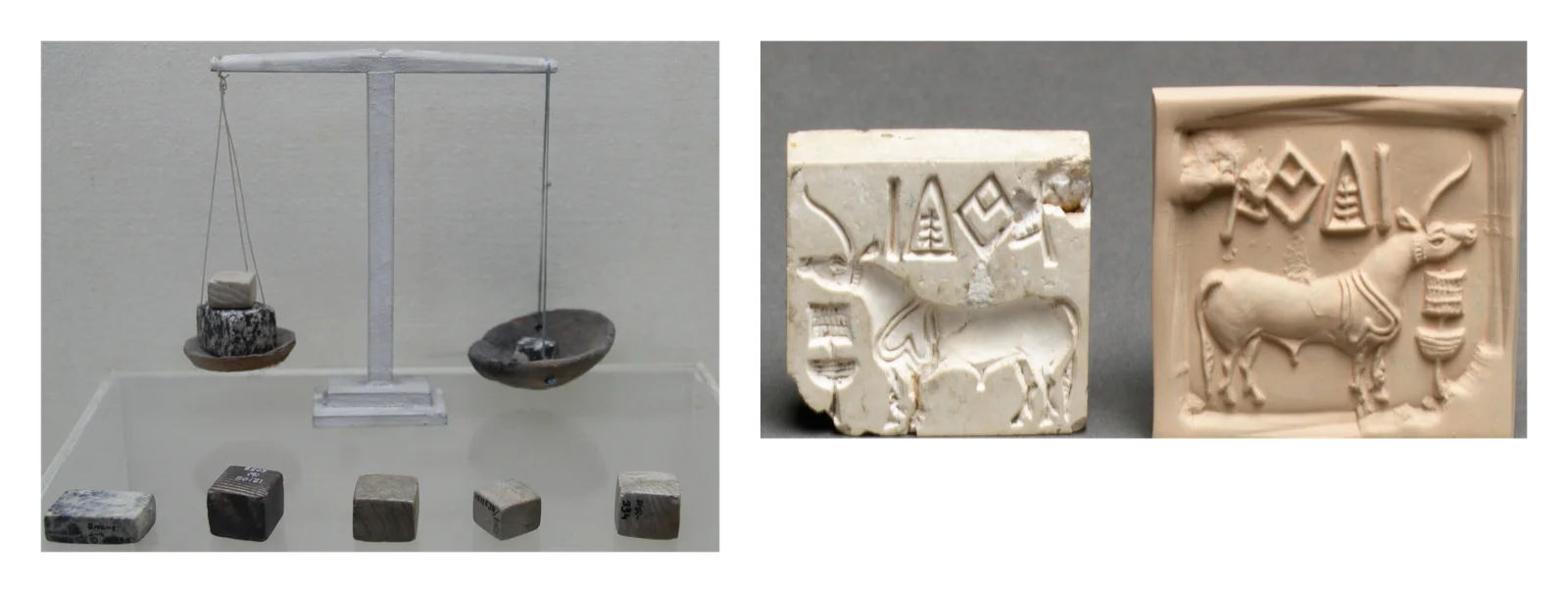
The Vedic vocabulary of value
Between the Indus cities and the coined economy lie the Vedic texts, which give us words rather than objects. They should be read carefully — many of the terms are ambiguous, and scholars disagree about which refer to money, which to ornaments, and which to weights.
Nishka — the most frequently discussed. A gold object, sometimes clearly an ornament worn at the neck, sometimes apparently a unit of value given in gifts. Probably both, at different periods. It is not a coin.
Satamana — literally "a hundred measures". A weight of a hundred krishnalas, and later the name of a silver piece. The Gandharan bent bars of Stage 16 weigh approximately this.
Krishnala or ratti — the seed of Abrus precatorius, the red-and-black gunja seed. Remarkably consistent in weight, at roughly 0.11 to 0.12 g, and used across India as the base unit for weighing precious metal for well over two thousand years.
Pada, masha, karsha, suvarna, dharana — further units in the same system, built up from the ratti.
The critical point: India's weight system is seed-based, and it survives. The ratti underlies the karshapana of the sixth century BCE, the Gupta dinara of the fourth century CE, the Mughal rupee of the seventeenth, and the tola used in Indian gold markets today. Stage 45 sets out the whole system.
The sixth century BCE: what changed
Historians call it the second urbanisation — the first being the Indus. Between roughly 700 and 500 BCE, the Gangetic plain filled with cities: Rajagriha, Kausambi, Sravasti, Champa, Varanasi, Ujjain, Taxila. Several of these have been excavated, and the archaeological marker of the period is a distinctive fine pottery, Northern Black Polished Ware, found across an enormous area — itself evidence of trade.
Four developments matter for coinage.
States with revenue needs. The Mahajanapadas — the sixteen "great realms" listed in Buddhist and Jain texts — were substantial polities, some monarchies and some republics (gana-sanghas). They maintained armies and bureaucracies, and they taxed.
Trade routes. Two great highways structured Indian commerce: the Uttarapatha, the northern route running from the Gangetic plain through Taxila towards Central Asia, and the Dakshinapatha, the southern route into the Deccan. Both connected regions with different currencies of exchange, different goods and no shared social ties.
Guilds. The shreni — associations of merchants and artisans — were organised, wealthy, and in some cases acted as bankers. Guild seals and guild involvement in coinage are both attested.
Ideas about wealth. This is the period of the Buddha and Mahavira, and of religious movements that were notably urban and notably supported by merchants. Buddhist texts refer to the kahapana — the Pali form of karshapana — casually and often, as an everyday unit. By the time these texts were composed, coinage was ordinary.
Persian contact. The Achaemenid empire reached the Indus under Darius I in the late sixth century BCE, and Gandhara became a satrapy. Persian coinage — the gold daric and silver siglos — circulated in the northwest. Whether Indian coinage was prompted by this contact or developed independently alongside it is a real and unresolved question, and the northwest's bent bars, which are quite unlike Gangetic punch-marked coins, sit right at the centre of it.
The Arthashastra on money
The Arthashastra, attributed to Kautilya (Chanakya), is the most detailed ancient Indian text on statecraft and includes a strikingly specific account of a state mint.
What it describes:
- The Lakshanadhyaksha — the superintendent of the mint, responsible for producing coinage
- The Rupadarshaka — the examiner of coins, responsible for testing currency in circulation, judging what was acceptable, and taking a fee for the service
- Denominations: rupya-rupa in silver (the pana and its fractions — half, quarter, eighth) and tamra-rupa in copper (the masha, half masha, and the kakani)
- Specified alloy compositions, including proportions of copper and other metals added to silver
- Penalties for counterfeiting, and for officials who passed bad coin
What we are about to look at
The rest of Section A follows Indian coinage from the first punched silver to the collapse of the Gupta gold standard — roughly a thousand years.
Four traditions run through it, and they interact constantly:
The indigenous punch-marked tradition (Stages 16 and 17): symbolic, non-figural, weight-standardised, purely Indian.
The Hellenistic tradition arriving from the northwest (Stage 18): portraits, Greek deities, Greek weight standards, legends naming the ruler.
The Central Asian and Iranian tradition (Stages 19 and 20): brought by the Sakas, Parthians and Kushans, and carrying its own iconography and its own habit of dating coins.
The Sanskritic imperial tradition (Stage 22): the Guptas, who took Kushan gold technique and Hellenistic portraiture and made something entirely Indian out of them, with Sanskrit verse on the reverse.
Stage 21 covers the Deccan, which went its own way in lead and potin, and Stages 23 and 24 handle the fragmentation afterwards and the quite separate story of the far south.
We begin with a piece of cut silver, punched five times, in the sixth century BCE or thereabouts.
Next: Stage 16, punch-marked coins — the oldest coinage of India and, for the collector, still one of the cheapest genuinely ancient coins in the world.
Stage 16Punch-Marked Coins
The karshapana is India's first coin and one of the world's first. It is also, for the collector, the most accessible ancient coin in existence — genuine examples from the Mauryan period can still be bought for very modest sums.
It looks like nothing else. Not round, not portrait-bearing, not inscribed. A flat irregular piece of silver, cut to weight, struck with a handful of small punches carrying symbols that nobody can fully read.
The object
Metal: silver, generally of high purity in the earlier issues and progressively alloyed later.
Weight: the standard is the karsha, 32 rattis, approximately 3.3 to 3.5 g. Fractions exist — half, quarter, eighth — and a heavier standard is found in some regional series.
Shape: irregular. Rectangular, square, trapezoidal, roughly circular, often with one or more clipped corners. This is a direct consequence of manufacture: the blanks were cut from beaten silver sheet and then adjusted to weight by clipping. The clipped corner is not damage; it is the mint hitting its target.
Obverse: several small punches, each with a single symbol, applied individually. They overlap, sit at different depths and angles, and frequently run off the edge.
Reverse: usually blank at issue, then progressively covered with tiny shroff marks as the coin circulated — each a money-changer testing and endorsing it.
Names: karshapana in Sanskrit, kahapana in Pali, pana in common use. Buddhist texts use the term constantly and casually, which tells you how ordinary these coins were.
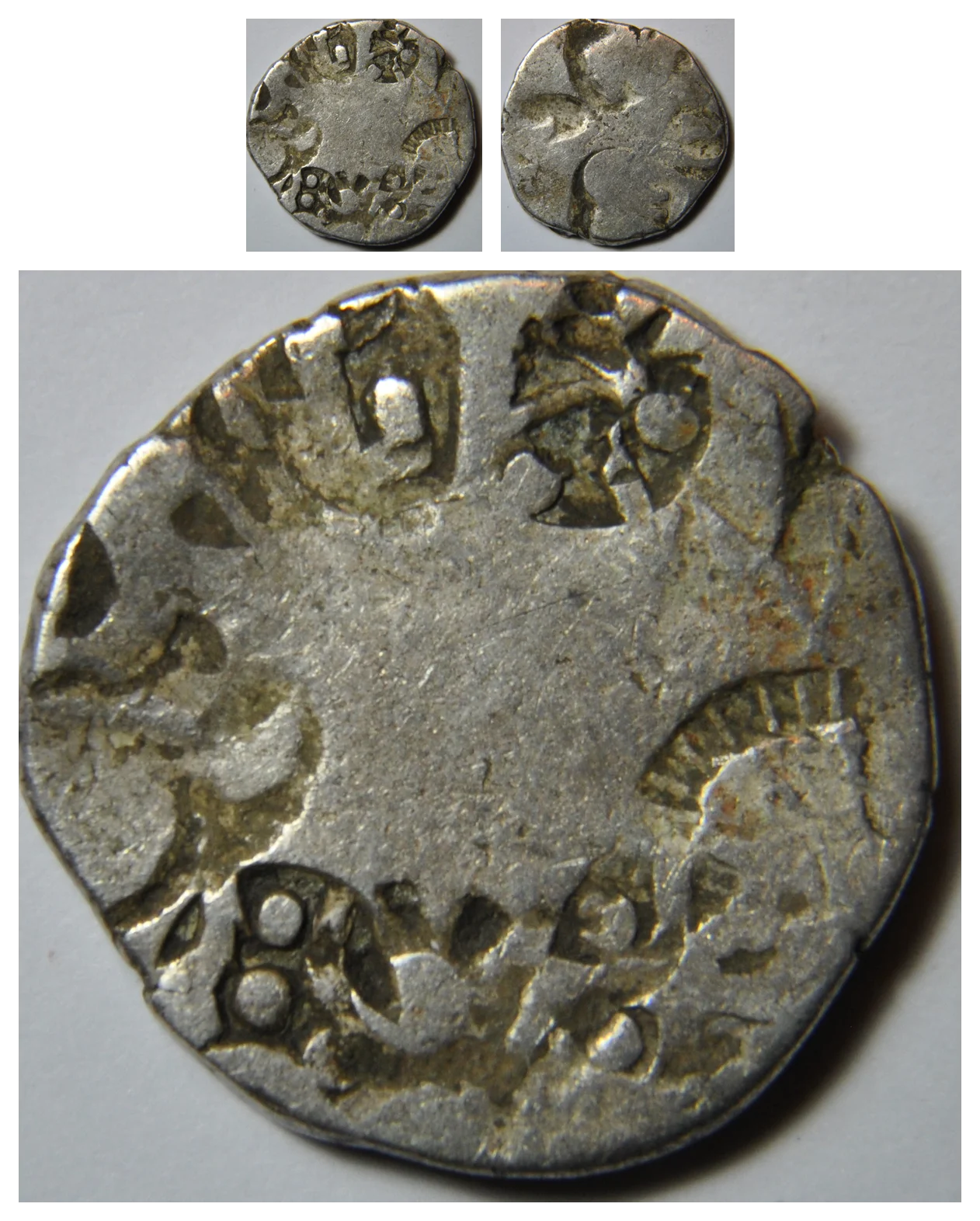
The bent bars of Gandhara
Before or alongside the Gangetic karshapana, the northwest produced something quite different.
Bent bars — sometimes called satamana bars — are long strips of silver, roughly 11 g, curved along their length, punched at each end with a large symbol, usually a six-armed or wheel-like device. Some carry a smaller central punch.
They belong to Gandhara and the Indus region, precisely the area that came under Achaemenid control. Their weight of approximately 11 g corresponds to the satamana of a hundred rattis, and it has also been compared to Persian standards. Whether they are an independent Indian development, a response to Persian coinage, or something in between is one of the open questions of the field.
They are visually striking and are among the most desirable punch-marked pieces.
The dating problem, stated honestly
There is no agreed date for the beginning of Indian coinage, and the range under discussion is wide.
The early view places the earliest punch-marked silver in the seventh or early sixth century BCE, making Indian coinage roughly contemporary with Lydia and arguably independent of it.
The later view places it in the fifth or fourth century BCE, after Achaemenid contact, allowing for the idea to have travelled.
Why it is unresolved: many punch-marked coins come from hoards without stratigraphic context. Where excavated contexts exist, the associated material often gives only broad dating. Hoards contain coins of long circulation, so a hoard's burial date is a terminus ante quem, not a date of issue. And the coins themselves carry no dates, no ruler names and no legends.
What this book does: uses "sixth century BCE or somewhat later" for the beginning of the series, and flags the uncertainty wherever a date matters. Readers will find sources stating an early date with confidence. That confidence is a position, not a consensus.
Who issued them
Punch-marked coins fall into two broad groups.
Local and regional series — associated with individual Mahajanapadas and regions, each with its own repertoire of symbols, weight standard and fabric. Series are identified for Gandhara, Kuru-Panchala, Kosala, Kashi, Magadha, Avanti, Surashtra, Vidarbha and others. They vary considerably: some use few punches, some many; some are heavy, some light.
The imperial series — a large, standardised, widely distributed group associated with Magadha and then the Mauryan empire. These are the coins most collectors encounter. They characteristically carry five punches on the obverse, with a consistent grammar: a sun symbol, a six-armed symbol, and three further symbols drawn from a larger repertoire.
The imperial series was struck in enormous quantity and circulated across most of the subcontinent. It is why punch-marked coins remain affordable today.
The symbols
Around three hundred distinct symbols have been catalogued. A selection of the most common:
| Symbol | Description |
|---|---|
| Sun | A central dot with radiating rays, usually six or more |
| Six-armed symbol (shadara chakra) | Six arms radiating from a centre, each ending in a distinct terminal — arrowhead, taurine, oval |
| Hill / mountain | Arches in a pyramid, commonly three or six, often with a crescent or peacock above |
| Tree-in-railing | A stylised tree within a square enclosure |
| Taurine | A bull's-head or nandipada shape, resembling a stylised U with a bar |
| Bull, elephant, dog, hare, frog, fish | Various animals |
| Crescent-on-hill | Combination symbol |
| Wheel | Spoked circle |
What they mean is genuinely unknown. The main interpretations, none conclusive:
- Marks of issuing authority — dynastic or state emblems
- Regional marks identifying where the coin was struck
- Officials' marks, one per successive mint officer, in the manner of the Arthashastra's superintendent
- Series or batch identifiers, functioning like a date
- Religious or auspicious symbols
The most productive modern approach treats the symbols as a system rather than individually: the sun and six-armed symbols are near-constant on the imperial series, while the other three vary, which suggests the constant ones identify the issuing authority and the variable ones identify something that changed — batch, official, mint or period.
Weight, and what it tells you
The karshapana standard of roughly 3.4 g is the anchor. Deviations are informative.
Consistently below standard within a series suggests either wear or a deliberately reduced local standard.
Individual variation of a few percent is normal — mints worked al marco, as Stage 3 explained.
Progressive weight reduction over time within the imperial series is one of the things used to construct a relative chronology.
Heavily worn coins can be substantially light. A karshapana at 2.9 g is a normal worn coin; one at 3.8 g deserves a hard look.
The end of the series
Punch-marked coinage did not stop abruptly. It faded through the last two centuries BCE as die-struck coinage — introduced from the northwest under Greek influence, and adopted by local dynasties — displaced it.
The two overlap. Some post-Mauryan issues are punch-marked; some regions continued the technique long after others abandoned it. Copper punch-marked coins exist and are a separate, less studied field.
What survived is the weight standard. The karsha of 32 rattis outlives the punch-marked coin by two thousand years, and the ratti is still in use.
Next: Stage 17 covers what filled the gap — the cast copper and die-struck local coinages of the tribes, republics and cities of post-Mauryan India.
Stage 17Cast Copper and Local Coinages
When the Mauryan empire fragmented after the third century BCE, its silver coinage did not have a single successor. What emerged instead was a proliferation: dozens of tribes, republics, cities and small dynasties issuing their own money, mostly in copper, across northern and central India.
This is the least glamorous material in Section A and one of the most interesting. These coins are the small change of ordinary life, they name political entities that appear nowhere else in surviving history, and they are inexpensive.
Cast copper
Alongside the punched silver of Stage 16, India produced a great deal of cast copper — poured into moulds by the method of Stage 4, then broken from the sprue.
Uninscribed cast copper is the earliest and most widespread group. Small, thick, often square or rectangular, carrying symbols similar in vocabulary to the punch-marked repertoire — hill, tree-in-railing, taurine, elephant, the Ujjain symbol. No legends, no ruler names.
They are found across a wide area from the Gangetic plain to the Deccan, and they are hard to attribute with precision. Many are known only by findspot.
How to recognise cast material: the diagnostics from Stage 4 apply — sprue stubs, edge seams, porosity, soft rounded detail on both faces. On genuine cast coinage these are features, not faults.
Die-struck copper appears alongside and eventually displaces casting, particularly under Greek influence from the northwest.
The tribal and republican coinages
Several of the political entities issuing coinage in this period were not monarchies. They were gana-sanghas — oligarchic or republican confederacies — and their coins reflect that.
This produces a genuinely interesting design problem, and Stage 1's point about coins as political statements applies directly: when there is no king, what goes on the coin?
The answer, consistently, is a deity, a tribal emblem, and the name of the people in the plural. Legends read in the form "of the Yaudheyas" or "of the Malavas" — the collective, not an individual.
Yaudheya. A large and long-lasting confederation in the region of modern Haryana, Punjab and western Uttar Pradesh. Their copper coins typically show a standing deity — identified as Brahmanya Deva, associated with Karttikeya — with a peacock, and a Brahmi legend naming the Yaudheya gana. Later issues carry numerals interpreted as marking divisions of the confederacy. Yaudheya coins are relatively common and are a good entry point.
Malava. Small, often crude copper coins from the Malwa region, with the legend Malavanam jaya — "victory of the Malavas". Frequently tiny and hard to read.
Arjunayana. Copper, from the region between Agra and Jaipur.
Audumbara. From the Punjab hills. Some issues name individual rulers, such as Dharaghosha, and show a trident-axe, a temple structure, and an elephant. Silver as well as copper.
Kuninda. From the Himalayan foothills. The best-known issues are the silver coins of Amoghabhuti, showing a deer with a female figure — usually identified as Lakshmi — and a legend in both Brahmi and Kharosthi. Handsome, well made, and among the most attractive coins of the group.
Rajanya, Trigarta, Vrishni, Sibi, Agra, Kulutas and others — smaller series, some known from only a handful of coins.
Suggested source: British Museum open access; own photography.City coinages
Cities issued their own copper, and several of these series are well studied because the sites have been excavated.
Taxila. The great northwestern city, on the Uttarapatha. Large cast copper pieces and later die-struck issues, with a rich symbol vocabulary. Taxila's coinage bridges the Indian and Hellenistic worlds, and the site's stratigraphy has been important for dating.
Ujjain. A major Malwa city and the source of the Ujjain symbol — a cross with a circle at each of the four ends — which appears on coins across central India and the Deccan for centuries, including on Satavahana issues.
Eran. Copper coins with a distinctive repertoire, some of the earliest die-struck Indian coins with legends.
Vidisha, Kausambi, Ayodhya, Mathura, Erikachha, Tripuri — each with its own series.
Mathura deserves particular mention. It produced a substantial coinage under a sequence of rulers whose names end in -mitra — the Mitra rulers — with Brahmi legends. The city was later a major Kushan centre, and its coinage records the transition.
Sunga, Kanva and the successor dynasties
The Sungas took power in Magadha after the last Mauryan ruler, traditionally around 185 BCE under Pushyamitra. Their coinage is copper, die-struck, with symbols continuous with the earlier repertoire.
The Kanvas followed briefly.
Neither dynasty produced a coinage comparable in scale or ambition to the Mauryan silver. What their coins mainly show is continuity of the symbol vocabulary alongside the arrival of legends.
What is actually happening in this period
Three changes run through the material, and they set up everything in the following stages.
Silver gives way to copper. The imperial silver of the Mauryas is not replaced. Regional powers issue copper for local circulation, and high-value silver largely disappears from the record in the Gangetic plain for a period. This is a real economic shift, not just a gap in survival.
Legends arrive. Punch-marked coins carry no writing. By the end of this period, most Indian coinage carries a Brahmi or Kharosthi legend naming the issuer. The idea that a coin should say who made it is new, and it comes largely from the northwest.
Casting gives way to striking. Die-striking, arriving with Greek technique, becomes standard.
All three are symptoms of the same thing: the northwest is transmitting Hellenistic numismatic practice into India, and Indian coinage is absorbing it. That is Stage 18.
Next: Stage 18 turns to the northwest and to the arrival of something India had never had on a coin — a human face.
Stage 18The Indo-Greeks
The Indo-Greek kings are known almost entirely from their coins. A handful of literary references, a few inscriptions, some archaeology — and several thousand coins naming around forty rulers, most of whom appear in no other source at all.
This is the clearest demonstration in the whole book of Stage 1's argument. Without the coins, an entire dynasty of Greek kings ruling in Afghanistan and Punjab for nearly two centuries would be a rumour. With them, we have names, portraits, approximate sequences, territorial ranges and religious affiliations.
They also brought India the royal portrait, and Indian coinage was never the same.
How Greeks came to be in India
Alexander reached the Indus in 327–325 BCE. His empire fragmented; the eastern portion went to Seleucus, whose successors ruled from Syria to Bactria.
Around the middle of the third century BCE, Diodotus I, the Seleucid governor of Bactria — roughly northern Afghanistan and the neighbouring region — broke away and established an independent Greco-Bactrian kingdom. His successors expanded it.
Under Demetrius I, in the early second century BCE, Greek forces crossed the Hindu Kush and took territory in Gandhara and the Punjab. The kingdoms that resulted — separate from Bactria proper, and often at war with each other — are what numismatists call the Indo-Greeks.
They lasted until roughly the end of the first century BCE, when the Sakas and then the Kushans displaced them.
The coins
Metal and denominations. Silver in the Greek pattern — tetradrachms, drachms and fractions — plus copper in a range of sizes. Gold is very rare.
Two weight standards, and the distinction is the key to the whole series:
The Attic standard, Greek, with a tetradrachm of roughly 16.8 g and a drachm of roughly 4.2 g. Used by the Bactrian kings and by the earliest Indian issues. Coins on this standard are typically round, with a Greek legend only.
The Indian standard, adapted to local practice, with a drachm of roughly 2.4 g. Used for coins circulating in Indian territory. These are typically bilingual — Greek on the obverse, Kharosthi on the reverse — and the copper is often square, following Indian habit.
That shift, from round Attic Greek-only to square-or-round bilingual Indian-standard, is a monetary system adapting itself to the market it served. It is one of the more elegant things in ancient numismatics.
The portrait
This is the substantive change.
Indian coinage before the Greeks is symbolic and impersonal. Punch-marked coins carry no ruler's name and no image of anybody. Republican coins name a people. The idea of putting a specific living individual's face on money was simply not part of the tradition.
Greek coinage was built on it. Hellenistic royal portraiture is realistic, individualised and frankly propagandistic — the king shown as vigorous, sometimes diademed, sometimes helmeted, sometimes ageing visibly across a long reign.
The Indo-Greek portraits are among the finest of the Hellenistic world. Some are conventional; others are startlingly specific — Eucratides in a plumed cavalry helmet, Antimachus in a flat kausia hat with a wry expression, elderly kings shown genuinely elderly.
The consequence for India: once the portrait arrives, it spreads. The Sakas use it, the Kushans use it, the Western Kshatrapas use it, and the Guptas eventually build an entire imperial iconography around the king in action. Stage 22 shows where that leads.
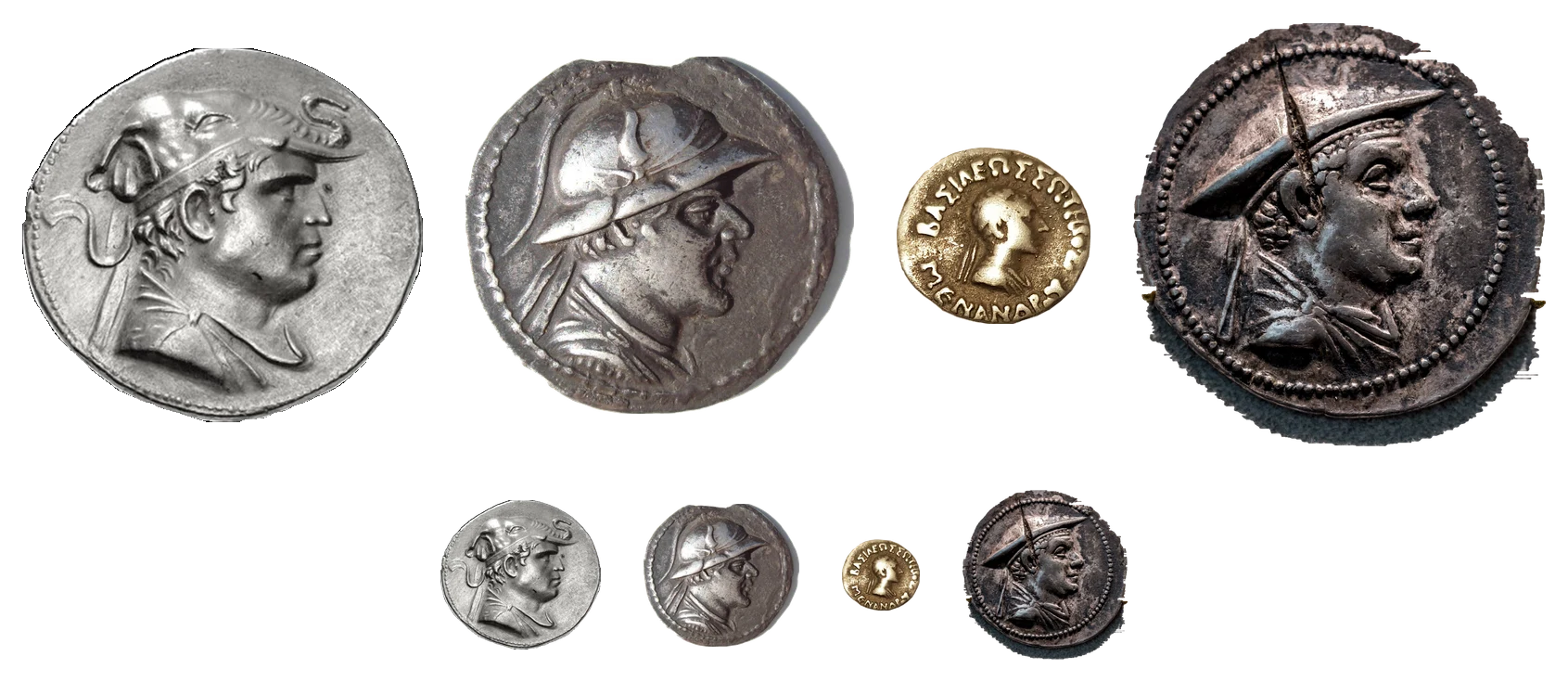
The principal rulers
Diodotus I and II — the founders of Bactrian independence. Zeus hurling a thunderbolt.
Euthydemus I — a strong portrait tradition; his coins were copied and imitated for centuries afterwards in Central Asia.
Demetrius I — shown wearing an elephant-scalp headdress, the symbol of conquest in India, borrowed from Alexander's iconography. He is the ruler traditionally credited with the invasion.
Agathocles and Pantaleon — important out of proportion to their political significance. They issued coins with Brahmi legends and with images of Indian deities: figures identified as Balarama-Samkarshana with plough and pestle, and Vasudeva-Krishna with wheel and conch. These are among the earliest datable representations of these deities anywhere, and they are on Greek coins. Agathocles also issued a pedigree series naming earlier rulers.
Eucratides I — a major ruler, prolific coinage, the helmeted portrait, and the reverse showing the Dioscuri, the divine twins, on horseback with spears.
Menander I Soter — the best known, and the one who entered Indian literature. His coins are the most common of the series, showing Athena Alkidemos hurling a thunderbolt on the reverse, with the bilingual legend giving his title Soter in Greek and Tratarasa — "saviour" — in Kharosthi.
Antialcidas — connected to the Heliodorus pillar at Besnagar near Vidisha, erected by his Greek ambassador, who describes himself as a devotee of Vasudeva. A Greek envoy from a Greek king setting up a Vaishnava pillar in central India is a single object that says a great deal about the period.
Hermaeus — generally taken as the last of the Indo-Greek kings. His coin types were imitated by the Kushans and others long after his death, in progressively degenerate versions.
Deities on the coins
The reverses are a religious map, and they change.
Greek deities dominate: Zeus, Athena, Apollo, Herakles, Nike, the Dioscuri, Poseidon, Artemis, Helios.
Indian deities appear, mostly under Agathocles and Pantaleon, as noted above.
Syncretic and ambiguous figures occur, where a deity could be read either way by either audience — which was very possibly the point.
This is the beginning of a pattern that runs through Stage 20 to the Kushans, whose coinage carries Greek, Iranian, Indian and Buddhist deities on a single series, and represents the most religiously plural coinage of the ancient world.
Collecting Indo-Greek coins
Availability. The silver of the common rulers — Menander above all, also Apollodotus, Eucratides, Azes in the following stage — is regularly available. Rare kings, known from a handful of coins, are expensive and mostly in museums.
What to look for: strike quality and centring matter more than wear on this series. A sharply struck, well-centred drachm with a clear portrait and a full legend is far more desirable than a higher-grade coin with the portrait half off the flan.
Fakes. Present, particularly for the rarer kings and for tetradrachms. Style comparison against museum examples is the primary defence — the portraits are individual and distinctive, and a modern engraver's version is usually detectably wrong in the face. Cast copies are common at the cheaper end and are caught by the edge test.
Cleaning. Indo-Greek silver from Central Asian hoards is often sold cleaned or "improved". Stage 8 applies.
A good starting point: a bilingual drachm of Menander. Common, affordable, historically resonant, and it displays every feature that makes the series important — portrait, Greek legend, Kharosthi legend, Greek deity, Indian weight standard.
Next: Stage 19 follows the Sakas and Parthians who displaced the Greeks, and the Western Kshatrapas, who did something no Indian dynasty had done before — they put a date on every coin.
Stage 19Indo-Scythians, Indo-Parthians and Western Kshatrapas
Between the Indo-Greeks and the Guptas sits a period of Central Asian rule in northern and western India, and it produces the single most useful body of coins in ancient Indian numismatics.
Not the most beautiful — the Kshatrapa drachm is a small, crude, repetitive coin. But it is dated. Every one of them, in an era we can convert, for nearly three hundred years. For historians building a chronology of a period where almost nothing else is securely dated, that is worth more than any amount of artistry.
The Sakas arrive
The Sakas — the Indian name for Scythians, Central Asian steppe peoples — moved south under pressure from other migrations and displaced the Greeks from Gandhara and the Punjab in the first century BCE.
They kept the coinage system they found. Indo-Scythian coins are recognisably continuous with Indo-Greek ones: bilingual, Greek and Kharosthi, with a ruler on one side and a deity on the other. The change is in the imagery — the ruler is often shown on horseback, sometimes with a whip or a spear, which is a steppe convention rather than a Hellenistic one.
Maues (c. 90–60 BCE) is the first significant Saka ruler in India, taking the title Basileos Basileon Megalou — great king of kings.
Azes I, Azilises and Azes II follow. Their silver tetradrachms and drachms are among the more common ancient Indian coins on the market. The typical Azes drachm shows the king on horseback holding a whip, with Zeus or Athena on the reverse.
The northern Kshatrapas
Kshatrapa is the Indian form of the Persian satrap — a provincial governor. The title was adopted by Saka rulers, with Mahakshatrapa for the senior and Kshatrapa for the junior, often reigning simultaneously as a father and son or senior and heir.
The northern Kshatrapas ruled around Mathura. Rajuvula and his son Sodasa are the principal names, and their coins are heavily influenced by the Indo-Greek types they replaced — some are direct, degenerate imitations of Strato's coinage.
The Indo-Parthians
Gondophares, ruling from around 20 CE, established a Parthian-descended kingdom in the region of Arachosia, Gandhara and the Punjab. His coinage continues the established pattern — king on horseback, bilingual legends, silver and copper.
Gondophares is the subject of a durable legend: the Acts of Thomas, an apocryphal Christian text, names a King Gundaphorus at whose court the apostle Thomas is said to have arrived. The identification of the coin ruler with the literary king is generally accepted; whether the underlying story is historical is a separate question and not one numismatics can settle. It remains one of the few points where Indian coinage touches early Christian tradition, and it is why Gondophares is better known outside the field than his political importance would suggest.
The Western Kshatrapas
Now the important part.
The Western Kshatrapas ruled Gujarat, Malwa, Saurashtra and neighbouring regions from roughly the first century CE to about 400 CE — a very long run. Two lines are distinguished:
The Kshaharatas, of whom Nahapana is the major figure. His silver is common. He was defeated by the Satavahana ruler Gautamiputra Satakarni, who restruck large numbers of his coins — an event visible in the coinage itself and discussed in Stage 21.
The Kardamakas, founded by Chashtana and including Rudradaman I, the most celebrated of the line. Rudradaman is known from the Junagadh rock inscription of around 150 CE, one of the earliest substantial Sanskrit inscriptions, recording his repair of the Sudarshana lake dam and listing his conquests.
The line runs on through many rulers to Rudrasimha III, defeated by Chandragupta II of the Guptas around 400 CE — which is how the Guptas acquired both western India and the silver coinage tradition described in Stage 22.
The Kshatrapa drachm
A small silver coin, roughly 2.0 to 2.4 g, about 15 mm, struck in enormous numbers over three centuries with very little change.
Obverse: a bust of the ruler, facing right, in profile, in a style descended ultimately from Hellenistic portraiture but increasingly stylised. Around it, a corrupt Greek legend — Greek letters that had ceased to spell anything meaningful, retained as decoration long after anyone could read them. In front of the face, the date, in Brahmi numerals.
Reverse: a three-arched hill (chaitya), with a crescent and a star or sun above, a wavy line below representing a river, and a Brahmi legend running around the edge giving the ruler's name, his father's name and their respective titles — Mahakshatrapa or Kshatrapa.
That reverse type is remarkably stable. Recognising it is one of the easiest identifications in Indian numismatics: three arches, crescent, sun, wavy line, Brahmi legend in a circle is a Western Kshatrapa drachm, and the Gupta silver that follows it copies the layout while replacing the hill with a Garuda.
Suggested source: own photography; American Numismatic Society.The dates
This is the earliest continuously dated coinage of India, and one of the earliest sustained dated coinages anywhere.
The dates are in the Shaka era, which begins in 78 CE. Conversion is simple addition:
CE = Shaka year + 78
The date is written in Brahmi numerals in front of the ruler's face on the obverse. Brahmi numerals are not positional — they use distinct symbols for units, tens and hundreds, which are combined. Reading them takes a chart and a little practice, and the chart is in the back matter.
Why this matters so much. Ancient Indian chronology is notoriously difficult. Literary sources rarely date events in a convertible era, inscriptions are scattered, and most coinage is undated. The Kshatrapa series provides a dated sequence spanning centuries, in a region with active trade contacts, which allows:
- The reigns of Kshatrapa rulers to be fixed closely
- Hoards containing Kshatrapa coins to be dated
- Associated material — Satavahana coins found alongside, restrikes, overstrikes — to be placed relative to that framework
- The Gupta conquest of the west to be dated by the end of the series
A great deal of the chronology of western and central India in this period rests on these small worn coins.
Collecting this material
Availability. Kshatrapa drachms are among the most available ancient Indian silver coins, and prices are modest. Indo-Scythian silver of Azes is likewise common. Rarer rulers in both series cost considerably more.
What to look for: a legible date above all, then a clear reverse legend, then portrait quality. A common ruler with a sharp readable date is more interesting than a scarcer one with the date gone.
A collecting project worth suggesting: a date run of Kshatrapa drachms. Because the coins are dated, cheap and were struck almost every year over a very long period, assembling a chronological sequence is genuinely achievable, and the resulting collection is a visible timeline of a dynasty across three centuries. Few ancient series allow this.
Fakes. Less of a problem here than for gold, because the values are low. Cast copies exist; the Stage 4 edge test catches them.
Next: Stage 20 covers the Kushans, who took the Central Asian inheritance, added Roman gold, and produced the most religiously plural coinage of the ancient world.
Stage 20The Kushans
The Kushan empire, at its height in the second century CE, ran from Central Asia across Afghanistan and northern India to the Gangetic plain. It sat astride the trade routes connecting Rome, Persia, India and China, and it grew wealthy on them.
Its coinage is the most religiously plural of the ancient world. On a single series you will find Shiva, the Buddha, a Zoroastrian fire god, an Iranian moon god, a Sumerian-descended goddess, Herakles and Serapis. No other state has ever put that range of deities on its money.
Who they were
The Kushans emerged from the Yuezhi, a Central Asian people displaced westward, who settled in Bactria in the second century BCE. One of their five divisions, the Kushana, gained supremacy under Kujula Kadphises in the first century CE, and expansion into India followed.
The main sequence:
Kujula Kadphises — the founder. Copper coinage, heavily imitative of what came before: Roman portrait styles, Hermaeus's Indo-Greek types, Augustan busts.
Vima Takto — associated with the extensive coinage inscribed Soter Megas, "Great Saviour", which carries a title rather than a name. The attribution took a long time to establish and rested partly on an inscription found at Rabatak in Afghanistan in 1993.
Vima Kadphises — the crucial reign for numismatics. He introduced gold coinage to the Kushan system, and his coins show Shiva with a bull.
Kanishka I — the best-known Kushan ruler, a major patron of Buddhism in tradition, and the ruler whose coinage carries the widest religious range.
Huvishka — an enormous and varied coinage, with the largest pantheon.
Vasudeva I — the last of the major rulers. The coinage narrows sharply to Shiva-and-bull types, which is itself a statement.
Later Kushans and Kushano-Sasanians — the empire fragments; the Sasanians take the western portion; degenerate imitations of Kushan types continue for centuries.
The gold
Vima Kadphises introduced gold, and it is the defining Kushan denomination.
The dinara weighs approximately 8 g, which is close to the Roman aureus. This is not a coincidence. Kushan territory was the eastern terminus of a trade in which Roman gold flowed into Asia in exchange for spices, textiles, gems and silk — and Roman gold coin arrived in quantity. Matching the standard made conversion trivial. Quarter dinaras and other fractions exist.
The gold is generally of high purity and survives beautifully, which is why Kushan gold looks fresh in a way that most ancient coinage does not.
Copper was struck in vast quantities alongside, and is the metal most collectors will actually own — Kushan copper is common and inexpensive.
The language on the coins
The legends change, and the change is worth tracking because it dates a coin quickly.
Early Kushan coins use Greek, inherited from the Indo-Greeks, sometimes alongside Kharosthi.
Kanishka's early issues use Greek. Then, during his reign, the coinage switches to the Bactrian language written in Greek script. Bactrian is an Iranian language; writing it in Greek letters required an extra character, Ϸ (sho), for a sound Greek did not have.
That letter Ϸ is a reliable marker. If you see it in the legend, you are looking at a Bactrian-language Kushan coin, and you are after Kanishka's reform.
Deity names on the reverse are given in Bactrian, which is how we know what the figures are meant to be — a rare piece of good fortune, since ancient coin deities are usually identified by guesswork.
The pantheon
This is the heart of the stage. The reverse of a Kushan coin names its deity, and the range is extraordinary.
Iranian and Zoroastrian:
- Athsho — fire
- Mao — the moon, shown with crescents rising from the shoulders
- Miiro — the sun
- Pharro — divine glory or fortune (Avestan khvarenah)
- Ardoxsho — abundance, holding a cornucopia; later merges iconographically with Lakshmi
- Oado — wind
Indian:
- Oesho — shown with multiple arms, a trident and often a bull. Conventionally identified with Shiva, though there is a scholarly argument that the name derives from the Iranian wind god Vayu and that the figure is a fusion. The Shiva identification is the mainstream reading.
- Skando, Kumaro, Bizago, Maaseno — forms of Skanda-Karttikeya
- Ommo — Uma
- Boddo and Sakamano Boudo — the Buddha, and Shakyamuni Buddha. Kanishka's Buddha coins are among the earliest datable images of the Buddha in human form anywhere, and they are consequently among the most famous coins in the world.
- Metrago Boudo — Maitreya
Mesopotamian and Greek:
- Nana or Nanaia — a goddess of great antiquity, ultimately Mesopotamian, often shown with a lion
- Herakles, Serapis, Helios, Selene on earlier issues
Suggested source: British Museum open access; American Numismatic Society.* ### Box 20.2 — What the pantheon actually means It is tempting to read Kushan coinage as evidence of a uniquely tolerant state ideology. That may be part of it, but there are more concrete readings. A territorial map. The empire spanned Iranian, Indian, Central Asian and Hellenised populations. A coinage carrying all their gods is a coinage that circulates acceptably everywhere in the empire. Legitimation. A ruler whose authority derives from conquest rather than descent benefits from association with every available source of divine sanction. Trade. Coins moving along the routes to Rome, Persia and China passed through many hands. Iconographic flexibility is commercially useful. Genuine syncretism. The Kushans were themselves a Central Asian people ruling an Indo-Iranian world, and the coinage may simply reflect what they actually believed. Note also Vasudeva's narrowing to Shiva-and-bull. Whatever the earlier plurality represented, it contracted — and reading that contraction is one of the more interesting exercises the series offers.Kanishka's Buddha coins
These deserve separate treatment because of their significance beyond numismatics.
Kanishka issued gold and copper coins showing the Buddha standing, haloed, in monastic robe, with the right hand raised in abhaya mudra, and the Bactrian legend BODDO. A variant names SAKAMANO BOUDO, Shakyamuni.
Why they matter: the depiction of the Buddha in human form — as opposed to by symbols such as the empty throne, the footprint or the wheel — was a development of roughly this period, and its origins in Gandharan and Mathuran art are debated. These coins are dated by their ruler, which makes them a fixed point in an argument otherwise conducted on stylistic grounds.
For the collector: the gold Buddha coins are among the most expensive Indian coins in existence and appear rarely. The copper is more attainable but still commands a substantial premium. Both are faked, and Stage 11 applies with full force.
Roman gold and Indian trade
Kushan gold sits inside a larger story that Stage 24 picks up in the south.
Roman writers complained about the outflow of gold to India. Pliny the Elder gives a figure for the annual drain to India, Arabia and China, and while the number is rhetorical rather than accounting, the underlying phenomenon is real and archaeologically confirmed: large hoards of Roman gold and silver coin have been found in India, particularly in the south.
The Kushans, controlling the northern routes, converted incoming Roman gold into their own coinage on a compatible standard. Roman coin found in Kushan territory is frequently found alongside Kushan issues.
This is one of the clearest cases of coins evidencing an economy that documents describe only vaguely.
Collecting Kushan coins
Copper is common, affordable and varied. A collection of Kushan copper covering the main rulers and a spread of deities is achievable at modest cost and is genuinely instructive — you can lay out the pantheon on a tray.
Gold is expensive and heavily faked. Buy only from established dealers, slabbed, or at major auction. Apply every test in Stage 11.
What to look for: Kushan coins are often struck on small flans relative to the die, so centring is a major quality factor. A coin with the full deity, full legend and full ruler figure on the flan is worth considerably more than a worn-off example. Legibility of the Bactrian legend matters, since it identifies the deity.
A good collecting project: one coin of each named deity. It is a finite, well-defined target; it produces a display that tells the empire's story directly; and most of it can be done in copper.
Next: Stage 21 turns south to the Deccan, where the Satavahanas built a coinage out of lead and potin and put a ship on their money.
Stage 21Satavahanas and the Deccan
While the north was absorbing Greek, Saka and Kushan influence, the Deccan went its own way. The Satavahanas ruled the plateau from roughly the first century BCE to the third century CE, and their coinage is unlike anything north of the Narmada.
It is mostly lead. It is unusually local in design. And one of its types shows a two-masted ship, which is one of the more directly informative images in ancient Indian numismatics.
The metals of the Deccan
Lead is the characteristic Satavahana metal, and it is unusual. Very few states anywhere have based a coinage on lead.
The reason is almost certainly supply. The Deccan has substantial lead resources, and lead is a by-product of silver extraction. It is soft, cheap and easy to cast or strike.
It is also a difficult metal to collect. Lead corrodes to a white or grey powdery carbonate, and lead coins survive badly — many are pitted, swollen, encrusted or crumbling. A well-preserved Satavahana lead coin is genuinely scarce, and this is worth knowing before you assume a poor-looking example has been mistreated.
Potin — a high-tin, often leaded bronze — is the other characteristic Deccan alloy, used extensively.
Copper is common.
Silver is rare and is mostly the portrait issues discussed below. Gold is essentially absent, which is a striking contrast with the Kushans in the same centuries.
The rulers
Satavahana chronology is contested — the dynasty's dates, its origin and even the number of rulers are debated, with proposed starting points ranging across two centuries. The names come from the Puranas and from inscriptions, and matching them to coins is not always straightforward.
The figures who matter numismatically:
Gautamiputra Satakarni — the most important reign. He defeated Nahapana, the Kshaharata Kshatrapa of Stage 19, and the coinage records it directly (below).
Vasishthiputra Pulumavi — his successor; a large coinage.
Yajna Sri Satakarni — a late ruler, and the issuer of the ship-type coins.
Note the metronymics: Gautamiputra means "son of Gautami", Vasishthiputra "son of Vasishthi". Satavahana rulers are identified by their mothers' clan names, which is unusual and has been read as evidence of matrilineal elements in the dynasty's practice.
The restrikes: history you can hold
This is the best single example in Indian numismatics of a coin recording an event.
Nahapana issued a large silver coinage in western India. Gautamiputra Satakarni defeated him — an event also recorded in the Nashik cave inscription of Gautamiputra's mother.
Gautamiputra then restruck Nahapana's silver coins with his own dies. Large numbers survive, and on many of them the undertype is still visible — Nahapana's portrait and legend showing through beneath Gautamiputra's design.
What this tells you, directly from the object:
- That the conquest happened
- That Gautamiputra captured Nahapana's treasury or currency in bulk
- That he chose to overstrike rather than melt — faster, and a public statement
- The relative sequence of the two rulers, independent of any text
- Given that Kshatrapa coins are dated (Stage 19), a chronological anchor for Satavahana history
A hoard of these restrikes was found at Jogalthembi in Maharashtra and is the standard reference for the phenomenon.
For a collector, an overstruck coin where both types are legible is far more desirable than a clean strike, which inverts the usual rule and is worth remembering.
Suggested source: Chhatrapati Shivaji Maharaj Vastu Sangrahalaya; British Museum open access.The ship coins
Yajna Sri Satakarni issued lead and potin coins showing a two-masted ship.
It is a simple image — a hull, two masts with rigging, sometimes oars or steering oars — and it is one of the most quoted objects in the history of Indian maritime trade, for good reason. It is direct, contemporary, state-issued evidence that the Satavahanas had ocean-going shipping and thought it worth putting on their money.
The context: the Deccan's western coast faced the Arabian Sea, and this is precisely the period of the Indo-Roman trade described in the Periplus of the Erythraean Sea, a first-century CE Greek merchant's guide that names Indian ports and lists what was traded through them. Satavahana territory included several of those ports.
What the coin does not tell you: the ship's construction details are too stylised to reconstruct, and the image is not a technical drawing. It tells you shipping mattered. It does not tell you what the ships looked like in detail.
Ship coins are scarce and command a substantial premium.
The other types
The Satavahana repertoire is largely symbolic, drawing on the shared Indian vocabulary of Stage 16 and 17:
- Ujjain symbol — the cross with four circles, extremely common on Deccan coinage
- Chaitya — the arched hill, shared with the Kshatrapas
- Tree-in-railing
- Elephant, horse, lion, bull
- Nandipada and taurine symbols
- Conch, wheel, srivatsa
A typical Satavahana coin has an animal or symbol on one side and the Ujjain symbol or chaitya on the other, with a Brahmi legend giving the ruler's name.
Portrait coins exist in silver for Gautamiputra Satakarni and Vasishthiputra Pulumavi, showing the ruler in profile in a manner clearly derived from Kshatrapa and ultimately Hellenistic practice. They are rare and expensive, and they are the point at which northern influence is most visible.
After the Satavahanas
The Ikshvakus succeeded them in the eastern Deccan, ruling from Nagarjunakonda in the Krishna valley — a major Buddhist centre. Their lead coinage continues Satavahana practice, with a lion as a characteristic type.
The Vakatakas were politically significant in central India and connected by marriage to the Guptas, but they issued very little coinage. Their near-absence from the numismatic record, despite their importance, is a useful reminder that coin evidence is not evenly distributed and that silence in the coinage is not silence in history.
The Western Kshatrapas continued in the west until the Gupta conquest of Stage 22.
Later Deccan powers — Kadambas, Chalukyas, Rashtrakutas — take up in Stages 23 and 24.
Collecting Satavahana coins
Availability. Lead and potin coins are available and inexpensive. Condition is the constraint, not price.
What to look for:
- Surface stability above all. A lead coin with active white corrosion is a problem. Look for a stable, hard surface.
- Legible legend and clear type. Many are worn or corroded past identification.
- Overstrikes with both types visible — a premium and a genuine historical document.
- Ship types — scarce, expensive, and the highlight of the series.
- Portrait silver — rare and costly.
Fakes. Less common than in the gold series, but cast copies of the desirable types — ships especially — exist. The Stage 4 diagnostics apply. Be particularly wary of a "ship coin" in unusually good condition offered cheaply.
A realistic project: a type collection of Deccan symbols in lead and potin — Ujjain symbol, chaitya, elephant, horse, lion, tree-in-railing — assembled for very little money, showing the full design vocabulary of the region.
Next: Stage 22 is the high point of ancient Indian coinage — the Gupta gold dinara, and an imperial iconography that puts Sanskrit poetry on the reverse of a coin.
Stage 22The Guptas
Gupta gold is the finest coinage India produced before the modern era, and it is the point at which everything in Section A converges. The technique is Kushan. The portrait convention is ultimately Hellenistic. The weight standard is Indian. The legends are in Sanskrit, in metre, and the reverse deity is Lakshmi.
It is also, for the collector, the most dangerous series in Indian numismatics. More on that below.
The dynasty
The Gupta empire ruled northern India from roughly 320 to the later fifth century CE.
Chandragupta I (c. 320–335 CE) — the founder of Gupta power in the meaningful sense, marrying the Licchavi princess Kumaradevi, an alliance the coinage advertises explicitly.
Samudragupta (c. 335–375 CE) — the great conqueror, whose campaigns are recorded in the Allahabad pillar inscription. His coinage is the most varied and inventive of the series.
Chandragupta II Vikramaditya (c. 375–415 CE) — conqueror of the Western Kshatrapas, which brings silver coinage into the Gupta system.
Kumaragupta I (c. 415–455 CE) — a long reign and a very large coinage with many types.
Skandagupta (c. 455–467 CE) — defended the empire against the Hunas; the gold declines in his reign.
Later Guptas — fragmentation, debasement, and the end of the series.
Dates for Gupta rulers are approximate. The Gupta era begins in 319/320 CE and is used in inscriptions, but Gupta coins are largely undated, and reign lengths are reconstructed from inscriptions and coin sequences.
The gold dinara
The name. Gupta gold coins are called dinara in inscriptions — a word descended, through Kushan usage, from the Roman denarius aureus. The Guptas inherited both the standard and the name from the Kushans.
The weight, and its drift. This is one of the more informative details in the series.
Early Gupta gold follows the Kushan standard of roughly 7.8–8.0 g. Over the course of the dynasty the weight rises to roughly 9.0–9.2 g, approaching the Indian suvarna of 80 rattis.
And here is the thing to notice: while the weight rose, the purity fell. The coins got heavier and worse. This is a debasement disguised as an increase — a heavier coin of lower fineness contains less gold while looking more impressive. It is precisely the manoeuvre Stage 2 identified as the standing temptation of coinage, executed elegantly.
The trend accelerates under Skandagupta and the later Guptas, and it tracks the empire's decline.
The types
Gupta coinage is organised by type, named after what the king is doing on the obverse. This is the vocabulary you need to read any catalogue entry or auction lot.
Obverse: the king, standing or seated or mounted, engaged in some activity. Reverse: almost always a goddess, usually Lakshmi, seated on a throne or lotus, with a Sanskrit legend in Brahmi naming the ruler and giving an epithet.
The principal types:
King-and-Queen type — Chandragupta I with Kumaradevi, both named, with the reverse legend Licchavayah — "the Licchavis". A coin advertising a marriage alliance and naming a queen, which is unusual anywhere in the ancient world. Attribution of the issue — whether struck by Chandragupta I or by Samudragupta commemorating his parents — is debated.
Standard type — the king standing, holding a standard, making an offering at an altar. The commonest type across several reigns and the workhorse of the series.
Archer type — the king standing with a bow and arrow. Very common under Chandragupta II and Kumaragupta.
Battle-axe type — the king with an axe.
Tiger-slayer type — Samudragupta trampling a tiger and drawing a bow. The reverse shows a goddess on a makara, associated with the Ganga.
Lyrist type — Samudragupta seated on a couch playing a vina. A conquering emperor depicted as a musician. It is the single most quoted Gupta coin, and it corroborates the Allahabad inscription's praise of his musical and poetic accomplishments. Rare and expensive.
Ashvamedha type — a horse before a sacrificial post, with a legend referring to the horse sacrifice. The ashvamedha was the great imperial ritual asserting universal sovereignty, and issuing a coin for it is a political act of the first order. Samudragupta and Kumaragupta both issued these.
Lion-slayer type — Chandragupta II shooting a lion.
Horseman type — the king mounted.
Peacock type — Kumaragupta with a peacock, referencing Karttikeya.
Chhatra type — the king with an attendant holding a parasol over him.
Kacha type — coins naming a ruler "Kacha", whose relationship to the known sequence is one of the standing puzzles of Gupta numismatics.
Suggested source: British Museum open access; Indian Museum, Kolkata; National Museum, New Delhi.Sanskrit poetry on the reverse
The legends are the thing that makes Gupta coinage distinctively Indian rather than a Kushan continuation.
Kushan reverses name a deity in Bactrian. Gupta reverses carry Sanskrit epithets in Brahmi, often metrical, praising the ruler.
The formulas are elaborate and self-consciously literary — declaring the king victorious, comparing him to gods, asserting that having conquered the earth he wins heaven by his good deeds. On the Ashvamedha type the legend proclaims the performance of the sacrifice and the king's invincibility.
This is composed language, in metre, on a coin. It belongs to the same cultural moment as classical Sanskrit literature, and it is deliberate: the Guptas were positioning themselves as an indigenous imperial and Sanskritic power, in contrast to the foreign dynasties they succeeded.
For the collector: the legend is often the first thing lost to wear or off-flan striking, and a coin with a complete legible legend is worth substantially more.
The silver
Chandragupta II defeated the Western Kshatrapas around 400 CE, and with the territory came a functioning silver currency and a population used to it.
The Gupta response was pragmatic: they kept the Kshatrapa coin and changed the badge.
Gupta silver copies the Kshatrapa drachm of Stage 19 almost exactly:
- Same weight, roughly 2.0–2.2 g
- Same size
- Same ruler's bust on the obverse
- Same circular Brahmi legend on the reverse
With one change: the chaitya — the three-arched hill — is replaced by Garuda, the Gupta dynastic emblem.
This is a textbook case of monetary conservatism at conquest. Change the coinage too much and the market rejects it; change the emblem and everyone knows who is in charge. Stage 32 shows the East India Company making exactly the same calculation thirteen centuries later.
Gupta silver is more affordable than the gold and considerably less faked. For a collector who wants a genuine Gupta coin without the risk, this is the answer.
Copper was issued from Chandragupta II onwards, in modest quantity. It is scarce, poorly documented, and inexpensive.
The end of the series
The Huna invasions from the later fifth century put the empire under sustained pressure. Skandagupta's reign is the last strong one, and the coinage shows the strain — heavier, baser gold, declining artistic quality.
Later Gupta issues continue as increasingly debased and crude versions of the established types. The dynasty fragments; successor states in Bengal, Malwa and elsewhere issue derivative coinages.
The gold standard of northern India effectively ends here. After the Guptas, gold coinage in northern India becomes intermittent for centuries. It does not return as a systematic imperial coinage until the Delhi Sultanate, and that is Stage 25.
Next: Stage 23 covers the long fragmentation that follows — Hunas, regional dynasties, the strange afterlife of a Sasanian fire altar, and the bull-and-horseman coin that would outlast them all.
Stage 23Post-Gupta and Early Medieval
The seven centuries between the Guptas and the Delhi Sultanate are the least glamorous stretch of Indian numismatics and one of the most instructive. Gold largely disappears from northern India. Coinage becomes regional, debased and repetitive. Designs degenerate into abstraction as die-cutters copy copies of copies.
But this period produces one coin that matters more than anything else in the stage — a silver piece showing a bull on one side and a horseman on the other, which becomes the single most widely copied design in Indian history and carries straight into Stage 25.
The Hunas
The Hunas — the Indian name for the Hephthalites or "White Huns" — pressed into northwest India from the later fifth century CE and contributed to the collapse of Gupta power.
Toramana and his son Mihirakula are the two rulers whose coins survive in quantity. The coinage is derivative, which is itself informative: it copies Gupta silver types in the areas the Hunas took from the Guptas, and Sasanian types in the areas facing Iran.
Huna silver based on Sasanian prototypes shows the characteristic fire altar with two attendants on the reverse and a stylised royal bust on the obverse. That design has an extremely long afterlife in India, discussed below.
Mihirakula's coins carry a bull and a Brahmi legend. He is remembered harshly in Buddhist and Jain sources as a persecutor, though the coins say nothing about that.
Regional successors in the north
The Maitrakas of Valabhi, in Saurashtra, issued a modest coinage descended from Gupta and Kshatrapa silver.
The Vardhanas, and Harsha in particular (c. 606–647 CE), present one of the odder gaps in Indian numismatics. Harsha ruled a substantial north Indian empire, is well documented in Bana's Harshacharita and in the Chinese pilgrim Xuanzang's account, and yet the coinage attributed to him is thin and uncertain. A major ruler with almost no coins is a useful corrective to any assumption that political importance and numismatic output track each other.
Later regional dynasties — Kalachuris, Chalukyas of Badami and later of Kalyani, Rashtrakutas, Paramaras of Malwa, Chandellas, Gahadavalas — issued coinage of varying scale. The Gahadavalas of Kanauj struck gold showing a seated Lakshmi, at around 4 g, which is one of the few systematic gold coinages of northern India in this period.
Kashmir ran a coinage of its own for many centuries — a long series of small copper pieces under the Utpala, Lohara and later dynasties, including issues of Queen Didda. The series is highly debased and stylistically frozen, with essentially the same design repeated across generations, and it is a useful study in what happens when a coinage stops evolving.
The Gadhaiya paisa
One of the strangest objects in Indian numismatics, and a perfect illustration of how a design decays.
The ancestry: the Sasanian silver drachm of Iran, with a crowned royal bust on the obverse and a fire altar flanked by two attendants on the reverse.
The transmission: Sasanian and Sasanian-derived types entered western India through the Hunas and the Indo-Sasanian series.
The result: over centuries, in Gujarat, Malwa and Rajasthan, local die-cutters copied the design without understanding it. The king's bust dissolved into a pattern of dots and curves. The fire altar became a stylised abstraction of lines and pellets. The attendants vanished into marks. What remains, by the tenth to thirteenth centuries, is a small, thick, debased silver or billon coin covered in geometric shapes that were once a portrait and an altar and are now purely conventional.
These are the Gadhaiya paisa, and they circulated in enormous numbers.
Why they are worth attention: they are the clearest surviving demonstration of design degeneration through copying — a visual game of telephone conducted over five hundred years, and the whole sequence can be laid out on a tray. They are also cheap, common and easy to obtain.
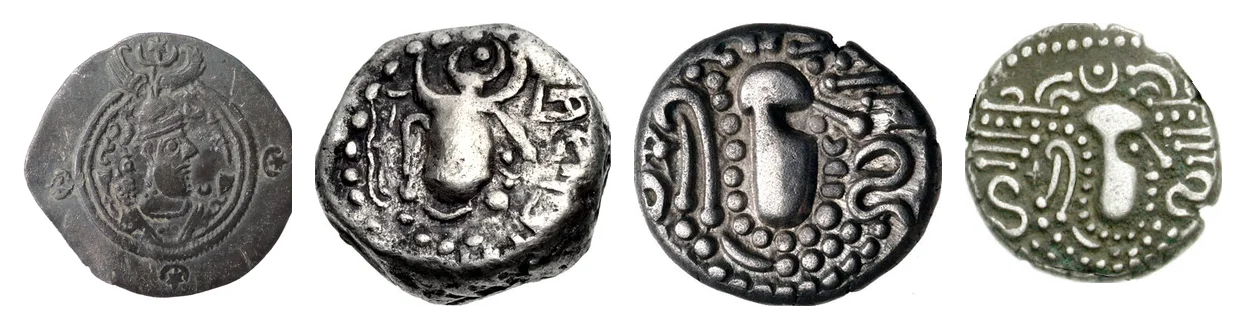
The bull-and-horseman jital
Now the important coin.
The Hindu Shahis ruled Kabul and Gandhara from roughly the ninth century, and their silver jital carries:
Obverse: a recumbent bull, with a Nagari legend giving a ruler's name — Samanta Deva, Spalapati Deva, Khudavayaka and others.
Reverse: a horseman, mounted, usually with a lance or standard.
Weight around 3.4 g — the old karsha standard of Stage 16, still working after fifteen centuries.
What happened next is the point. The bull-and-horseman jital became so established, so trusted and so widely circulated that every subsequent power in the northwest kept striking it, regardless of who they were or what they believed.
- The Ghaznavids struck it after conquering Shahi territory
- The Ghurids struck it — Muhammad bin Sam, the conqueror of northern India, issued bull-and-horseman coins with Arabic legends replacing the Nagari
- The early Delhi Sultanate continued it
- Local rulers across the northwest and Punjab struck versions for centuries
Names persisted past the people who held them. "Samanta Deva" appears on coins struck long after any such ruler, having become a type name rather than a personal one — a brand rather than an attribution.
What this period tells you about the economy
The numismatic evidence points fairly clearly in one direction, though the interpretation is debated.
Gold coinage largely ceases in northern India after the Guptas. It does not return as a systematic imperial coinage until the Delhi Sultanate.
Silver is debased, progressively, across most regional series. Billon — silver so alloyed it looks like copper — becomes normal.
Coinage becomes local. Where the Mauryan karshapana and the Gupta dinara circulated across huge areas, early medieval coinage is regional, with local weight standards and local designs.
Designs freeze or degenerate. Kashmir repeats one design for centuries; the Gadhaiya dissolves into abstraction.
The debated interpretation: an older school read this as evidence of urban decline, a contracting money economy and a shift towards a land-based, less monetised society. More recent work has questioned how far the coin evidence supports that, pointing to survival bias, to the continued circulation of older coin, and to regional variation.
What is not disputed is the pattern in the coins themselves. What it means economically is a live argument, and this book flags it rather than settling it.
Collecting this period
Availability is excellent and prices are low. Gadhaiya paisas, Kashmiri coppers and bull-and-horseman jitals are all common and cheap.
The challenges: attribution is difficult, the literature is scattered, and many coins are crude, small and worn. This is not a series for someone who wants immediate satisfaction.
Two projects worth suggesting:
A degeneration series. Assemble Sasanian through Indo-Sasanian to fully abstract Gadhaiya, showing the design's decay in sequence. Cheap, visually striking, and it teaches you more about how die-cutting worked than any amount of reading.
A bull-and-horseman sequence. Hindu Shahi with Nagari legend, then Ghaznavid, then Ghurid with Arabic, then early Sultanate. Four or five coins, all inexpensive, tracking a single design through three centuries and two religions. It sets up Stage 25 perfectly.
Next: Stage 24 closes Section A by turning to the far south, which followed a different trajectory entirely — and where Roman gold arrived by the shipload.
Stage 24The South
South India ran a separate monetary world. Different metals, different weight standards, different denominations, different design vocabulary, and a trade orientation that faced west to Rome and east to Southeast Asia rather than north to the Gangetic plain.
It also has the one thing the north lacks: a continuous gold coinage. While northern India went through the post-Gupta gold drought of Stage 23, the south kept striking gold, and by the Vijayanagara period was doing so on a large scale.
The Sangam kingdoms
The earliest Tamil coinage belongs to the three crowned kingdoms of the Sangam literature — Chera, Chola and Pandya — and to the smaller Velir chieftaincies.
Their emblems are the identifying feature, and they are consistent across a very long period:
| Kingdom | Emblem |
|---|---|
| Chera | Bow |
| Chola | Tiger |
| Pandya | Fish |
These appear on coins, on inscriptions and in the literature, and they persist for well over a thousand years. When you see a fish on a South Indian coin, think Pandya; a tiger, Chola.
The coinage itself is mostly copper, in square and round forms, both punch-marked and die-struck, with silver less common. Some Sangam-era pieces carry a portrait — a ruler's head in profile — which appears independently of, or in parallel with, the northern portrait tradition.
Tamil-Brahmi legends occur on some issues, giving ruler names, and these are among the earliest Tamil inscriptions of any kind.
Roman coins in South India
One of the best-documented episodes in ancient Indian economic history, and it rests almost entirely on numismatic evidence.
The finds. Large hoards of Roman gold aurei and silver denarii have been recovered from South India, concentrated in the interior of Tamil Nadu and Kerala — the Coimbatore and Karur regions especially — and at coastal trading sites. Arikamedu, near Pondicherry, excavated in the 1940s, produced Roman amphorae, Arretine pottery and other imports and became the type-site for Indo-Roman contact.
The context. The Periplus of the Erythraean Sea, a Greek merchant's handbook of the first century CE, names South Indian ports and lists their trade: pepper and other spices, pearls, gemstones, ivory, fine textiles going west; wine, glass, metals and coin coming east.
The Roman complaint. Pliny the Elder wrote about the drain of Roman gold eastward, giving a figure for the annual outflow to India, Arabia and China. The number is rhetorical rather than accounting, and it should not be quoted as data — but the underlying phenomenon is confirmed by the hoards.
The detail that matters most. Many Roman coins found in India have been slashed, cut or countermarked across the emperor's portrait.
The usual reading is that these coins were valued as bullion, not as coin. A defaced coin cannot re-enter circulation as Roman currency but weighs the same in gold. The cut marks are the South Indian market treating Roman gold as metal by weight, in exactly the manner of Stage 2 — buying it for its content, not accepting it on Rome's authority.
That single observation says a great deal. South India had its own coinage and did not need Rome's; what it wanted was the gold.
Suggested source: Government Museum, Chennai; British Museum open access.The Imperial Cholas
The Cholas rose to dominance in the tenth century and built an empire that reached Sri Lanka and mounted naval expeditions into Southeast Asia.
Rajaraja I (c. 985–1014) and Rajendra I (c. 1014–1044) are the major figures.
The characteristic type shows a standing king on one side and a seated king on the other, with a legend in Nagari or Tamil. The design derives from types current in Sri Lanka, which the Cholas conquered — another instance of the conquest-conservatism pattern of Stage 23.
Struck in gold, silver and copper. Chola copper is common and cheap; the gold is scarce.
The tiger emblem, sometimes with the Pandya fish and Chera bow alongside it, appears on Chola issues and is read as a claim to overlordship of all three ancient kingdoms.
Other southern dynasties
The Pandyas continued through the medieval period with the fish emblem, in gold, silver and copper.
The Western Gangas of Karnataka issued gold with an elephant type.
The Kadambas of Goa and Karnataka struck the padmatanka — a gold coin with a lotus as its central device, punched rather than fully die-struck, distinctive and attractive.
The Hoysalas issued gold with lion and other types.
The Yadavas of Devagiri, the Kakatiyas of Warangal and other Deccan powers each produced their own series.
Vijayanagara
The Vijayanagara empire (c. 1336–1646) dominated southern India for three centuries and produced the largest gold coinage of medieval India.
The rulers who matter numismatically: the founders Harihara and Bukka; Devaraya II; and above all Krishnadevaraya (r. 1509–1529), whose reign is the high point.
The types:
- Balakrishna — the infant Krishna, crawling, a signature Krishnadevaraya type
- Venkatesha / Vishnu, standing
- Shiva and Parvati seated
- Hanuman, Garuda
- Gandabherunda — the double-headed eagle, a striking device later adopted as the emblem of Mysore
- Bull, elephant
Reverses typically carry the ruler's name in Nagari or Kannada.
The denominations are the ones Europeans encountered and adopted, and they run right through the colonial stages:
| Denomination | Metal | Approx. weight | Notes |
|---|---|---|---|
| Pagoda (varaha, hun, gadyana) | Gold | ~3.4 g | The principal gold coin |
| Half pagoda (pratapa) | Gold | ~1.7 g | |
| Quarter pagoda | Gold | ~0.85 g | |
| Fanam (panam) | Gold or silver | ~0.35 g | Small change in gold — tiny, thick, common |
| Kasu / cash | Copper | Varies | Base small change |
What made the south different
Four things, and they hold across the whole period:
Gold-based, not silver-based. The northern system rests on silver — karshapana, tanka, rupee. The southern system rests on gold — pagoda and fanam. This is a fundamental structural difference and it survives until the British unify the coinage.
Continuous gold. No post-Gupta gold drought. Southern gold coinage runs unbroken through the period when northern India had almost none.
Maritime orientation. Trade faced west to Rome and the Arabian Sea and east to Southeast Asia, not north over land.
Temple economy. South Indian temples were major landholders, employers and financial institutions, and religious iconography on the coinage reflects a genuine institutional reality rather than only royal piety.
Collecting South Indian coins
Availability. Copper of the Cholas, Pandyas and Vijayanagara is common and inexpensive. Vijayanagara gold pagodas are available and, for a gold coin of the period, reasonably priced. Fanams are cheap and often overlooked.
What to look for: on Vijayanagara gold, the deity type and centring; on Chola copper, legibility of the standing and seated figures; on fanams, complete design, since they are struck on tiny flans and are usually partial.
A word of caution on fanams. They are so small and so numerous that they are frequently sold in unattributed lots. That can be a bargain or a bag of unidentifiable metal. Buy attributed material until you know the series.
Fakes. Vijayanagara gold is faked, though less aggressively than Gupta gold. The Stage 11 tests apply. Cast copies of Chola copper exist and are caught on the edge.
A good project: the three Sangam emblems — bow, tiger, fish — in whatever metal you can find them, followed by a Chola copper and a Vijayanagara pagoda. Five coins covering fifteen hundred years of southern coinage, and only one of them expensive.
END OF SECTION A
Next: Section B opens with Stage 25 and the Delhi Sultanate — where the bull-and-horseman of Stage 23 gives way to a silver coin that will define Indian currency for six hundred years.
Medieval and Early Modern
Stage 25The Delhi Sultanate
Part II — Section B: Medieval and Early Modern
The Delhi Sultanate changed Indian coinage more decisively than any event since the Indo-Greeks. Within a few decades of its establishment, the coinage of northern India went from figural and symbolic to purely calligraphic — no images, no deities, no portraits, just Arabic text arranged with great care.
It also introduced the silver tanka, a coin of roughly eleven grams that becomes the direct ancestor of the rupee, and it produced the most spectacular monetary failure in Indian history.
The Ghurid transition
The change did not happen at once, and the intermediate stage is the interesting part.
Muhammad bin Sam — Muizz al-Din Muhammad of Ghur — conquered northern India in the 1190s. His coinage shows a state working out how to be legitimate in two idioms simultaneously.
He struck bull-and-horseman jitals — the Hindu Shahi type of Stage 23 — with Arabic legends replacing the Nagari. Same coin, same weight, same market acceptance, new authority.
He also struck gold showing a seated Lakshmi with his own name in Nagari script.
A Muslim conqueror issuing a coin with a Hindu goddess and a Sanskritic legend is not a contradiction once you apply the Stage 23 principle: the coin had to circulate, and the market recognised Lakshmi gold. Political messaging came second to acceptance.
Qutb al-Din Aibak, his general and successor in India, continued in the same vein.
Iltutmish and the silver tanka
Shams al-Din Iltutmish (r. 1210–1236) is the founder of Indian Islamic coinage in the full sense.
He introduced the silver tanka, weighing approximately 11 grams, and a gold tanka of similar weight. Alongside them ran the jital in billon, as small change.
More importantly, he established the form that Indian Islamic coinage would keep for six centuries:
- No figural images. The bull and horseman go; nothing replaces them pictorially.
- Arabic legends only, arranged in horizontal lines within a circular or square border.
- The kalima — the Islamic declaration of faith — on many issues.
- The name of the Abbasid Caliph at Baghdad, acknowledging a higher authority and thereby claiming legitimacy from it.
- The mint name.
- The Hijri date.
That combination — issuer, caliph, mint, date, kalima — is the template. Everything from here to Stage 33 is a variation on it.
Razia
Razia al-Din (r. 1236–1240), Iltutmish's daughter, ruled Delhi in her own right and struck coins in her own name.
Her coins give her titles in the masculine forms used for a sovereign, and some name her as Sultan rather than Sultana. A reigning woman issuing coinage in her own name is rare in the medieval Islamic world and rare in Indian history, and the coins are the primary evidence of her sovereignty as opposed to regency.
They are scarce and expensive.
The Khaljis
Alauddin Khalji (r. 1296–1316) is best known for his market and price controls, an ambitious attempt at economic management documented by contemporary chroniclers.
Numismatically, his significant move was dropping the Caliph's name from the coinage and instead styling himself with grand titles including Sikandar al-Thani — "the Second Alexander".
This matters because it is a claim of independent sovereignty. Naming the Caliph acknowledges a superior; removing him asserts that the Sultan of Delhi answers to nobody. The coin is the medium through which the claim is published.
Muhammad bin Tughlaq and the token currency
The most famous episode in Indian monetary history, and the one every general reader has heard of.
Muhammad bin Tughlaq (r. 1325–1351) was an experimenter — in his capital, his taxation and his coinage. Numismatists sometimes call him the "prince of moneyers" for the sheer variety of his issues.
The token currency, around 1330. He introduced coins of brass and copper to circulate at the value of the silver tanka.
The idea was not absurd. It is fiat money — a coin whose value derives from state declaration rather than metal content. China had been running paper money on the same principle for centuries, and every coin in your pocket today works this way. Stage 1's point about nomisma applies exactly: the value would rest on the authority of the stamp.
The execution failed, for a specific and instructive reason. The tokens were easy to counterfeit. They carried no security features beyond their design, they were made of cheap and readily available metal, and the state lacked any means of controlling private production. Contemporary chroniclers describe forgery on a large scale — the claim that every household became a mint is a rhetorical flourish, but it captures the scale of the problem.
The treasury was obliged to redeem the tokens in silver and gold. Vast quantities were presented. The experiment was abandoned and the coinage withdrawn.
Firoz Shah and after
Firoz Shah Tughlaq (r. 1351–1388) issued a range of small denominations, which contemporary sources present as a deliberate provision of usable small change for ordinary transactions — a practical and unglamorous piece of monetary policy.
The Sayyids and Lodis (fifteenth to early sixteenth centuries) presided over a shrinking Sultanate and a progressively debased coinage. The billon tanka becomes the standard, silver content falls, and the coinage of the last decades before Babur's invasion is markedly poorer than what Iltutmish issued three centuries earlier.
Reading a Sultanate coin
The elements, and where to find them:
| Element | Typically | What it gives you |
|---|---|---|
| Kalima | Obverse, central | Religious formula; present on many issues |
| Sultan's name and titles | Obverse or reverse, central lines | The ruler |
| Caliph's name | Margin or reverse | Present before Alauddin Khalji, generally absent after |
| Mint name | Margin, after duriba bi- ("struck at") | Where |
| Hijri date | Margin, in words or numerals | When — convert with the Stage 10 formula |
Practical difficulties: the marginal legend, which carries mint and date, is the most likely to be off the flan, because Sultanate coins were often struck on blanks smaller than the die. A coin with a complete legible margin is worth considerably more than one without.
Collecting Sultanate coins
Availability. Billon jitals and tankas of the common rulers are inexpensive and plentiful. Silver tankas of major rulers are affordable. Gold, and coins of Razia, are scarce and costly.
What to look for: a complete marginal legend with mint and date is the single biggest value factor. After that, calligraphic quality and centring.
The learning curve. This series requires reading Arabic script, or at least recognising it. That is a genuine barrier and it is why Sultanate coins are undervalued relative to their historical importance — fewer collectors can attribute them. For someone willing to learn the script, this is one of the better opportunities in Indian numismatics.
Fakes. Present but less aggressive than in the gold series. Cast copies are the main risk; the Stage 4 edge test catches them.
Next: Stage 26 follows the Sultanate's fragmentation into regional kingdoms, each with its own coinage — and into the Deccan, where five sultanates went their own way.
Stage 26The Regional Sultanates
As Delhi weakened through the fourteenth and fifteenth centuries, its provinces broke away. Each new kingdom did what a new kingdom does: it struck coins.
The result is a rich, varied and often beautiful body of material that most collectors overlook. Bengal alone produced a coinage of extraordinary calligraphic ambition. The Deccan sultanates ran hybrid systems that mixed Islamic denominations with the southern gold pagoda. And several of these states were substantially wealthier than the rump Sultanate they had left behind.
Bengal
The most numismatically important of the regional sultanates, and the one worth studying first.
Independent from Delhi from the mid-fourteenth century, Bengal was ruled successively by the Ilyas Shahi dynasty, an interlude of Abyssinian rulers, and the Husain Shahi dynasty, until the Mughal conquest in the later sixteenth century.
The coinage:
- Heavy silver tankas, generally around 10.5–11 g, struck in large numbers
- Broad flans, generously proportioned, which gave die-cutters room to work
- Exceptional calligraphy. Bengal Sultanate coins are among the finest epigraphic coins of the medieval Islamic world, with elaborate ornamental scripts, decorative borders and sophisticated arrangement of the legend within the field
- A wide range of mint names and epithets
Bengal mints include Lakhnauti, Firuzabad, Satgaon, Muazzamabad, Sonargaon, Husainabad and others. Bengali mint epithets are particularly elaborate.
Why Bengal produced this quality: the region was agriculturally rich, controlled the eastern trade routes and the Bay of Bengal ports, and its sultans had money. Coinage quality tracks state wealth reasonably reliably, and Bengal's does.
For a collector, Bengal tankas are the best value in the whole Sultanate field — large, silver, handsome, historically significant, and priced well below what comparable Islamic coinage from elsewhere commands.
Suggested source: Indian Museum, Kolkata; British Museum open access.Jaunpur
The Sharqi sultans ruled Jaunpur in eastern Uttar Pradesh through the fifteenth century, a short-lived but culturally significant kingdom.
Their coinage follows Delhi practice — silver and billon tankas with Arabic legends — and is scarcer than Bengal's. The Sharqis are better known architecturally than numismatically.
Malwa
The sultans of Malwa ruled from Mandu in central India.
The distinctive feature is square coinage. Malwa struck square silver and copper alongside round issues, a form with Indian precedent (Stage 18's Indo-Greek square copper) that would reappear under Akbar.
Gujarat
The Muzaffarid sultans of Gujarat, ruling from Ahmadabad and Champaner, presided over one of the wealthiest states in India, drawing revenue from the ports of the Arabian Sea.
Their principal silver coin, the mahmudi, is named after Sultan Mahmud Begada. It is lighter than the Delhi tanka and became a widely recognised trade coin along the western coast — European traders of the following century deal in mahmudis constantly, and the name appears throughout early Company records.
Gujarat also struck substantial copper.
Kashmir and Madura
Kashmir had its own sultans from the fourteenth century, striking silver and copper with Arabic legends, and continuing the region's long tradition of separate coinage.
Madura in the far south had a brief sultanate in the fourteenth century whose coinage is scarce.
The Deccan
The Deccan produced the most complex regional monetary situation in India, and it needs its own treatment.
The Bahmani Sultanate
Established in 1347, ruling from Gulbarga and later Bidar, the Bahmani Sultanate dominated the northern Deccan for nearly two centuries.
Its coinage follows the Islamic epigraphic pattern — gold, silver and copper with Arabic legends, mint names and Hijri dates.
The five successor sultanates
The Bahmani state fragmented around the turn of the sixteenth century into five kingdoms, each of which struck coins:
| Sultanate | Dynasty | Capital |
|---|---|---|
| Bijapur | Adil Shahi | Bijapur |
| Golconda | Qutb Shahi | Golconda, later Hyderabad |
| Ahmadnagar | Nizam Shahi | Ahmadnagar |
| Bidar | Barid Shahi | Bidar |
| Berar | Imad Shahi | Achalpur |
They fought each other constantly, combined against Vijayanagara at Talikota in 1565, and were absorbed one by one into the Mughal empire during the seventeenth century — Aurangzeb completing the process.
Golconda deserves particular note. It controlled the diamond mines that supplied the world — the Koh-i-Noor came from the region — and it was correspondingly wealthy. Its ports handled the trade of the eastern coast.
The hybrid currency system
Here is what makes the Deccan interesting.
The Deccan sultanates ruled a population accustomed to the southern gold system of Stage 24 — pagoda, fanam, cash. They were themselves part of the Islamic world with its silver and gold denominations named in Arabic and Persian.
They ran both.
Deccan coinage includes:
- Gold pagodas (hun), on the southern standard of roughly 3.4 g, sometimes with Islamic legends, sometimes with retained Hindu devices
- Fanams, tiny gold coins in the southern manner
- Silver on Islamic patterns
- Copper in both traditions
This is the Stage 23 principle again, applied to a whole currency system rather than a single coin type. The rulers did not impose their system on the market; they issued whatever the market used, in their own name.
For a collector, the Deccan sultanates offer the unusual sight of a gold pagoda carrying an Arabic legend — an object that belongs to two numismatic traditions at once.
Reading regional sultanate coins
The elements are those of Stage 25 — kalima, ruler's name and titles, mint, Hijri date — with regional variations:
Titles proliferate. Regional sultans, asserting independence, adopted grand titulature. Expect long strings of honorifics.
The Caliph is usually absent, since these states were asserting independence from Delhi and had no reason to acknowledge a distant Abbasid authority.
Mint names are regionally distinctive and are often the fastest route to attribution — recognising "Lakhnauti" places a coin in Bengal immediately.
Calligraphic style varies sharply by region, and with practice it becomes a reliable attribution tool on its own. Bengal's ornamental scripts do not look like Gujarat's or the Deccan's.
Next: Stage 27 is short and it is the hinge of the whole book — one ruler, five years, and a coin whose name you still use.
Stage 27Sher Shah Suri and the Birth of the Rupee
Sher Shah Suri ruled northern India for five years. He died in 1545, at the siege of Kalinjar, when a stack of gunpowder exploded.
In those five years he standardised a silver coin at roughly 178 grains and called it the rupiya. Four hundred and eighty years later, about a fifth of the world's population still uses money that carries the name.
This is the shortest stage in Part II and the one everything else hangs on.
The man and the interruption
Sher Shah Suri, born Farid Khan, was an Afghan noble who rose through service in Bihar, defeated the Mughal emperor Humayun at Chausa in 1539 and again at Kannauj in 1540, and drove him out of India entirely.
Humayun spent fifteen years in exile in Persia before returning to reclaim the throne in 1555. So the Sur interlude sits inside the Mughal period, between Humayun's first and second reigns, and the Mughals inherited what Sher Shah built.
His administrative reforms were extensive and are better remembered than his coinage: a systematic land revenue survey and settlement, a reorganised bureaucracy, the rebuilding of the Grand Trunk Road with sarais — rest houses — at intervals along it, and a postal system. Akbar's celebrated administration is in substantial part Sher Shah's, continued and elaborated.
The coinage reform belongs to the same programme. It was not an aesthetic project. It was infrastructure.
The reform
Sher Shah replaced the debased, inconsistent, multi-standard billon coinage of the late Sultanate with a clean trimetallic system.
The rupiya. Silver, of high purity, weighing approximately 178 grains — about 11.5 grams.
The dam. Copper, weighing approximately 380 grains — about 20.9 grams.
The mohur. Gold, at a comparable weight to the rupiya, around 11 g.
The relationship between rupiya and dam was later formalised under Akbar at 40 dams to the rupee, and the ratio moved over time — 64 dams to the rupee is also recorded. The essential point is that a fixed, known, official relationship existed between the metals, which is precisely what the preceding decades of debasement had destroyed.
The design follows Sultanate practice: Arabic legends, the kalima, the ruler's name and titles, mint and Hijri date. Some issues carry the ruler's name additionally in Nagari script, which is a small but significant concession to the population that actually handled the coins.
The name
Rupiya derives from Sanskrit — rupya, meaning wrought silver, from rupa, form or shape. The word was already in use for silver coin; Sher Shah attached it to a specific standardised issue.
That is worth noting. He did not invent a name. He took an existing generic term and made it mean one particular, reliable, government-guaranteed coin.
Why it survived
Sher Shah's dynasty lasted barely a decade. His coin outlasted every state that issued it. The reasons are worth setting out, because they are the reasons any monetary standard succeeds.
It was well judged. 178 grains of good silver was a practical size for significant transactions — not so small as to be fiddly, not so large as to be inconvenient. It fitted the actual pattern of Indian commerce.
It was consistent. After decades of debasement, a coin you could trust by weight and fineness was enormously valuable to merchants, and they adopted it readily.
The Mughals kept it. Humayun returned in 1555 and did not disturb the system. Akbar adopted it wholesale, elaborated it and ran it across an empire that eventually covered most of the subcontinent. Three centuries of Mughal rule embedded the rupee everywhere Mughal authority reached.
Everyone else kept it too. The Marathas struck rupees. The Sikhs struck rupees. The princely states struck rupees. The East India Company struck rupees — because it had to, since nothing else would circulate (Stage 32). The British Crown struck rupees. Independent India, Pakistan, and their neighbours kept striking rupees.
Nobody could afford to change it. By the eighteenth century, the rupee was so deeply embedded in Indian commerce, contracts, revenue records and habit that replacing it would have been enormously disruptive for no gain. This is Stage 23's monetary conservatism operating at the scale of a continent and across five centuries.
The coins themselves
Sur coinage is scarcer than its importance suggests. The dynasty ruled for about fifteen years in total including Sher Shah's successors, over a limited though substantial territory.
Sher Shah's rupees are available but not common, and they command a premium for their historical significance well beyond their scarcity. Expect to pay considerably more than for a comparable Mughal rupee.
The dams are more affordable and are large, satisfying copper coins.
Islam Shah and the later Sur rulers issued coinage of declining quality as the dynasty weakened.
What to look for: complete marginal legend with mint and date, as always with this material; good silver surface; clear calligraphy.
Mints include Agra, Delhi, Gwalior, Bengal and others. Some are considerably scarcer than others, and mint rarity drives value in this series more than condition does.
Fakes exist, driven by the premium the name commands. Weight is the first test — 11.5 g is the target, and a coin significantly off it deserves scrutiny. Style comparison against published examples is the second.
Next: Stage 28 takes the rupiya into the hands of the Mughals, who kept the standard exactly and did remarkable things with everything else — including putting the zodiac on their coins, and a woman's name.
Stage 28The Mughals
Mughal coinage is the largest, best organised and most consistently documented coinage of pre-modern India. It ran for over three centuries, from hundreds of mints, in three metals, on a standard inherited unchanged from Stage 27.
It is also, once you can read it, the most information-dense coin series in this book. A single Mughal rupee tells you the emperor, the mint, the regnal year, the Hijri year and often a line of Persian verse. Very few coinages anywhere are so talkative.
The dynasty
Babur (r. 1526–1530) — founder, victor at Panipat. His Indian coinage is limited; he ruled India for four years.
Humayun (r. 1530–1540, 1555–1556) — lost the empire to Sher Shah, spent fifteen years in exile, returned, and died within months of his restoration.
Akbar (r. 1556–1605) — the great organiser. The Mughal mint system, the revenue system and the imperial ideology are all substantially his.
Jahangir (r. 1605–1627) — the most numismatically inventive emperor in Indian history.
Shah Jahan (r. 1628–1658) — orthodoxy restored, and a very large regular coinage.
Aurangzeb (r. 1658–1707) — the longest reign, the widest territorial extent, and a significant change to what appears on the coin.
Later Mughals (1707–1857) — declining real power, continuing nominal authority, and a coinage struck in their name by people who did not obey them.
Akbar: the system
Akbar built the machine that produced Mughal coinage for the next three hundred years.
The mints. Akbar operated a large number of mints across the empire, organised under a defined administrative structure with officials responsible for assay, weight and issue. Abu'l-Fazl's Ain-i-Akbari describes the mint organisation in detail — the offices, the procedures, the testing — and it is the Arthashastra of Stage 15 made concrete and datable.
The standard. Sher Shah's rupee, unchanged. Roughly 11.5 g of high-purity silver. The mohur in gold, the dam in copper.
The Ilahi era. From 1584 Akbar introduced his own era, counted from his accession in 1556 and using solar years with Persian month names. This appears on coinage alongside or instead of the Hijri date. Because it is solar and the Hijri is lunar, the two drift apart, and coins carrying both are useful for cross-checking.
Square coins. Akbar issued square silver and gold as well as round, following the Malwa precedent of Stage 26.
Religious experimentation on the coinage. Akbar's coins carry the formula Allahu Akbar — "God is great", and also, punningly, "Akbar is God's" or susceptible to that reading, which contemporaries noticed and orthodox critics objected to. Coins bearing this formula with jalla jalaluhu are associated with his later religious programme.
The Ram–Siya coins. A series of gold and silver coins showing Rama and Sita with Devanagari legends, conventionally attributed to Akbar. The attribution is discussed and not entirely settled; some scholars have proposed alternative origins. What is not in doubt is that they exist and that they are among the most remarkable objects in Indian numismatics — Hindu deities on Mughal imperial coinage.
Jahangir: the extraordinary decade
No Indian ruler did more unusual things with coinage than Jahangir, and he did most of them in about ten years.
The zodiac coins
Between roughly 1618 and 1622, Jahangir issued gold and silver coins showing the twelve signs of the zodiac — Aries as a ram, Taurus a bull, Leo a lion with the sun, Sagittarius an archer, and so on — in place of the customary legend on one side.
Why they matter: figural imagery had been absent from Indian Islamic coinage since Iltutmish, four hundred years earlier (Stage 25). Jahangir simply put animals and human figures back on the money. His own memoirs, the Tuzuk-i-Jahangiri, record the decision.
They were controversial, and they did not survive him. Shah Jahan discontinued them and is said to have withdrawn and melted what he could.
For the collector: the zodiac series is among the most desirable and most expensive Indian coinage, and it is heavily faked, with forgeries dating back to the nineteenth century. Stage 11's warning applies in full. Assume any zodiac coin offered outside a major auction is fake until proved otherwise.
The portrait coins
Jahangir also issued coins bearing his own portrait — in some cases shown holding a wine cup. A Muslim sovereign depicting himself, and depicting himself drinking, on imperial coinage is a striking act. These are extremely rare and correspondingly valuable.
The Persian couplets
Jahangir had verses composed for his coinage, and different mints carried different couplets. These are proper Persian poetry, celebrating the emperor and the coin, and they replace or supplement the standard formulaic legends.
For a numismatist this is useful as well as charming: the couplet identifies the mint, so a coin with a legible verse can often be attributed even when the mint name itself is off the flan.
Nur Jahan
Coins were struck in the name of Nur Jahan, Jahangir's empress, jointly with his own — declaring that the coin gained lustre by bearing her name.
Along with Razia of Stage 25, this is one of the very few instances of an Indian coinage naming a woman as an issuing authority. It reflects Nur Jahan's exceptional political position in the later years of the reign.
Suggested source: British Museum open access; National Museum, New Delhi; major auction archives.Shah Jahan and Aurangzeb
Shah Jahan returned the coinage to orthodoxy. The zodiac and portrait types ended; the kalima returned to prominence; the coinage became regular, abundant and conventional. Shah Jahan's rupees are common and are the standard entry point for collecting Mughal silver.
Aurangzeb made the change that distinguishes his coinage instantly.
He removed the kalima from the coins.
The reason is not impiety — it is the opposite. The Islamic declaration of faith is sacred text. A coin passes through every hand in the empire, including those of non-Muslims; it is dropped, trodden on, taken into unclean places. Aurangzeb's judgement, consistent with his general religious strictness, was that the sacred formula should not be subjected to that.
In its place he used a Persian couplet, which appears on his coinage throughout the reign, describing the coin as struck in the world like the shining full moon and naming Shah Aurangzeb Alamgir.
This is a genuinely useful attribution tool. The presence or absence of the kalima is one of the fastest ways to place a Mughal coin before or after 1658.
The later Mughals
After Aurangzeb's death in 1707, Mughal power fragmented rapidly. The coinage records the process with unusual clarity.
Coins continued to be struck in the emperor's name — by the Marathas, by the Nawabs of Bengal and Awadh, by regional governors who had ceased to obey, and by the East India Company.
Striking coin in a ruler's name is the classic assertion of that ruler's sovereignty. That everyone kept doing it, long after Delhi controlled nothing, shows how much residual legitimacy the Mughal name carried — and how useful that legitimacy was to people who wanted their coins accepted.
Shah Alam II (r. 1759–1806) is the name most frequently encountered, because the Company struck enormous quantities of rupees in his name (Stage 32).
Bahadur Shah II (Zafar), the last emperor, was deposed after 1857. Coins struck in his name during the uprising are historically significant and scarce.
Reading a Mughal coin
This is the practical core of the stage.
A typical Mughal rupee carries, distributed across the two faces:
| Element | Gives you |
|---|---|
| Emperor's name and titles | The ruler |
| Kalima (pre-Aurangzeb) or couplet (Aurangzeb onward) | Broad period |
| Mint name, usually after darb or zarb ("struck at") | Where |
| Mint epithet | Confirms the mint; changes over time |
| Hijri year (AH) | When — use the Stage 10 formula |
| Regnal year (julus, or sanah) | Year of the reign; cross-checks the Hijri date |
The cross-check is important. Regnal year and Hijri year must be consistent with each other and with the emperor's known accession. A mismatch is a warning sign for a fake — one of the more reliable tests available for this series.
The practical problem is the same as for the Sultanate: Mughal coins were commonly struck on flans smaller than the die, so the marginal legend carrying mint and date is frequently partly off the coin. A fully legible mint and date substantially increases value.
Collecting Mughal coins
Availability is excellent. Rupees of Shah Jahan, Aurangzeb, Shah Alam II and other common reigns are plentiful and affordable. Copper dams are cheap. Gold mohurs are expensive but obtainable.
Where the value is:
- Scarce mints. Common emperor, rare mint, can be worth many times common mint. Mint rarity is the primary value driver in this series.
- Complete legible mint and date.
- Full flan — Mughal coins are frequently struck on undersized blanks, and a coin with the whole design on it is unusual.
- Special types — zodiac, portrait, Nur Jahan, Ram–Siya, square issues. All expensive, all faked.
Collecting projects that work:
A mint collection — one rupee from as many different mints as you can find, of any emperor. Finite in principle, enormous in practice, and it turns into a map of the empire.
An emperor set — one rupee from each of Babur through Bahadur Shah Zafar. Achievable, and it shows the calligraphic and political evolution across three centuries in a dozen coins.
A kalima-to-couplet pair — one pre-Aurangzeb and one Aurangzeb rupee, side by side, illustrating the change and the reasoning behind it.
Fakes. Common types are not much faked, because the values are low. The special types are faked heavily, and so are rare-mint coins — sometimes by altering the mint name on a genuine common coin, which is the Stage 11 "altered genuine coin" category and requires magnification of the mint area to detect.
Next: Stage 29 covers the powers that filled the vacuum as Mughal authority collapsed — Marathas, Sikhs and Mysore, each of which handled the legitimacy problem differently.
Stage 29Marathas, Sikhs and Regional Powers
As Mughal authority collapsed through the eighteenth century, the powers that replaced it each faced the same question: in whose name do we strike coins?
Their answers differ sharply, and the differences are more revealing than any chronicle. The Marathas mostly kept striking in the Mughal emperor's name. The Sikhs struck in the name of their Gurus and never in the ruler's own. Tipu Sultan renamed everything — denominations, mints, the calendar itself.
Three solutions to the legitimacy problem, all visible on the coins.
Shivaji and the Marathas
Shivaji was crowned Chhatrapati in 1674, and the coronation was itself a claim to independent sovereignty. Issuing coinage was part of it.
The hon — gold, small, around 2.7–2.9 g, on the southern hun standard of Stage 24 rather than the Mughal mohur standard. This choice of standard is itself a statement: Shivaji's state faced south and west, not towards Delhi.
The shivrai — copper, the coin most collectors will encounter. Small, thick, roughly struck.
The legends are in Devanagari, not Persian. Typically Sri Raja Shiva on one side and Chhatrapati on the other, in some arrangement.
This is a deliberate break. No kalima, no Persian, no Mughal emperor, no Hijri date — a Sanskritic Hindu sovereign issuing coins in an Indian script on a southern weight standard. Everything about the coin refuses the Mughal framework.
Shivrais are common and cheap, and they were struck in vast numbers, including long after Shivaji's death — the type continued as a standard copper coin under successive Maratha authorities for well over a century. Dating individual specimens is difficult for exactly this reason.
The Peshwas and later Maratha coinage
Here the picture changes completely.
Under the Peshwas and the Maratha confederacy of the eighteenth century, Maratha-controlled mints struck coins in the Mughal style, with Persian legends, in the name of the Mughal emperor — usually Shah Alam II.
Why the reversal? Because by then the Marathas controlled large territories with populations, merchants and revenue systems accustomed to Mughal-style rupees. The Stage 23 principle applies: monetary conservatism at the point of conquest. Shivaji was building a new state and could afford a symbolic coinage; the Peshwas were administering an empire and needed money that circulated.
Maratha rupees are identified by small marks added to otherwise standard Mughal-type coins:
- The Ankushi rupee carries an ankusha — an elephant goad — as a distinguishing mark
- The Chandori rupee, from the Chandor mint, and other named types
- Various privy marks, symbols and letter-marks identifying the issuing authority
For a collector this is fiddly and rewarding work: two apparently identical Mughal-style rupees can be a genuine imperial issue and a Maratha issue, distinguished only by a tiny added symbol.
Other Maratha houses — Scindia of Gwalior, Holkar of Indore, Gaekwad of Baroda, Bhonsle of Nagpur — issued their own coinage and continue into Stage 30 as princely states.
The Sikhs
The Sikh solution to the legitimacy question is the most distinctive in Indian numismatics.
The misls and Banda Singh Bahadur
Early Sikh coinage is associated with Banda Singh Bahadur in the early eighteenth century, and then with the misls — the confederacies that controlled Punjab in the middle decades of the century.
Ranjit Singh
Maharaja Ranjit Singh (r. 1799–1839) built the Sikh Empire, ruling Punjab, Kashmir and the northwest from Lahore. He was, by any measure, one of the most powerful rulers in India.
His coins do not carry his name.
This is remarkable and it was deliberate. Sikh coinage is struck in the name of the Gurus. The standard legend on the Nanakshahi rupee invokes Guru Nanak and Guru Gobind Singh, in a Persian couplet attributing the coin's authority — the sword, the cauldron and victory — to the grace of the Gurus.
The theology behind it: sovereignty belongs to the Guru and to the Khalsa, the community, not to an individual ruler. Ranjit Singh governed but did not claim to be the source of authority. The coinage says so, on every piece, throughout a forty-year reign.
The coins:
- Nanakshahi rupee — the standard silver, roughly 11 g, on the rupee standard of Stage 27
- Gobindshahi — a related series
- Legends in Persian, in Nastaliq script
- A leaf mark appears on many Sikh coins as a distinguishing symbol
- Mints include Amritsar, Lahore, Multan, Kashmir, Peshawar and Derajat
Sikh coins are dated in both Vikram Samvat and Hijri on some issues — use the Stage 10 conversion table.
Mysore
Haidar Ali (r. 1761–1782) and his son Tipu Sultan (r. 1782–1799) ruled Mysore as a major independent power and fought four wars against the British.
Haidar Ali's coinage is relatively conventional — gold pagodas and fanams on the southern standard, silver and copper, with an elephant device on some issues and legends in Persian and Kannada.
Tipu Sultan's coinage is one of the most systematically reimagined currencies in Indian history.
He renamed essentially everything.
The denominations were given new names drawn from Islamic religious history — the gold, silver and copper coins carried names such as Ahmadi, Faruqi, Imami, Sadiqi, Abidi, Haidari, Bahadur and Mustafi, replacing the conventional mohur, rupee, paisa vocabulary.
The mints were renamed. Srirangapatna became Patan; Bangalore became Dar al-Surur; other mints received similarly newly minted names, several of them honorific compounds.
The calendar was replaced. Tipu introduced the Mauludi era, counted from the birth of the Prophet rather than from the Hijra — an epoch of approximately 572 CE. To convert a Mauludi date to CE, add roughly 572, noting that the reckoning and the exact epoch are debated in the literature and different authorities give slightly different equations.
He also used a distinctive cyclic year notation on some issues.
Why he did it. Tipu was constructing a sovereign identity deliberately separate from both the Mughal framework and the British. Renaming the currency, the mints and the calendar is comprehensive symbolic independence — the coinage of a state that recognises no predecessor.
For the collector: Tipu's coins are in strong demand, driven substantially by historical interest in the man rather than by numismatic scarcity, and they are heavily faked as a result. Stage 11's box lists them among the five fakes that fool almost everyone. Weight standards, calligraphic style and comparison against published examples are the defences.
The other successor states
Awadh (Oudh). The Nawabs of Lucknow struck rupees, initially in the Mughal emperor's name and later in their own, with distinctive marks including a fish device — the fish being the emblem of Awadh. Later issues under the Kings of Awadh are handsome machine-influenced coins.
Bengal. The Nawabs of Murshidabad struck rupees in Mughal style; the Murshidabad rupee becomes central to Stage 32, because it is the coin the East India Company inherited when it took Bengal's revenues.
Rohilkhand, Bharatpur, Farrukhabad and numerous smaller authorities issued rupees in Mughal style with local marks.
Hyderabad, the largest and longest-lasting of the successor states, continues into Stage 30.
Collecting this period
The material is abundant and inexpensive. Shivrais, Maratha-marked rupees and Sikh rupees are all readily available at modest prices. Tipu's coins cost more.
The identification challenge is the appeal. Distinguishing a Peshwa rupee from a genuine imperial Mughal issue means finding a small privy mark. Attributing an eighteenth-century rupee to the right successor state means knowing which mint marks belong to whom. It is close, detailed work, and the literature is scattered.
What to look for: clear privy marks, legible mint and date, and — for Sikh coins — a complete Persian couplet, which is the whole point of the coin.
A collecting project: the legitimacy set. A shivrai, a Peshwa-marked rupee, a Ranjit Singh Nanakshahi rupee, and a Tipu coin. Four inexpensive pieces demonstrating four different answers to the question of where authority comes from. Add the Company rupee from Stage 32 and you have five.
Next: Stage 30 covers the princely states — over five hundred issuing authorities, one of which was the only Indian state to run its own paper currency.
Stage 30The Princely States
At independence in 1947 there were more than five hundred princely states in India — territories under Indian rulers, in treaty relationship with the British Crown rather than under direct British administration. They ranged from Hyderabad, larger than most European countries, down to estates of a few square kilometres.
A great many of them struck coins. Some struck coins for centuries. One of them ran its own paper currency.
This is the largest and least systematised field in Indian numismatics, and it is where a collector can still find things nobody has properly written up.
The scale of it
There is no single agreed number of coin-issuing states, because the boundaries of the category are unclear — some states issued briefly, some issued jointly, some issued coins that barely circulated. Catalogues list well over a hundred issuing authorities with substantial series, and many more with minor ones.
The variety is the defining feature. Princely state coinage includes:
- Hand-hammered silver in Mughal style, struck into the twentieth century
- Machine-struck coins from dies supplied by Calcutta or Birmingham
- Coins with British monarchs' portraits
- Coins with Hindu deities
- Coins in Persian, Devanagari, Kannada, Malayalam, Gujarati and English
- Gold pagodas, silver rupees, copper paisas, tiny gold fanams
- Denominations found nowhere else
The major series
Hyderabad — the Asaf Jahi Nizams, the largest and wealthiest princely state. Struck the Hali Sicca rupee, with a distinctive type showing the Charminar, Hyderabad's landmark gateway. Hyderabad ran a full monetary system parallel to British India's, with its own exchange rate against the British Indian rupee. It is also the paper money exception, below.
Baroda — the Gaekwads. Silver and copper, later machine-struck, with the ruler's name in Devanagari.
Gwalior — the Scindias. A substantial coinage, later machine-struck, with an issue showing the ruler's portrait.
Indore — the Holkars. Silver and copper; the Malharshahi rupee.
Jaipur, Jodhpur, Bikaner, Udaipur (Mewar), Kotah, Bundi — the Rajput states, most striking rupees and paisas, several continuing hammered production into the machine age.
Travancore — a distinctive system using the chuckram and fanam rather than the rupee, with tiny silver and gold pieces. Travancore's small denominations are unlike anything else in India and are cheap and easy to obtain.
Cochin — small gold fanams and copper.
Kutch — the kori, a silver coin, in a long-running and well-documented series. Kutch also issued machine-struck coins with the British monarch's name alongside the ruler's, and its later coinage is among the most attractive of the princely states.
Junagadh, Nawanagar, Porbandar and other Kathiawar states.
Bahawalpur, Sailana, Dewas, Dhar, Ratlam, Jaora — smaller states with modest but collectable series.
Mysore — after Tipu, restored to the Wodeyars, with a coinage using the Gandabherunda double-headed eagle of Stage 24.
The British portrait problem
Several princely states struck coins carrying the name or portrait of the British monarch — Victoria, Edward VII, George V — alongside or instead of their own ruler's.
Kutch is the standard example: its koris name the British sovereign in Persian alongside the Rao of Kutch.
Sailana, Dewas, Dhar, Bikaner and others issued coins naming or depicting the British monarch.
Hyderabad's paper money
The exception that deserves its own section.
Hyderabad was the only Indian princely state to issue its own paper currency on a substantial scale.
The circumstances. During the First World War, silver became scarce and expensive worldwide — the same pressure that would later force the British Indian debasement of Stage 33. Hyderabad, running a silver-based currency, faced a shortage of coin.
The response. From 1918 the state issued paper notes denominated in Osmania Sicca rupees, its own currency unit, printed for the Hyderabad government.
The notes carry legends in Urdu, English and other scripts, with denominations including one, five, ten, one hundred and one thousand rupees. Early issues were printed in India; later issues were produced with more elaborate security features.
They circulated within Hyderabad alongside the state's own coinage and, in practice, alongside British Indian currency.
After 1948, when Hyderabad was integrated into India, the currency was withdrawn and replaced by Indian rupees.
For collectors: Hyderabad notes are the bridge between Section B and Section D. They are the only substantial princely state paper money, they are collectable, and they are the answer to a question that otherwise has none — did any Indian state other than the British issue banknotes? Stage 35 picks up the wider story.
Suggested source: RBI Monetary Museum; Salar Jung Museum, Hyderabad.Wartime cash coupons
A second paper phenomenon, and one that surprises most people.
During the Second World War, India faced an acute shortage of small coin. Silver and copper were diverted to the war effort; the metal itself was needed; and hoarding removed what remained from circulation.
Many princely states responded by issuing paper cash coupons for very small denominations — one anna, two annas, quarter rupee, half rupee.
They are crude. Printed on card or thin paper, often locally, sometimes with minimal security features and hand-applied numbering or stamps. Several states issued them; the surviving examples vary enormously in quality and in survival rate.
They are genuinely interesting as emergency money in the Stage 7 sense — the response of small states to a monetary crisis they did not cause and could not otherwise solve.
They are also cheap and under-collected, and the literature on them is thin. For anyone wanting a field where original work is still possible, this is one.
Integration and the end
Between 1947 and 1950 the princely states acceded to India or Pakistan and were integrated.
Their coinages were demonetised, and the coins were withdrawn and largely melted. This is why some princely state issues, struck in millions, are now scarce — a systematic recall removed most of them.
Hyderabad's currency was withdrawn after 1948.
The Republic's coinage, described in Stage 41, replaced everything with a single national issue for the first time since the 1835 Uniform Coinage of Stage 32 — and for the first time ever under an Indian government.
Collecting princely states
The great advantage: it is enormous, varied, cheap, and genuinely under-researched. A collector can specialise in a single state and become one of a small number of people who know that series well.
The great difficulty: attribution. Many small states' coins are crude, undated, poorly documented and easily confused with neighbours' issues. Catalogue coverage is uneven — Krause covers the machine-struck material reasonably and the hammered material patchily.
Where to start:
One state, deeply. Pick a state with a documented series — Kutch, Baroda, Travancore, Hyderabad, Gwalior — and collect it properly. This is far more satisfying than a scattering of unrelated pieces.
A denomination survey. Kori, chuckram, fanam, anna, paisa, rupee, pagoda — the princely states used the widest range of denominations in India, and a set illustrating them is instructive.
The dual-sovereignty set. Coins naming both an Indian ruler and a British monarch, from several states. A small, cheap, pointed collection that makes the argument of Box 30.1 visually.
What to watch for: cleaned coins are common in this material, since much of it is base metal that has been polished by dealers or previous owners. Stage 8 applies. Machine-struck princely issues in genuine uncirculated condition exist and are worth seeking.
END OF SECTION B
Next: Section C opens with Stage 31 and the arrival of the Portuguese, Dutch, French and Danes — and then the company that would eventually strike more Indian coins than any Indian state ever had.
Colonial
Stage 31The Europeans Arrive
Part II — Section C: Colonial
Four European powers established coin-issuing settlements in India before the British became dominant. Their coinages are small, scattered, and collectively they demonstrate the same principle that has run through every stage since Stage 23.
None of them tried to make India use European money. Every one of them struck coins on Indian standards, in Indian denominations, for Indian markets. The European element is a badge — a cross, a monogram, a king's name — added to a coin that was otherwise entirely local.
The Portuguese
The Portuguese arrived first and stayed longest. Goa was taken in 1510; Diu, Daman and Bassein followed; Portuguese India survived until 1961, four and a half centuries.
The mint at Goa was operating within a few years of the conquest, and Portuguese Indian coinage is the largest European series in India before the Company.
The denominations are a hybrid vocabulary:
| Denomination | Metal | Origin of the name |
|---|---|---|
| Xerafim | Silver | From the Arabic/Persian ashrafi |
| Tanga | Silver | From the Indian tanka (Stage 25) |
| Pardao | Gold, later silver | From the Indian pratapa |
| Bazaruco | Copper, lead or tin | Local |
| Rupia | Silver | The rupee, adopted later |
Look at that list. Four of the five names are Indian or Persian. The Portuguese did not import a currency; they took over one.
The designs carry European markers on Indian-standard coins:
- The cross of the Order of Christ
- The armillary sphere, the personal device of Manuel I and a symbol of Portuguese navigation
- Portuguese royal arms
- St Thomas on some Goan issues
- Legends in Latin and Portuguese
Later Portuguese Indian coinage became conventional European machine-struck currency, with the monarch's portrait, denominated in rupias and centavos, through to 1961.
Bazarucos are the cheapest and most common Portuguese Indian coins — small, crude, often in lead or a tin alloy, and frequently badly corroded.
The Dutch
The Vereenigde Oostindische Compagnie (VOC) held settlements on both coasts — Pulicat, Nagapattinam, Cochin, Bimlipatnam and others.
The Dutch approach was the most thoroughly local of the four. VOC coins in India are, for the most part, Indian coins with a Dutch mark:
- Gold pagodas on the southern standard of Stage 24
- Fanams — the tiny southern gold pieces
- Copper cash (kasu)
- Silver rupees in Mughal style, struck at Dutch mints for circulation in Mughal territory
The identifying feature is the VOC monogram — the three letters interlaced into a single device, one of the earliest recognisable corporate logos.
Some Dutch issues carry Hindu deities, following local pagoda types exactly, with the VOC monogram as the only European element on the coin.
The French
The Compagnie des Indes held Pondicherry, Chandernagore, Karikal, Mahé and Yanam — the last of which remained French until the 1950s.
The French struck:
- Fanams and cash for the south, on local standards
- Rupees in Mughal style, with Persian legends, carrying a small French mark — often a fleur-de-lis — as the distinguishing device
- Later, coinage naming the Compagnie des Indes or the French Republic, denominated in fanams, cash, doudous and roupies
The Arcot rupee connection matters here: French, English and Indian mints all struck rupees to the Arcot standard in the Carnatic, and telling them apart depends on small marks. This is fiddly attribution work and it carries into Stage 32.
The Danes
The smallest presence, and the most easily overlooked.
The Danish East India Company established Tranquebar (Trankebar) on the Coromandel coast in 1620, and later Serampore (Frederiksnagore) in Bengal. Both were sold to the British in the 1840s.
Danish Indian coins include cash and fanams on local standards, and later small copper denominations. The identifying feature is usually the crowned royal monogram of the Danish king — a C or F with a numeral, under a crown.
They are scarce, small, and often overlooked in mixed lots, which occasionally makes them a bargain.
Collecting the European settlements
Availability. Portuguese Indian material is the most available, particularly the later machine-struck coinage, which is common and cheap. Bazarucos are plentiful but usually in poor condition. Dutch, French and Danish issues are scarcer.
The attribution challenge. Many of these coins are small, crude, worn and carry their identifying mark in a place that has worn away. A VOC monogram on a corroded copper cash is often not visible at all.
What to look for:
- Legible European marks — the whole identity of the coin depends on them
- Portuguese silver in reasonable grade, which is genuinely attractive
- Dutch pagodas and fanams, where the combination of Hindu deity and VOC monogram is the point
A collecting project: one coin from each of the four powers, ideally all on Indian standards with their European badge. Four small cheap coins that demonstrate the argument of Box 31.1 in a single row.
Next: Stage 32 follows the one European company that did not stay small — and watches a trading firm turn into a government, entirely visibly, through its coins.
Stage 32The East India Company
The East India Company's coinage is the clearest documentary record of a trading firm turning into a state. You can watch it happen: first a company striking small change for its factories, then a company striking rupees in a Mughal emperor's name, then a company issuing a single currency for the whole subcontinent under a British king's portrait.
Nobody wrote the transition down as it happened. The coins did.
From factory to territory
The Company received its charter in 1600. Its early Indian presence was a handful of fortified trading posts:
- Surat, from 1613 — a factory in Mughal territory
- Madras, from 1639 — Fort St George, on land granted by a local ruler
- Bombay, from 1668 — acquired by the Crown as part of Catherine of Braganza's dowry from Portugal, and leased to the Company
- Calcutta, from 1690
Each was a separate administration. Each developed its own currency. This is the single most important fact about Company coinage before 1835: there were three systems, not one.
The three presidencies
Madras: the gold system
Madras used the southern system of Stage 24 — gold-based, not silver.
| Denomination | Metal | Notes |
|---|---|---|
| Star pagoda | Gold | The principal coin; named for the star on its reverse |
| Fanam | Gold or silver | Small change |
| Cash (kasu) | Copper | Base small change |
| Arcot rupee | Silver | Introduced later, on the Mughal standard |
| Dub | Copper | Local |
The star pagoda is one of the most attractive Company coins — small, thick, gold, with a granulated obverse and a star reverse.
The accounting relationships were awkward: a pagoda divided into fanams, fanams into cash, in ratios that were not decimal and not consistent. English merchants complained about it for two centuries.
Bombay: the rupee system
Bombay was Crown territory leased to the Company, which gave it a freedom the other presidencies lacked — it could strike coins in the Company's own name without reference to any Indian sovereign.
Early Bombay issues carry the Company's arms, English legends and dates, alongside rupees on the Mughal standard. Denominations included the rupee, the pice and the copper budgrook — the latter a corruption of the Portuguese bazaruco of Stage 31.
Bengal: the Mughal system
Bengal is where it gets interesting.
The Company acquired the Diwani of Bengal, Bihar and Orissa in 1765 — the right to collect revenue, granted by the Mughal emperor Shah Alam II following the battle of Buxar. In legal form, the Company became a Mughal revenue official. In practice, it became the government of the richest province in India.
It therefore struck coins in the Mughal emperor's name. The Bengal rupee, struck at Murshidabad and later Calcutta, carries Shah Alam II's name and titles in Persian, in the standard Mughal format of Stage 28.
A British joint-stock company, striking Islamic coinage in Persian in the name of an emperor it was in the process of displacing.
The Uniform Coinage of 1835
By the 1830s the three-presidency system was indefensible. A merchant moving from Madras to Calcutta changed currency systems entirely — gold pagodas to silver rupees, with different weights, different fineness, different accounting.
The Coinage Act of 1835 created a single currency for all Company territory.
The specification:
- One rupee, of 180 grains (approximately 11.66 g), eleven-twelfths fine — that is, 916.7 parts silver per thousand
- Divided into 16 annas, each of 4 pice, each of 3 pies
- Struck at Calcutta, Bombay and Madras to a single standard
- The King's portrait on the obverse — William IV — with English legends
What changed, and what did not:
The weight is essentially Sher Shah's. 180 grains against 178 — a marginal adjustment to a standard set in 1540. Stage 27's point holds: nobody could afford to change the rupee.
The name did not change. Rupee, anna, pice, pie.
Everything else did. A British monarch's portrait replaced Persian calligraphy. English replaced Persian. The Mughal emperor's name disappeared from the coinage of Bengal after two centuries of pretence.
The southern gold system was abolished. Pagodas, fanams and cash were demonetised and withdrawn. A monetary tradition running back to the Cholas and beyond ended by statute in 1835.
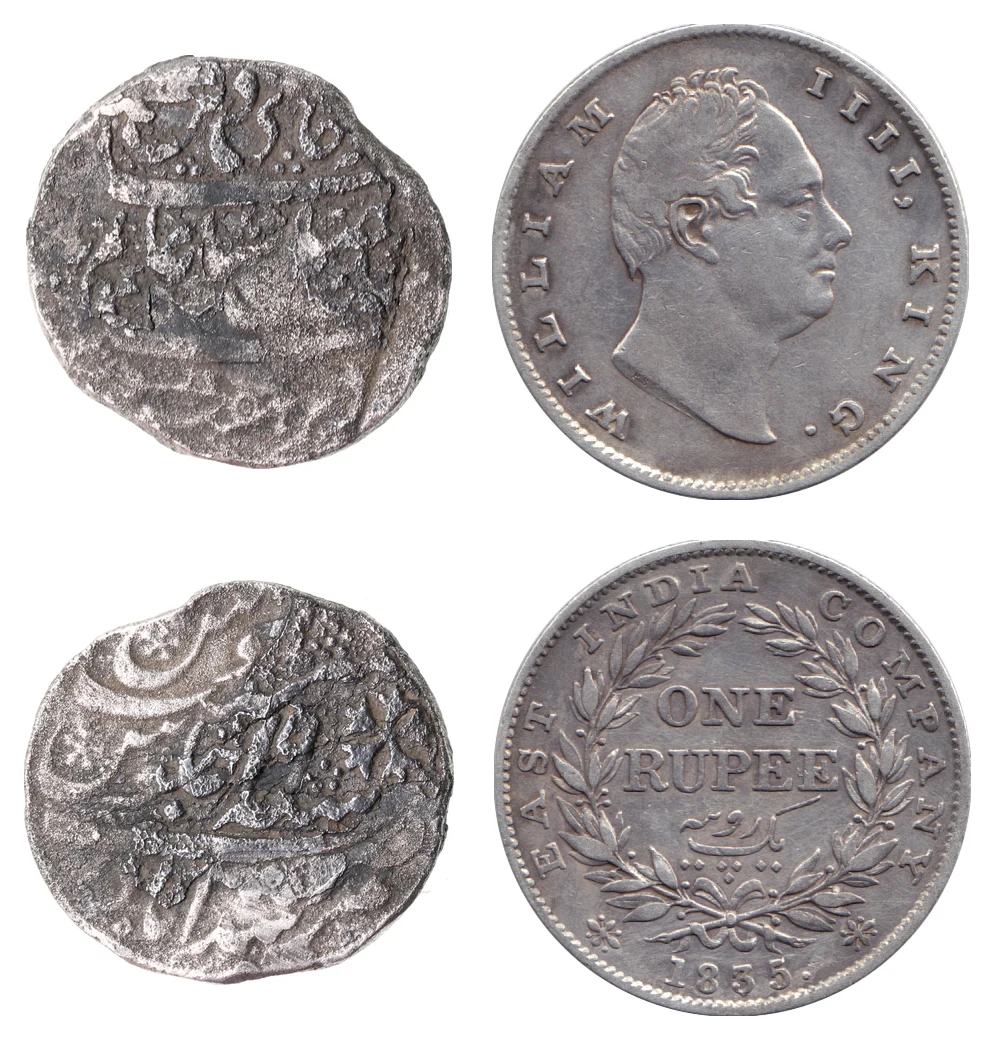
Victoria and the transfer of power
1840: Victoria. The Company issued rupees with the young Queen Victoria's portrait, dated 1840 — and, following the frozen-date logic, struck them for years afterwards with the same date. Distinguishing the actual years of issue again depends on die varieties and small marks.
1857: the uprising. Coins struck by rebel authorities in the name of Bahadur Shah II exist and are scarce and historically significant.
1858: the Crown takes over. The Government of India Act transferred the Company's territories and administration to the British Crown. The Company itself was wound up over the following years.
1862: the first Crown coinage. Rupees with Victoria as Queen, dated 1862 — and, once more, struck under a frozen date for an extended period, with the actual year indicated by small dots or marks below the date or in the design. The dot-and-mark systems of the 1862 series are a specialist study in themselves.
1877: Empress. Following the Royal Titles Act of 1876, which made Victoria Empress of India, the coinage legend changed from Victoria Queen to Victoria Empress. The change is the fastest way to date a Victoria rupee to before or after 1877, and it is the point at which British India's coinage acquires its imperial form.
Collecting Company coinage
Availability. Presidency coppers are common and cheap. Company rupees in Shah Alam II's name are plentiful. Star pagodas are available and, being small gold coins, reasonably priced. The 1835 and later portrait rupees are common in circulated grades.
Where the difficulty is: attribution of the frozen-date issues. Two rupees that look identical may be from different mints and different decades, distinguished by a dot the size of a pinhead. Doing this properly requires specialist references and good magnification.
Where the value is:
- Scarce mints and varieties within the frozen-date series
- Early Bombay issues with the Company's arms
- Star pagodas in good condition
- 1857 rebel issues
- High grade on any portrait rupee — most circulated hard
Collecting projects:
The three presidencies. One coin from each of Madras, Bombay and Bengal, before 1835. Three coins that show three incompatible currency systems inside one company.
Before and after 1835. A Shah Alam II Company rupee and an 1835 William IV rupee. The single most eloquent pair in Section C.
The Victoria transition. A Queen rupee and an Empress rupee, showing the 1877 change.
Next: Stage 33 takes the coinage from Victoria to independence — through four monarchs, a world war and the moment the silver ran out.
Stage 33British India
British India's coinage is the most systematic, best documented and most easily collected material in this book. It runs from 1862 to 1947, under four monarchs, on a single standard, from a small number of mints, with dates you can read at a glance.
It is where most Indian collectors start, and it is a good place to start. It is also the series where mint marks matter more than anything else — two coins identical in every visible respect can differ tenfold in value on the basis of a dot below the date.
The four monarchs
Victoria — Queen 1862–1876, Empress from 1877 to 1901. The legend change is the fastest dating tool in the series.
Edward VII — 1903 to 1910. A short reign and a straightforward coinage.
George V — 1911 to 1936. The longest and largest series, and the one containing the most famous error in Indian numismatics.
George VI — 1938 to 1947. The wartime coinage, the debasement, and the last British Indian issues.
Edward VIII — no British Indian coins were issued for the brief 1936 reign, since he abdicated before any coinage was struck.
The 1911 "pig rupee"
The best-known incident in British Indian coinage, and a genuine example of a design failure with political consequences.
What happened. The first coins of George V, issued in 1911, showed the King wearing the robes and collar of the Order of the Indian Empire. The collar included a small pendant elephant.
The problem. At coin scale, engraved in low relief, the elephant's trunk read as a snout. The animal looked like a pig.
Why that mattered. The pig is unclean in Islam and the depiction caused immediate and serious offence among Muslim subjects. The King-Emperor apparently wearing a pig on his chest was not a small matter.
The response. The design was withdrawn and re-engraved, with the elephant redrawn so that the trunk was unmistakable. The 1911 coins bearing the original design are the "pig rupee" — and by extension the pig half rupee, quarter rupee and two annas.
For collectors: the 1911 pig issues are keenly sought and command a substantial premium. They are also faked and misidentified, and the difference between the two designs requires magnification and a comparison image. Do not buy one on a seller's description alone.
Suggested source: own photography; auction archives.The silver crisis
The most consequential event in the series, and it is an economic story rather than a design one.
The background. The rupee had been 180 grains, eleven-twelfths fine since 1835 (Stage 32) — genuine, high-purity silver. That works only as long as the silver in the coin is worth less than the coin's face value.
The war. The Second World War drove silver prices up sharply and simultaneously created enormous demand for coinage — troops to pay, war production to fund, a wartime economy in motion. India was also a major theatre of supply.
The consequence: the silver in a rupee started to approach and exceed its face value. Gresham's law, from Stage 4's box, did the rest. Rupees vanished from circulation into hoards and melting pots.
The response, in stages:
1940 — debasement. The rupee's fineness was cut from 0.917 to 0.500 — half silver. The coin looked similar and contained half the metal.
1942 — quaternary alloy. Silver was reduced further, to an alloy of approximately 50% copper, 40% silver, 5% nickel and 5% zinc. These coins are noticeably duller and greyer than earlier issues, and the difference is visible once you know to look.
1947 — nickel. The final British Indian rupees, issued in the year of independence, contain no silver at all. A pure nickel coin, ending 407 years of silver rupees dating back to Sher Shah.
Wartime coinage
Beyond the rupee, the war reshaped the whole denomination structure.
The holed pice. From the early 1940s, the pice was issued as a bronze coin with a hole in the centre. The hole saved metal and made the coins easy to string — the same logic as Chinese cash coins two thousand years earlier (Stage 2).
Small denominations proliferated as silver and copper were diverted, and the quality of striking declined.
Princely states issued paper cash coupons, as described in Stage 30, because they could not get small coin at all.
Mints and mint marks
This is the practical heart of the stage.
British Indian coins were struck at several mints, and the mint is identified by a small mark below or beside the date. Getting this right is the difference between a common coin and a scarce one.
Denominations
The 1835 system of Stage 32 continued essentially unchanged until independence.
1 rupee = 16 annas = 64 pice = 192 pies
| Denomination | Metal | Notes |
|---|---|---|
| Rupee | Silver, then debased, then nickel | |
| Half rupee (8 annas) | Silver, then debased, then nickel | |
| Quarter rupee (4 annas) | Silver, then debased, then nickel | |
| Two annas | Silver, then cupro-nickel | |
| One anna | Cupro-nickel; distinctive scalloped shape on some issues | |
| Half anna | Cupro-nickel | |
| Quarter anna | Copper, bronze | |
| One pice | Bronze; holed in the 1940s | |
| Half pice | Bronze | |
| One twelfth anna (one pie) | Bronze |
The scalloped one anna and the holed pice are the two most visually distinctive British Indian coins, and both are cheap.
Collecting British India
This is the easiest series in the book to collect, and the best starting point for a beginner.
Why it works for beginners:
- Dates are in the Western calendar and legible
- Legends are in English
- The material is abundant and inexpensive
- Catalogue coverage (Krause) is thorough
- Grading follows the standard system of Stage 8 without complication
- Uncirculated examples genuinely exist and are affordable
Collecting projects:
A monarch set. One rupee each of Victoria Queen, Victoria Empress, Edward VII, George V and George VI. Five coins, all common, covering 85 years.
A denomination set. One of each denomination from pie to rupee. Around ten coins, mostly cheap, showing the whole anna system that decimalisation abolished.
A date run. Every date of one denomination. Large but finite, and it forces you to learn mint marks properly.
The silver decline. A pre-1940 rupee, a 1940–45 rupee, a quaternary alloy rupee and a 1947 nickel rupee. Four coins telling the economic story of the war in metal.
What to watch for:
- Mint marks, always. Check them before buying anything described as scarce.
- Cleaning. British Indian silver is heavily cleaned in the market. Stage 8 applies.
- 1911 pig issues — verified by image, not description.
- Counterfeit key dates — some scarce date-and-mint combinations are worth faking by altering a common coin's mark. Magnify the mark area.
END OF SECTION C
Next: Section D leaves metal behind entirely. Stage 34 begins with the paper instrument India was using for centuries before anyone printed a banknote.
Paper Money in India
Stage 34Before the Banknote
Part II — Section D: Paper Money in India
India had paper money before it had banknotes. Not state-issued currency, but a private system of written credit instruments that moved value across the subcontinent for centuries, backed by nothing but the reputation of the people who wrote them.
The hundi is one of the more impressive institutions in Indian economic history and one of the least collected. This stage is short because the material is scarce, and it is here because Section D makes no sense without it.
The problem it solved
A merchant in Surat owes money to a supplier in Patna. The distance is over 1,500 kilometres. Between them lie bandits, rivers, tolls, and a journey of weeks.
Moving silver is a bad idea. It is heavy, it is conspicuous, it attracts theft, it costs money to guard, and if it is lost it is gone.
The hundi is the alternative. The merchant writes a document instructing an associate — or a correspondent banker — to pay the stated sum to the supplier or to whoever presents the document. The paper travels. The silver stays where it is, and accounts are settled between the bankers periodically, by netting off what each owes the other.
This is a bill of exchange, and India ran on them.
The types
Hundis were not one instrument but a family, each doing a different job. The terminology varies by region and by community, and the following are the most commonly encountered forms:
| Type | Meaning | Function |
|---|---|---|
| Darshani | "On sight" | Payable on presentation — effectively a demand draft |
| Muddati / Miadi | "Term" | Payable after a stated period — a credit instrument |
| Namjog | "Named person" | Payable only to the person named |
| Dhanijog | "To the owner" | Payable to the bearer or holder — negotiable |
| Firmanjog | "To order" | Payable to order, transferable by endorsement |
| Shahjog | "To a respectable person" | Payable to a person of standing, who could vouch for their identity |
| Jokhmi | "Risk" | Payable only if the goods it covers arrive safely — combining credit and insurance in one document |
*The jokhmi deserves particular note.* It makes payment contingent on safe arrival of a cargo, which means the writer is simultaneously extending credit and bearing marine or transit risk. That is a marine insurance contract embedded in a bill of exchange, developed independently of the European tradition.
Who ran the system
The hundi networks were operated by specific merchant-banking communities, each with its own geographic reach and its own internal codes of practice:
- Marwari bankers, from Rajasthan, with a network reaching across northern and eastern India
- Gujarati merchant houses, dominant on the western coast and in the Indian Ocean trade
- Chettiar bankers of Tamil Nadu, whose network extended to Burma, Ceylon and Southeast Asia
- Multani and Shikarpuri bankers, operating into Central Asia and Persia
The individual banker or money-changer was the shroff (sarraf) — the same figure whose test punches appear on the reverse of the punch-marked coins of Stage 16, two thousand years earlier.
The physical object
What a hundi looks like:
- Written on paper, frequently stamped paper bearing a government revenue stamp — the stamp duty being one of the ways the colonial state did interact with the system
- Small — often the size of a hand or smaller
- Written in Gujarati, Marwari, Devanagari, Modi or another regional script and language
- Highly formulaic — the wording follows set patterns, which is what made them recognisable and enforceable
- Frequently carrying endorsements on the reverse, added as the instrument passed from hand to hand — the direct equivalent of the shroff marks on a punch-marked coin
- Sometimes bearing seals, thumb impressions or distinguishing marks
Suggested source: RBI Monetary Museum; private collections; state archives.The legal afterlife
Hundis were not abolished by the arrival of banknotes. They were absorbed into the legal system.
The Negotiable Instruments Act, 1881 — still the governing statute for cheques and bills in India — expressly preserved the operation of local usage relating to instruments in oriental languages. In effect, the Act recognised that hundis existed, worked, and had their own customary rules, and declined to override them.
Hundis continued to be used in Indian commerce well into the twentieth century, and hundi-like informal transfer systems persist in various forms.
Collecting hundis
They are scarce. Hundis were working documents. Once settled, they had no value and were discarded, filed or destroyed. Survival is accidental.
They are cheap when they appear. Because there is almost no collector market, surviving examples sell for very little relative to their historical interest.
They are hard to read. Regional scripts, archaic commercial formulae, abbreviations, and often poor condition.
Where they turn up: family papers, old business records, dealers in ephemera and documents rather than coin dealers, and occasionally in paper money auctions grouped with early banknotes.
What to look for: an intact revenue stamp, legible text, and — most valuable of all — endorsements on the reverse, which show the instrument actually circulated rather than being drawn and settled directly.
Preservation. These are paper documents, often two centuries old, frequently on poor stock. Stage 13's environmental advice applies with full force, and the foxing warning in particular. Store flat, in inert sleeves, in stable low humidity. Do not attempt to flatten, clean or repair.
Next: Stage 35 turns to the first printed banknotes in India — issued by a private bank in Calcutta in 1770, ninety years before the government claimed a monopoly.
Stage 35The Private Bank Era
For ninety years, anybody in India with a bank and enough capital could print money.
Between the first Indian banknotes around 1770 and the government monopoly of 1861, note issue was a private commercial activity. Banks issued their own notes, payable at their own counters, backed by their own reserves — and when a bank failed, its notes became waste paper.
This stage covers that era and the state's decision to end it.
The Bank of Hindostan
The first Indian banknotes are generally attributed to the Bank of Hindostan, established in Calcutta around 1770 as part of the agency house Alexander & Co.
Agency houses were the characteristic commercial institutions of Company-era Calcutta — trading firms that also handled banking, insurance, shipping and agency business for European residents. Note issue was a natural extension: a firm with a reputation and a strongroom could issue paper against deposits.
The Bank of Hindostan lasted until 1832, when Alexander & Co. failed in one of the commercial crises that periodically destroyed Calcutta's agency houses.
Other early issuers:
- The General Bank of Bengal and Bihar (c. 1773–1775) — short-lived, with some government involvement
- The Bengal Bank (c. 1784–1791)
- Various agency house banks through the late eighteenth and early nineteenth centuries
These notes are extremely rare. Survival rates are minimal. Most are known from a handful of examples, largely in institutional collections, and they appear on the market only occasionally.
The Presidency Banks
The three Presidency Banks were the major note issuers of the period and the direct institutional ancestors of India's banking system.
| Bank | Established | Presidency |
|---|---|---|
| Bank of Bengal | 1806 (as Bank of Calcutta; renamed 1809) | Bengal |
| Bank of Bombay | 1840 | Bombay |
| Bank of Madras | 1843 | Madras |
They were semi-official — privately owned but with government participation, government deposits and charters granting privileges including the right of note issue.
Their notes circulated within their presidencies and were the most trusted paper money in India before 1861.
Their later history: the three were amalgamated in 1921 into the Imperial Bank of India, which in 1955 became the State Bank of India. The lineage runs unbroken from a Calcutta bank of 1806 to India's largest bank today.
What the early notes look like
They are not much like a modern banknote.
Uniface. Printed on one side only. The reverse is blank.
Hand-signed. An actual signature in ink, by an actual bank officer, on each note.
Hand-numbered. Serial numbers written by hand.
Hand-dated in many cases.
Text-heavy. The promise to pay, the bank's name, the denomination and the place of payment, set in type, with limited decoration.
Security by engraving. The only real defence was the difficulty of reproducing fine engraved work — the situation described in Stage 6's account of the arms race, at its earliest stage.
Large. Early notes are physically big by modern standards.
The effect is closer to a legal document than to currency, which is exactly what they were: individual promissory instruments, issued one at a time, signed by a person.
The Paper Currency Act, 1861
The end of private issue.
The Act gave the Government of India the sole right to issue paper currency across British India. Private and Presidency Bank issues were wound down.
Why the state took the monopoly:
Bank failures destroyed notes. When an issuing bank collapsed — and several did — its notes became worthless in the hands of whoever was holding them. The losses fell on ordinary users.
Seigniorage. The profit from issuing paper against reserves is substantial, and the state wanted it.
Uniformity. Multiple issuers meant multiple currencies of varying trustworthiness, discounted against each other.
Control. The 1857 uprising had ended Company rule and produced a Crown administration considerably more interested in direct control of the machinery of state.
The precedent was the Bank of England's move towards monopoly in England, and the general nineteenth-century direction of travel towards central note issue.
The Victoria Portrait series
The first government notes under the 1861 Act.
Issued from 1861, these are uniface notes carrying a portrait of Queen Victoria, in denominations of 10, 20, 50, 100 and 1,000 rupees.
They had a security problem. Being uniface and relatively simple, they proved vulnerable to forgery, and the series was replaced.
They are extremely rare today. Very few survive.
The Underprint series
Introduced from around 1867, replacing the Victoria Portrait notes.
The innovation is in the name. An underprint — a coloured background pattern printed beneath the main design — makes reproduction far harder, because the forger must match both layers in exact register. This is the Stage 6 offset background layer, at its introduction into Indian currency.
The Underprint series ran, with modifications, for decades and is the foundation of Indian government note design.
Circles of issue
The single most distinctive feature of Indian paper money in this period, and one that surprises people.
An Indian banknote was not payable everywhere in India.
The country was divided into circles of issue, and a note was legally payable only at the currency office of the circle where it was issued. A note issued in Calcutta was not payable in Bombay.
The circles included:
- Calcutta
- Bombay
- Madras
- Karachi
- Cawnpore (Kanpur)
- Lahore
- Rangoon (Burma being part of British India until 1937)
- and others added over time
The circle is identified on the note by the place name and by identifying letters.
Collecting this era
Difficulty: high. Cost: high. Availability: low.
This is the hardest part of Indian notaphily. Realistic expectations:
Bank of Hindostan and other private bank notes — essentially museum material. If you see one offered, treat it with extreme caution; the rarity makes forgery worthwhile.
Presidency Bank notes — very rare, occasionally at major auction.
Victoria Portrait notes — very rare.
Underprint series notes — rare but obtainable, particularly in lower denominations and common circles. Prices are substantial and condition is generally poor: these notes circulated hard, in a hot humid climate, and were stapled and folded (Stage 9).
What to look for:
- The circle, always, and first
- Signature and date
- Completeness — many survivors are damaged, repaired or have pieces missing
- Provenance, which for material this rare is a meaningful protection
Grading expectations. Do not expect Uncirculated. A complete, legible, intact note of this era in Fine or Very Fine is a good example. Stage 9's grade table applies, but the whole distribution shifts downward.
Fakes and reproductions. Modern reproductions of early Indian notes exist, some sold openly as replicas and some not. For material at these prices, buy from a specialist dealer or a major auction house, with a guarantee, or buy graded.
Next: Stage 36 covers the Government of India notes of the George V era — including the emergency issue that put paper into ordinary hands for the first time.
Stage 36Government of India Notes
Between the Underprint series of Stage 35 and the founding of the Reserve Bank in 1935, Indian paper money was issued directly by the Government of India, signed by the Controller of Currency, and carried the portrait of George V.
The period's defining moment came in 1917, when a war on the other side of the world put a one rupee note into Indian pockets for the first time.
The George V series
From around 1917–1923, Government of India notes carried a portrait of King George V, replacing the earlier Underprint designs.
The denominations ran from the very small to the very large:
| Denomination | Notes |
|---|---|
| 1 rupee | Introduced 1917 as an emergency measure |
| 2 rupees 8 annas | Introduced 1918; an unusual denomination |
| 5 rupees | |
| 10 rupees | |
| 50 rupees | |
| 100 rupees | |
| 500 rupees | |
| 1,000 rupees | |
| 10,000 rupees | The highest denomination ever issued in India |
The 10,000 rupee note is worth pausing on. In an economy where an agricultural labourer's annual income was a small number of rupees, a ten thousand rupee note was not currency in any ordinary sense — it was an instrument for inter-bank and large commercial settlement.
The 1917 one rupee note
The most historically significant Indian note of the period, and the reason is economic rather than aesthetic.
The problem. The First World War drove up the price of silver. India's currency was silver-based: the rupee was a silver coin of 180 grains, eleven-twelfths fine (Stage 32). As silver rose, the metal in a rupee approached and threatened to exceed its face value.
The consequence. Gresham's law again — rupees began disappearing from circulation into hoards and melting pots. India faced a shortage of its basic unit of currency.
The response. In 1917 the Government of India issued a one rupee note, and in 1918 a two rupees eight annas note — paper substitutes for silver coin.
Design and security
The George V notes continue the underprint principle of Stage 35, with:
- The King's portrait
- Multi-colour underprint patterns
- Guilloche and lathe work
- The promissory clause and the government guarantee
- Circles of issue on the higher denominations, progressively relaxed for the smaller ones
- Language panels giving the denomination in multiple Indian languages — the ancestor of the modern panel described in Stage 5
Watermarked paper was in use, and printing was by intaglio and letterpress in the manner of Stage 6.
Signatures: the Controllers of Currency
The signature on these notes is that of the Controller of Currency, a Government of India official, not a bank governor.
The signature is the primary variety marker for the series, exactly as the Governor's signature is for later RBI notes (Stage 39). Different Controllers signed different periods, and a note's signature dates it more precisely than anything else on it.
A caution for this book and for any collector: the full list of Controllers with their exact signing periods, and which denominations each signed, needs to be taken from a specialist reference rather than from memory. Jhunjhunwalla–Razack is the standard source for Indian paper money and is where the signature charts in Stage 45 will be sourced from.
Wartime and inter-war issues
The First World War produced the emergency denominations above.
The inter-war period saw the series continue with modifications, changing signatures, and the gradual universalisation of the smaller denominations across circles.
The 1920s and early 1930s brought severe economic strain — the collapse of agricultural prices, the global depression, and pressure on the rupee's exchange value against sterling. These are the conditions in which the case for a proper central bank was made, and the Reserve Bank of India Act followed in 1934.
Collecting the George V series
Availability. Better than Stage 35's material, but still a scarce and expensive field. These notes are a century old and circulated in a hot, humid, stapling climate.
Where to start:
The one rupee note. The most obtainable and the most historically interesting. It exists in several varieties and signature types, and it is the natural entry point to pre-independence Indian paper money.
Five and ten rupees. Available with patience.
Higher denominations. Scarce to rare, and expensive. The 10,000 rupee note is a major rarity.
What to check, in order:
- Circle of issue — still the primary variety on the higher denominations
- Signature — the dating tool
- Condition, with Stage 9's expectations adjusted downward for the period
- Pinholes, which on a note of this age are close to universal — a genuinely pinhole-free example commands a very large premium
Condition realities. Expect folds, soiling, staple holes, and often small edge tears or repairs. A complete, uncleaned, unrepaired note in Very Fine is a good example of this series. Uncirculated examples exist but are rare and priced accordingly.
Fakes and alterations. For material at these prices, the alteration risk described in Stage 11 applies — a common circle altered to a rare one, a signature tampered with, pinholes filled. Buy from specialists, and consider third-party grading for anything expensive, since the EPQ designation (Stage 9) directly addresses the pressing and repair problems that dominate this market.
Next: Stage 37 covers the founding of the Reserve Bank, its first notes, the overprints that turned Indian currency into the money of four other places, and the first Indian demonetisation.
Stage 37The Reserve Bank of India
The Reserve Bank of India began operations on 1 April 1935, and its first notes appeared in 1938. Within a decade it had issued currency for Burma, acted as central bank for Pakistan, printed money for the Persian Gulf, produced special notes for pilgrims to Mecca, and demonetised India's highest denominations.
For a series that lasted barely twelve years before independence, the George VI RBI issues carry an extraordinary amount of history.
Founding
The Reserve Bank of India Act, 1934, established the central bank, and the Bank commenced operations on 1 April 1935.
Its functions were the standard central banking ones: note issue, banker to the government, banker to the banks, and management of currency and credit.
Note issue transferred from the Government of India to the RBI — with the one exception described in Stage 36. The one rupee note remained a Government of India issue, signed by the Finance Secretary, and it still is.
The first Governors:
- Sir Osborne Smith (1935–1937) — the first Governor. No notes bear his signature, as RBI notes had not been issued during his tenure. This is a well-known point of trivia and a genuine collecting fact: there is no Osborne Smith note to find.
- Sir James Braid Taylor (1937–1943) — signed the first RBI notes.
- Sir C.D. Deshmukh (1943–1949) — the first Indian Governor, and the Governor across independence.
The first RBI notes
The five rupee note, issued in January 1938, was the first Reserve Bank of India note.
The 1938 series followed with 10, 100, 1,000 and 10,000 rupee denominations.
The design:
- Portrait of King George VI, facing, on the front
- Reserve Bank of India as issuer, with the promissory clause
- The Governor's signature
- Multi-language panel giving the denomination in Indian languages
- Reverse designs varying by denomination — tiger, elephant, and other subjects
- Watermark of the King's portrait
A security development. A security thread was introduced into Indian notes around 1940 — the same period in which the Bank of England adopted the metal thread, and for the same reason: wartime counterfeiting had become a serious threat. Stage 6 describes the technique.
Suggested source: RBI Monetary Museum.The overprints: Indian money in four other places
This is the most distinctive material in the stage, and it exists because the rupee's reach exceeded India's borders.
Burma
Burma was administered as part of British India until 1937, when it was separated into a distinct colony.
RBI notes were overprinted for Burma with legends restricting them to Burmese circulation — variations on wording making them legal tender in Burma only. A separate Burma Currency Board took over after the war.
Burma overprints are a well-defined and collectable category.
Pakistan
At Partition in August 1947, Pakistan had no central bank and no currency of its own.
The Reserve Bank of India acted as Pakistan's central bank during a transitional period, and Indian notes were overprinted "Government of Pakistan" for circulation there. The arrangement ran until the State Bank of Pakistan was established in 1948.
These notes are historically remarkable. They carry the Reserve Bank of India's name, a British king's portrait, and a Government of Pakistan overprint — three sovereignties in one object, produced in the months after partition.
They are collected in both India and Pakistan and are keenly sought.
The Gulf rupee
From 1959, the RBI issued special notes for circulation in the Persian Gulf states, which used the Indian rupee as their currency.
Why: gold smuggling. Gulf residents could buy gold cheaply and move it into India, where import was restricted and prices were higher, paying in Indian rupees. Issuing a physically distinct currency for the Gulf — different colour, distinct "Z" prefix — let the authorities separate Gulf circulation from domestic circulation and control the flow.
Gulf rupees were used in Kuwait, Bahrain, Qatar, Oman and the Trucial States until those countries introduced their own currencies through the 1960s.
They are a distinctive and popular collecting area.
Haj notes
Special notes were issued for Indian pilgrims travelling to Mecca, distinguished by an "HA" prefix and by colour, so that currency taken abroad by pilgrims could be identified and accounted for separately from domestic circulation.
Like the Gulf rupees, these are an exchange-control instrument in the form of a banknote, and they are collected as a category.
The 1946 demonetisation
India's first demonetisation, and the one most people have never heard of.
On 12 January 1946, notes of 500, 1,000 and 10,000 rupees were demonetised.
The stated purpose was to counter black marketeering, tax evasion and the accumulation of undeclared wealth during the war years, when controls, shortages and war contracting had generated large amounts of untaxed money held in high-denomination notes.
The effect was limited. High-denomination notes formed a small fraction of currency in circulation, and the amounts recovered were modest relative to expectations — a pattern that recurs.
High denominations were reintroduced in 1954 and demonetised again in 1978 (Stage 38).
For collectors: pre-1946 high denomination notes are scarce, because they were called in and destroyed. Surviving examples are valuable, and the 10,000 rupee note is a major rarity.
Partition and the division of currency
Independence and partition in August 1947 required the currency of one country to be divided between two.
The mechanics were complex: reserves had to be apportioned, the RBI continued to act for Pakistan temporarily, Pakistan overprints were issued, and eventually the two currencies separated fully with the establishment of the State Bank of Pakistan in 1948.
Princely state currencies — Hyderabad's Osmania Sicca notes of Stage 30 above all — were wound up as the states integrated.
The George VI notes continued in India after independence for a period, since replacing an entire currency takes time. The first distinctively Indian republican note appears in 1949, and that is Stage 38.
Collecting the RBI George VI series
Availability. Considerably better than Stages 35 and 36. This material is eighty to ninety years old rather than a century and a half, and it survives in reasonable numbers.
Where to start: the five and ten rupee George VI notes are the accessible entry point. Higher denominations are scarcer and more expensive.
The special categories — Burma overprints, Pakistan overprints, Gulf rupees, Haj notes — are each collectable in their own right and each command premiums. Pakistan overprints and Haj notes are the scarcest of the four; Gulf rupees are the most obtainable.
What to check:
- Signature — Taylor or Deshmukh, and this dates the note
- Overprint, if any, and its exact wording
- Prefix — particularly for Gulf ("Z") and Haj ("HA") notes
- Condition, with Stage 9's staple-hole caveat in full force
- Authenticity of the overprint — see below
Next: Stage 38 crosses into the Republic — the Ashoka Pillar series, the Gandhi series, and two demonetisations that between them are the most discussed monetary events in modern Indian history.
Stage 38Republic Paper Money
Independent India inherited a currency with a British king's portrait on it. Replacing that portrait was the first design decision of the new state's monetary life, and what it chose to put there instead is worth thinking about.
Not a person. Not Gandhi, not Nehru, not any individual. The Lion Capital of Ashoka — a sculpture from the third century BCE, made for an emperor who renounced war.
Gandhi did not appear on Indian currency as a standard portrait until decades later.
The Ashoka Pillar series
The first note of the Republic was the one rupee note issued in 1949, replacing the George VI portrait with the Lion Capital of Ashoka from Sarnath.
The full series followed across denominations through the early 1950s.
The design language:
- The Lion Capital in the position where the King's portrait had been
- Reserve Bank of India in Hindi and English
- The language panel, giving the denomination in Indian languages
- Reverse vignettes showing Indian subjects — the Konark wheel, agricultural and industrial scenes, dams, tea picking, and later the achievements of a developing economy
- Hindi given prominence alongside English
The 1954 high denominations
In 1954, the 1,000, 5,000 and 10,000 rupee notes were reintroduced, having been demonetised in 1946 (Stage 37).
They were intended for large commercial and inter-bank settlement rather than general circulation.
The 1978 demonetisation
On 16 January 1978, the 1,000, 5,000 and 10,000 rupee notes were demonetised under the High Denomination Bank Notes (Demonetisation) Act.
The stated purpose was, as in 1946, to strike at undisclosed wealth held in high-denomination notes.
The effect was again limited, for the same structural reason: high-denomination notes were a small share of currency in circulation, and people holding large amounts of undeclared wealth did not typically hold it in the form the government could most easily cancel.
For collectors: notes of these denominations are scarce and valuable, having been called in and destroyed. The 5,000 and 10,000 rupee notes are major rarities.
Gandhi arrives
The Mahatma's appearance on Indian currency happened in stages, and the sequence is often misremembered.
1969 — the centenary note. A commemorative 100 rupee note was issued for the centenary of Gandhi's birth, showing him seated, before the Sevagram Ashram. This is the first Gandhi note, and it is a commemorative rather than a standard series issue.
1987 — the 500 rupee note. A new 500 rupee denomination was introduced carrying a Gandhi portrait, the first standard circulating note to do so.
1996 — the Mahatma Gandhi Series. The full replacement series.
The Mahatma Gandhi Series, 1996
Introduced from 1996, replacing the Ashoka Pillar series across denominations.
Denominations: 5, 10, 20, 50, 100, 500 and 1,000 rupees (the 1,000 reintroduced in 2000).
The design:
- Portrait of Mahatma Gandhi on the front — replacing the Ashoka Capital as the principal device
- Ashoka Pillar emblem retained, moved to a subordinate position
- Language panel with fifteen languages in addition to Hindi and English
- Reverse vignettes on national and developmental themes
- Substantially upgraded security features, described below
Why the change. The Ashoka Pillar notes had been in service for four decades and their security features had been overtaken by the reprographic technology of Stage 6's arms race — accessible colour copying and scanning. The 1996 series was, more than anything else, a security refresh.
Security features of the 1996 series — the Stage 5 vocabulary applied:
- Gandhi portrait watermark with electrotype denomination numeral
- Windowed security thread with inscriptions
- Latent image of the denomination in the vertical band
- Microlettering
- Intaglio printing with tactile marks for the visually impaired, in different shapes by denomination
- Fluorescence features under UV
- See-through register
- Optically variable ink on higher denominations, added in later years
The 2016 demonetisation and the New Series
On 8 November 2016, the government announced that the existing 500 and 1,000 rupee notes would cease to be legal tender.
The scale was entirely different from 1946 and 1978. These were not rarely used high denominations for inter-bank settlement — the 500 and 1,000 rupee notes together constituted the great majority of the value of currency in circulation, and India was a heavily cash-based economy. The measure affected essentially the whole population.
The stated objectives included countering undeclared wealth, counterfeit currency and the financing of illegal activity.
The consequences — economic, social and political — have been extensively debated, and the debate is not settled. This book does not take a position on whether the policy achieved its aims. That is a live political and economic argument, and readers will find serious analysis on multiple sides of it. What follows is the numismatic content of the event.
What happened to the currency:
- The 500 and 1,000 rupee notes of the Mahatma Gandhi Series were withdrawn from legal tender status
- A new 2,000 rupee note was introduced immediately
- A new 500 rupee note followed
- Further denominations of the new series were issued over subsequent months and years: 200, 100, 50, 20 and 10 rupees
- The 1,000 rupee note was not reissued
- The 2,000 rupee note was subsequently withdrawn from circulation in a later exercise, which was managed as a withdrawal rather than a demonetisation — the notes remained legal tender through the exchange period
Because these events are recent and the position on the 2,000 rupee note in particular has continued to develop, readers should check the RBI's own published position for the current status of any denomination.
The Mahatma Gandhi New Series
The design is a substantial redesign rather than a variation:
- Gandhi portrait retained but redrawn
- New colour schemes by denomination, more strongly differentiated than before
- Smaller physical sizes than the equivalent old-series notes
- Reverse vignettes on themes of Indian heritage and achievement — the Mangalyaan Mars orbiter, the Red Fort, Sanchi, Hampi, Ellora, Konark, the Swachh Bharat logo, and others
- Enhanced security features, including colour-shifting ink on higher denominations and revised tactile marks
Collecting Republic paper money
This is where most Indian note collectors actually collect, and for good reasons: the material is available, affordable, well documented and connected to living memory.
Ashoka Pillar series notes are obtainable across denominations, with early issues and scarce signatures commanding premiums. Uncirculated examples exist.
Demonetised high denominations (1954–1978) are scarce and expensive.
The 1969 Gandhi centenary note is a popular and obtainable commemorative.
Mahatma Gandhi Series notes are common. Value lies in the varieties of Stage 39 rather than in the notes themselves.
Mahatma Gandhi New Series notes are current. The 500 and 1,000 rupee notes demonetised in 2016 are collectable but no longer legal tender, and the legal position on holding them is covered in Stage 44.
A collecting project: one note of each series — Ashoka Pillar, 1969 centenary, 1987 500 rupee, 1996 Gandhi, 2016 New Series. Five notes covering the whole of independent India's currency design, four of them cheap.
Next: Stage 39 is where Indian note collecting actually happens — signatures, inset letters, prefixes and star notes. This is the stage that turns a common note into a collectable one.
Stage 39Varieties, Signatures and Star Notes
Two hundred rupee notes of the same denomination and the same series, both worn, both apparently identical, can differ in value by a factor of fifty.
The difference is in the number panel, the signature and a small letter most people never notice. This is where Indian note collecting actually happens. Stage 38 gave you the series; this stage gives you the varieties within them, which is what collectors chase, catalogue and pay for.
The four variety systems
Every modern Indian note carries four independent identifiers, and any of them can make a note scarce:
| Identifier | Where | What it tells you |
|---|---|---|
| Signature | Below the promissory clause | Which Governor, and therefore roughly when |
| Inset letter | In the number panel | Which printing batch and press |
| Prefix | Before the serial number | Series and batch within the issue |
| Star (★) | In the number panel | Replacement note |
Learn to read all four and you can look at any Indian note and place it. Miss them and you are looking at a piece of paper.
Signatures
The signature is the primary variety marker on Indian notes, and the first thing an experienced collector checks.
The rule:
- All denominations except one rupee are issued by the Reserve Bank and carry the Governor's signature
- The one rupee note is issued by the Government of India and carries the Finance Secretary's signature — the hundred-year-old quirk explained in Stage 36
Why signatures matter so much:
A Governor serves for a defined period. A note bearing that signature was printed during it. That dates the note more precisely than anything else on it, since Indian notes do not generally carry a printing date on the face.
Scarcity follows tenure length and print volume. A Governor who served eighteen months during a period of low note production signed comparatively few notes. A Governor who served five years during an expansion signed vast numbers. The short-tenure signatures are the scarce ones, and some are genuinely rare on particular denominations.
The combination is what counts. A common signature on a common denomination is worth face value. The same signature on a denomination that was barely issued during that tenure can be scarce. The variety is signature × denomination × series, not signature alone.
Inset letters
The inset letter is a single character — a letter, or sometimes a symbol or blank — placed within the number panel, usually between the prefix and the serial number or adjacent to it.
What it identifies: the printing batch, and in practice the press and production run.
Why it matters: the same note, same signature, same denomination, with a different inset letter is a different collectable variety. Some inset letters were used for very short runs and are correspondingly scarce.
A blank inset — no letter at all — is itself a variety and is often scarcer than the lettered ones.
This is the variety most commonly missed by casual sellers. A listing that gives the denomination, the year and the signature but says nothing about the inset is a listing where a scarce variety may be sitting unrecognised.
Prefixes and numbering
The prefix is the letter-and-digit combination preceding the serial number.
Indian numbering systems have changed over time, and the format of the prefix identifies the era and series.
Why prefixes matter:
- Some prefixes were used for very small print runs
- The first prefix of a new series or a new signature is collected
- Low serial numbers within a prefix — 000001 upwards — carry premiums
- Prefix changes mark production transitions
The point from Stage 6 bears repeating: serial numbers are unique within a prefix, not globally. The same six digits exist many times over across different prefixes. When quoting or seeking a specific number, always specify both.
Star notes
The most collected category in modern Indian notaphily, and the mechanics are worth understanding properly.
How they arise. Stage 6 explained the production sequence. Notes are numbered in continuous sequence during printing. Inspection finds defective notes. A defective note cannot simply be discarded, because that would leave a gap in the numbering sequence and break the accounting.
The solution: print a replacement note carrying a distinguishing mark and substitute it for the rejected one.
In India the mark is a star (★) in the number panel, between the prefix and the serial number.
Star notes were introduced in India in the mid-2000s and are now a standard part of production.
Why they are collected:
- They are produced in far smaller numbers than regular notes
- They exist in the same signature, denomination and inset varieties as regular notes, multiplying the number of collectable combinations
- They have an appealing origin story: a star note exists because another note was destroyed
- Certain star prefixes and combinations are genuinely scarce
What to check on a star note:
- That the star is printed, not added
- The prefix and serial, since some star prefixes are much scarcer than others
- Signature and inset, as with any note
- Condition — star notes are worth substantially more in Uncirculated, and most collectors want them that way
Fancy numbers
A collecting field of its own, driven by the pattern of the digits rather than by scarcity of issue.
| Type | Example pattern | Description |
|---|---|---|
| Solid | 111111 | All digits the same |
| Low serial | 000001, 000007 | Leading zeros |
| Ladder | 123456 | Ascending or descending sequence |
| Radar | 123321 | Reads the same forwards and backwards |
| Repeater | 123123 | A block repeated |
| Binary | 101010 | Only two digits used |
| Bookend | 100001 | Matching ends |
A caution. Fancy number values are set entirely by collector demand, not by production scarcity — every number is printed exactly once per prefix, so a solid 111111 is no rarer than any other single number. Prices are therefore volatile and driven by fashion.
Buy them because you like them. Do not buy them as an investment.
Other variety categories
Specimen notes — marked SPECIMEN, issued to banks and institutions as reference material, not legal tender. Scarce and collected.
Cancelled notes — punched or marked as void.
Uncut sheets — issued by the RBI on occasion as collector items.
Printing press varieties — Nashik, Dewas, Mysuru and Salboni (Stage 6). Press identification is possible on many notes from marks in or near the number panel, and press varieties are collected.
Error notes — Stage 40.
How to actually collect this
Pick one denomination and go deep. The 10 rupee note across every signature, inset and star variety is a large, well-defined, achievable project that will teach you the whole system.
Or pick one system and go broad. Every Governor's signature on any denomination — a signature set — is the most popular Indian note collection and produces a chronological run of modern Indian monetary history.
Or collect star notes. Self-limiting, clearly defined, actively traded.
What you need:
- Jhunjhunwalla–Razack — the standard reference, and effectively required for this material
- A magnifier
- Inert sleeves and the storage discipline of Stage 13
- A record system — with four variety axes, an uncatalogued collection becomes unmanageable fast
What to avoid:
- Buying "rare" varieties on a seller's word without checking the reference
- Paying UNC prices for pressed notes — Stage 9's paper-wave test
- Assuming a star or a low number makes a note valuable on its own; it is always the combination
Next: Stage 40 covers the notes that should never have left the press — and how to tell a genuine error from a manufactured one.
Stage 40Error Notes
Stage 6 described a production line with inspection at the end and shredders for the rejects. Error notes are the ones that got past.
They are popular, affordable at the lower end, and more comprehensively faked than almost anything else in Indian collecting. This stage covers what genuine errors look like, how they happen, and how to tell them from the manufactured kind.
Why errors happen
Modern currency printing runs at enormous volume. Sheets carrying dozens of notes pass through three separate printing processes, numbering, examination and cutting. Every stage can go wrong.
Errors are increasing in India, not decreasing. Higher print volumes and faster machinery produce more opportunities for something to go wrong, and more notes reach the public before anyone notices.
The categories map directly onto the production stages of Stage 6. Knowing the sequence tells you which errors are possible and which are not — which is the foundation of detecting fakes.
Printing errors
Things that went wrong at the press.
Missing print. An entire printing layer absent — a note with no intaglio, or no offset background, or a blank reverse. Occurs when a sheet misses a pass or the ink supply fails.
Partial or incomplete print. A layer only partly applied, leaving a section of the note blank or faint.
Ink smear. Ink dragged across the note during printing.
Offset transfer (set-off). The image of one note's wet ink transferred onto the back of another sheet stacked against it, appearing as a faint mirror image. The mirroring is the diagnostic: it is a contact transfer, not a print.
Inverted back. The reverse printed upside down relative to the front. Occurs when a sheet is fed the wrong way round between passes. A well-known and desirable error.
Misaligned print. One layer shifted relative to the others, so the design elements do not line up. Distinct from a cutting error — here the printing is off, and the note's edges are correct.
Cutting errors
Things that went wrong when the sheet was guillotined into individual notes.
Miscut. The cut fell in the wrong place, so the note carries part of the adjacent note, or is missing part of its own design at one edge. Value rises with the severity, provided serial numbers remain visible.
Butterfly fold. A fold in the sheet before printing, which opens out after cutting to leave an unprinted wedge and a distorted design. The unprinted area was folded under and therefore never received ink.
Gutter fold. A crease present during printing, producing a blank line through the design where the ink could not reach. When opened flat, the note is wider than normal at that point.
Extra flap. A piece of the adjacent note still attached.
These are the most visually dramatic errors and the most sought after.
Numbering errors
Things that went wrong at the letterpress numbering stage — which, remember from Stage 6, is a separate operation from the main printing.
Mismatched serial numbers. The two serial numbers on the note differ. The classic error, and the one most frequently faked.
Missing serial number. One or both numbers absent.
Double numbering. A number printed twice, overlapping.
Inverted serial. A number printed upside down.
Wrong font or size. Numbering applied with incorrect characters.
Star errors. A star applied where it should not be, or a genuine star note with an additional error.
Obstruction errors
The most distinctive category, and the easiest to authenticate.
Something got between the printing plate and the paper. A piece of thread, a scrap of paper, a hair, a fragment of tape.
The result: an area of the note where the design is absent in the exact shape of the obstruction, with the surrounding print completely normal and the edges of the blank area sharp.
Why they are the easiest to verify: the blank area must correspond to a physical object with a plausible shape, the surrounding printing must be undisturbed, and the paper must be intact and unmarked. A solvent-removed area, by contrast, disturbs the paper surface and leaves a diffuse edge.
Occasionally the obstructing object is still attached to the note, which is the best possible evidence.
How Indian error fakes are made
Knowing the method is the defence.
Solvent removal. Chemicals dissolve ink to create a "missing print" area. Detectable by the diffuse edge, the disturbed paper surface, and often a faint residual tint or a smell.
Serial number alteration. A digit is chemically removed and reprinted, or altered mechanically, to create a mismatch. Detectable by ink mismatch, alignment, and disturbance around the altered character under magnification.
Splitting and rejoining. A note is split through its thickness — banknote paper can be delaminated — and rejoined the wrong way round to fake an inverted back. Detectable by thickness, by a visible join at the edges, and by holding to light, where the join and any adhesive show clearly.
Trimming. Edges cut to fake a miscut. Detectable by comparing the note's dimensions against a normal example, and by examining the cut edge — a factory guillotine cut and a hand cut do not look the same under magnification.
Deliberate folding before circulation. Attempting to simulate a gutter fold. The give-away is that a genuine gutter fold produces an unprinted line — the ink never reached the paper — whereas a note folded after printing has ink on both sides of the crease.
Applied stars and marks. As Stage 39.
Valuing an error note
Four factors, in order:
1. Dramatic visibility. A note with a huge miscut or a full missing print is worth far more than one with a subtle misalignment. The market pays for what can be seen across a room.
2. Denomination. Errors on higher denominations command more.
3. Condition. An Uncirculated error is worth substantially more than a circulated one. Many errors are found in circulation and are therefore worn, which caps their value.
4. Serial visibility. An error that removes or obscures the serial numbers is worth less, because the note cannot be fully identified and because authentication is harder.
Realistic expectations. Minor errors are worth modest multiples of face value. Dramatic errors on high denominations in Uncirculated condition can be worth a great deal. The gap between those two is very wide, and sellers routinely price minor errors as though they were major ones.
The Indian error market
It is active, and it is problematic.
Genuine errors circulate. India's cash volumes are enormous, and errors do reach the public regularly. Finding one in change is entirely possible and is how most collectors get their first.
Fabricated errors are sold in volume. Online marketplaces and social media groups carry large quantities of "error notes" that are manufactured, and they are sold to people who do not know the tests in Box 40.1.
Prices are quoted optimistically. Asking prices in the Indian error market frequently bear little relation to realised prices. Check what errors actually sell for, not what they are listed at.
Third-party grading is genuinely useful here. For any error note of significant value, authentication resolves precisely the question that matters. PMG attributes errors, and the fee is small relative to the risk.
END OF SECTION D
Next: Section E returns to metal for the coinage of independent India — the anna series, decimalisation, and the four mints.
Republic Coinage
Stage 41Coins of Independent India
Part II — Section E: Republic Coinage
For the first time since 1835, and for the first time ever under an Indian government, a single coinage circulated across the whole country. The princely state issues of Stage 30 were withdrawn, the British Indian coins of Stage 33 were replaced, and one series served everybody.
Then, seven years later, India threw out the anna system that had governed its small change since Sher Shah and replaced it with decimals.
The 1950 Anna series
The first coins of the Republic appeared in 1950.
The obverse carried the Lion Capital of Ashoka, the same choice made for the banknotes in Stage 38, replacing the King-Emperor's portrait. The reasoning set out in Box 38.1 applies equally here.
The denominations continued the British Indian system unchanged:
1 rupee = 16 annas = 64 pice = 192 pies
Coins were issued for the rupee, half rupee, quarter rupee, two annas, one anna, half anna and pice.
The reverse designs drew on Indian agriculture and fauna — grain, a humped bull, a horse, a tiger — replacing the imperial motifs of the previous series with images of the country itself. The scalloped one anna and the square denominations of the British series continued in form.
Precise reverse type attributions by denomination should be checked against Krause, as several sources give conflicting descriptions and the shapes and metals varied across the short life of the series.
This series is sometimes called the "frozen series", since it ran only until decimalisation.
Decimalisation, 1957
On 1 April 1957 India decimalised its currency.
The rupee was retained — Stage 27's point holds one final time. Nobody was going to replace the rupee.
Everything below it changed. The anna, the pice and the pie were abolished. The rupee was divided into 100 units.
*The new unit was called the naya paisa — "new paisa" — precisely to distinguish it from the old pice*, which had been worth a different amount. The word "naya" was a transitional device to prevent confusion during changeover.
In 1964 "naya" was dropped, and the unit became simply the paisa.
Denominations issued: 1, 2, 3, 5, 10, 20, 25 and 50 paise at various points, alongside the rupee.
Metals and the disappearance of small change
The story of Indian coinage after decimalisation is largely a story about metal cost, and it repeats the pattern of Stage 4's box on Gresham's law.
Nickel and cupro-nickel for the early decimal coins.
Aluminium from the 1960s for the smaller denominations, chosen because it was cheap and light. Aluminium coins are distinctive — very light, dull grey, and they wear and bend easily.
Stainless steel from the late 1980s for several denominations, replacing cupro-nickel as metal prices rose.
Ferritic stainless steel for the modern series.
The small denominations died. One by one, coins became worth less than the metal and effort required to make them:
- The 1, 2 and 3 paise coins were discontinued
- The 5, 10 and 20 paise followed
- From 30 June 2011, all coins of denominations below 50 paise ceased to be legal tender
- The 50 paise coin has since effectively disappeared from circulation
Today's circulating coinage runs from 1 rupee upward — 1, 2, 5, 10 and 20 rupees.
This is inflation made visible. A coin series that began with a pie worth one-192nd of a rupee now starts at the rupee itself. The entire sub-rupee structure that had existed since the sixteenth century has been eliminated by price rises within a single lifetime.
The rupee symbol
In 2010 India adopted a currency symbol: ₹
The design, by D. Udaya Kumar, combines the Devanagari letter र (ra) with a Latin R, with a double horizontal stroke that echoes the Devanagari shirorekha — the headline that hangs above Devanagari letters, described in Stage 10 — and also evokes the parallel lines used in other currency symbols.
It was selected through a public competition.
From 2011 the symbol appeared on coinage, and the series was redesigned around it. Notes followed.
Why it mattered: a currency symbol is a mark of international standing. The dollar, pound, yen and euro all have one. Adopting ₹ placed the rupee in that category and gave it a mark usable in typography worldwide.
For collectors: the symbol provides a clean dividing line. Coins with ₹ are 2011 or later; coins without it are earlier. It is the fastest sorting tool for modern Indian coinage.
The 20 rupee coin
Introduced in 2019, the 20 rupee coin is twelve-sided — India's first polygonal circulating coin of the modern era, and immediately distinctive.
The shape serves the same purpose as the tactile marks on banknotes described in Stage 5: identification by touch, particularly for visually impaired users.
The mints
India has four mints, operated by the Security Printing and Minting Corporation of India (SPMCIL).
Mint marks are the primary value driver in modern Indian coinage. Two coins of the same denomination and year from different mints can differ substantially in scarcity and price, and some date-and-mint combinations are genuinely hard to find.
Collecting Republic coinage
This is the most accessible series in the book. Cheap, abundant, in living memory, with legible dates and Western numerals.
Why it is a good place to start:
- Almost free at the entry level — much of it can be assembled from change and from family drawers
- Krause coverage is thorough
- Uncirculated examples are readily available
- It teaches mint marks, which transfers to every other modern series
Collecting projects:
The naya paisa set. Every denomination marked naya paisa, 1957–1964. Small, cheap, clearly bounded, and it captures the decimalisation moment.
A date-and-mint run. One denomination, every year, every mint. Large but finite, and it is the project that turns a casual collector into someone who checks mint marks reflexively.
The disappearing denominations. One example of each coin that has ceased to be legal tender — 1, 2, 3, 5, 10, 20 and 50 paise. A tray of obsolete money that was ordinary within living memory.
Before and after ₹. One coin of each denomination in the pre-2011 and post-2011 designs.
What to watch for:
- Cleaned coins. Modern Indian coins are frequently polished by sellers. Stage 8 applies, and a polished aluminium coin is unmistakable and worthless.
- Manufactured errors. Stage 4's box, and the availability test — if there are several identical ones, it is not an error.
- Altered dates and mint marks on key date-and-mint combinations. Magnify before paying a premium.
- Aluminium condition. Aluminium bends, scratches and corrodes. Genuinely uncirculated aluminium coins are less common than you would expect for their age.
Next: Stage 42 covers the commemoratives — and is blunt about what they are worth.
Stage 42Commemoratives and Special Issues
India has issued commemorative coins since the 1960s, on hundreds of themes. They are attractive, they are widely marketed, and a great many people buy them believing they are making an investment.
This stage explains what they are and is direct about what they are worth. That directness is the point of including the stage.
The first commemoratives
1964 — Jawaharlal Nehru. Coins issued following Nehru's death, in one rupee and 50 paise denominations, carrying his portrait. India's first commemorative coinage.
1969 — Gandhi centenary. A substantial issue for the centenary of Gandhi's birth, in several denominations including silver, alongside the commemorative banknote described in Stage 38.
From there the programme expanded steadily, and by the 2010s India was issuing commemoratives at a rate of several themes a year.
The two kinds
The distinction from Stage 7 matters financially, and it is worth restating precisely.
Circulating commemoratives are real coins. They are legal tender at face value, they are released into general circulation, and you can spend them. India's commemorative 2, 5, 10 and 20 rupee coins are of this kind, and they turn up in change.
Non-circulating legal tender (NCLT) commemoratives are technically legal tender but were never intended to circulate. They are struck for collectors, sold at a premium over face value, and issued in denominations — 100, 125, 150, 200, 500, 1,000 rupees and others — that do not correspond to anything you would spend.
The economic difference is fundamental:
A circulating commemorative's mintage is set by currency demand. The mint makes as many as circulation requires.
An NCLT commemorative's mintage is set by collector demand. The mint makes as many as it can sell, and issues more themes as long as people buy them.
That second point determines everything about their value.
The FAO and international programmes
From the early 1970s India participated in the Food and Agriculture Organization coin programme, an international scheme in which member countries issued coins on agricultural and food security themes.
Indian FAO issues carry legends such as "Grow More Food", "Food and Work for All" and similar, alongside agricultural imagery.
They were struck in ordinary circulating denominations and metals, and they circulated. Many are common and cost very little.
They are a good collecting field precisely because they are cheap, thematically coherent, and internationally connected — an Indian FAO coin sits alongside FAO issues from dozens of other countries.
Themes
Indian commemorative subjects fall into recognisable groups:
Political and national figures — Nehru, Gandhi, Ambedkar, Patel, Bose, Tagore, and a long list of others
Anniversaries — of independence, of the Republic, of the Constitution, of historical events
Institutions — the Reserve Bank, the Railways, universities, banks, the armed forces, government departments
Sport — the 1982 Asian Games and other events
Religious and cultural — temple anniversaries, saints, festivals
Development themes — the FAO series, family planning, literacy, environment
The programme is extensive and the catalogue coverage is uneven, particularly for recent NCLT issues.
Proof and UNC sets
SPMCIL sells collector sets directly, and these are the standard way commemoratives reach collectors.
UNC sets contain uncirculated coins of the year's issues, packaged.
Proof sets contain proof-struck coins — the manufacturing process described in Stage 4, with polished dies and blanks, multiple strikes, and individual handling. They are noticeably finer than circulation coins and are the best-made coins India produces.
Both are sold at a substantial premium over face value.
Where commemoratives fit in a collection
They fit well in three cases:
Thematic collecting. If you collect coins depicting a particular subject — a person, an institution, a theme — commemoratives are where that material is.
Completeness. If you collect India comprehensively, the commemoratives are part of it.
Quality. Proof coins are the finest-struck Indian coins available, and a proof set is a genuinely beautiful object.
They fit badly in one case: as an investment. See Box 42.1.
Practical advice
Buy from the mint or from established dealers, not from direct marketing. SPMCIL sells sets directly, and buying at issue price avoids the reseller's margin entirely.
Keep the packaging and certificate. For modern collector issues, the original packaging is a meaningful part of the value, and a coin removed from its capsule is worth less.
Handle proofs by the edges, in gloves. Proof surfaces mark permanently at a touch. Stage 13 applies with unusual force.
Check whether an issue is legal tender, particularly for anything sold as an "official India coin" by a third party. Medals marketed as commemorative coins are the Stage 7 problem, and they are common.
For circulating commemoratives, look in your change. They are free and genuinely uncirculated examples are worth keeping.
END OF SECTION E
Next: Section F is the practical close — how to actually buy, own and keep Indian coins and notes, and what the law says about it.
Practical Reference
Stage 43Collecting Indian Coins Today
Part II — Section F: Practical Reference
Stage 12 covered collecting in general. This stage covers what is specific to India: the market, the law, the fakes, and what you can actually build on a realistic budget.
A note on the legal material below. It describes the general shape of Indian law as it affects collectors. It is not legal advice, the interpretation of these statutes is contested in places, and anyone dealing at scale, exporting, or handling material of uncertain origin should take proper professional advice.
The market
Auction houses. India has an established numismatic auction market, with several houses running regular sales of Indian coins, notes and medals. Their catalogues and past-sale archives are the single best free resource for realistic prices, as Stage 14 argued. Use them before buying anything significant.
Dealers. Established dealers operate in the major cities, several with long histories and international reputations. A relationship with one or two who know what you collect is worth more than any discount.
Coin fairs and exhibitions. Held periodically in the major cities, often in association with numismatic societies. This is where to learn, because you can handle large quantities of material and talk to people who know it.
Societies and clubs. The Numismatic Society of India, IIRNS, and regional societies in Mumbai, Kolkata, Chennai, Hyderabad, Pune, Nagpur and elsewhere. Membership brings journals, meetings and access to expertise.
Online marketplaces and social media groups. The widest selection, the lowest prices, and by a considerable margin the highest risk. Fabricated errors, cast fakes, altered coins and misrepresented condition are all common. Buy from established sellers, insist on weight and measurements, and never send money for expensive material without a return period.
The legal framework
Two statutes matter.
The Antiquities and Art Treasures Act, 1972
The central statute governing old objects in India.
What counts as an antiquity. The Act defines antiquities to include coins and other objects that have been in existence for not less than one hundred years. Different thresholds apply to some categories, and manuscripts and records have their own provisions.
The provisions that affect collectors:
Export is prohibited. Export of antiquities is not permitted except by the Government or an authorised agency. This is the provision most likely to catch an ordinary collector — for example, someone emigrating and wishing to take a collection abroad, or selling to an overseas buyer.
Registration. Specified categories of antiquities are subject to registration requirements, administered through the Archaeological Survey of India.
Dealing requires a licence. Carrying on business in antiquities requires a licence under the Act.
Penalties include imprisonment and forfeiture of the objects concerned.
The Indian Treasure Trove Act, 1878
Governs treasure found in the ground.
In general terms, treasure found buried and exceeding a threshold value must be reported to the authorities, and failure to report has consequences. The Act sets out procedures for determining ownership between the finder, the landowner and the government.
Fakes in the Indian market
Stage 11 covered detection. This is what is actually being faked here.
Gupta gold — the most faked series in Indian numismatics. Full treatment in Stage 22's box.
Jahangir zodiac and portrait coins — faked since the nineteenth century, some fakes now antiques themselves. Stage 28.
Tipu Sultan — strong demand driven by historical interest, supply manufactured to meet it. Stage 29.
Ram–Siya coins — the attribution is already debated; fakes compound the problem.
Kushan gold, particularly Buddha types — very high values, heavily targeted.
Rare-mint Mughal rupees — made by altering the mint name on a genuine common coin. Requires magnification of the mint area to detect. Stage 28.
Key date-and-mint British India and Republic coins — made by altering the mint mark or a date digit. Stage 33 and Stage 41.
Manufactured error coins — fabricated off-centre strikes, filed "cuds", drilled coins. Stage 4's box, and the availability test.
Punch-marked coins struck from a single die instead of individual punches. Stage 16's box.
Ramatankas sold as ancient coins — not fakes, but misrepresented objects. Stage 7.
Gaming counters sold as gold — nineteenth-century brass counters imitating sovereigns. Stage 7.
Grading Indian material
The international standards of Stage 8 apply, with adjustments.
Ancient and hammered material is graded relative to the issue, with centring quoted separately. "VF for issue, well centred" is a complete and meaningful description. Stage 8 covers this.
Shroff marks on Indian silver are evidence of circulation, not damage. They are generally neutral in value and on ancient coins can be positive as an indicator of genuineness.
Cleaning is widespread in the Indian market, more so than in many others. Assume a bright coin has been cleaned until you have looked at it under a raking light.
Third-party grading is well established for British India and Republic coinage and thinner for ancient and medieval material, where attribution expertise matters more than a numerical grade.
Starting on a modest budget
Realistic collections that can be built without significant money.
Building expertise
Buy the reference first. Stage 14 lists them. The standard work for whatever you collect costs less than one mistake.
Handle genuine material in volume. Clubs, fairs, museums, dealer trays. There is no substitute.
Learn one script. Arabic or Persian for Sultanate and Mughal, Brahmi for ancient. This is the single highest-return investment of effort in Indian numismatics, and it is why the material in Stages 25 and 26 is undervalued — most collectors cannot read it.
Photograph and record everything, per Stage 13.
Join a society. The expertise is concentrated there and is freely shared.
Next: Stage 44 does the same job for banknotes, where the market, the law and the risks are all different.
Stage 44Collecting Indian Banknotes Today
The note market works differently from the coin market in almost every respect. Different sellers, different reference works, different storage problems, different fakes, and an entirely different legal position.
The most important difference: coins over a hundred years old are antiquities. Notes are currency. One set of laws restricts the export of old objects; another governs money. A collector who assumes the coin rules apply to notes will get both wrong.
The legal material below describes the general position and is not legal advice. Currency law changes, and anyone holding significant quantities of demonetised notes should check the current position and take advice.
The legal position
Notes are not antiquities
The Antiquities Act of Stage 43 concerns objects a hundred years old or more. Almost all collectable Indian paper money falls outside it — the Reserve Bank was founded in 1935, and the great bulk of what collectors handle is younger than that.
The very earliest material is a different question. Bank of Hindostan notes and early Presidency Bank issues are approaching or past the hundred-year threshold. Whether the Act applies to them is not a question this book can settle, and anyone dealing in material of that age should take advice.
Demonetised notes
This is the provision that matters most to Indian note collectors, and it deserves care.
Following the 2016 demonetisation, legislation was enacted addressing the holding of the demonetised 500 and 1,000 rupee notes — the Specified Bank Notes (Cessation of Liabilities) Act, 2017. In broad terms it extinguished the liability on those notes and restricted holding them beyond a small number.
Critically for this book: an exemption was provided for holding a limited quantity for the purposes of study, research or numismatics. The legislation recognised that collectors and researchers have a legitimate reason to keep specimens.
What a collector should do:
- Check the current position. This is recent legislation in an area that continues to develop, and the details of thresholds and exemptions should be verified against the current statute and RBI guidance rather than taken from any book.
- Hold specimens, not quantities. A handful of examples for a collection is a different proposition from a bag of notes.
- Keep them identifiable as a collection — sleeved, catalogued, part of a documented holding.
Earlier demonetisations. The 1946 and 1978 exercises are historically settled, and notes from those issues circulate freely in the collector market.
Mutilated and defaced notes
The Reserve Bank operates rules for the exchange of soiled, mutilated and imperfect notes through banks. These are a currency-management matter rather than a collecting one, but they are worth knowing about — a note that a bank would exchange is a note that could be removed from the collector market, which is one reason high-grade older notes are scarce.
The market
Dealers. Specialist note dealers exist and are a different set of people from coin dealers, though some handle both. The specialist knowledge required — signatures, insets, prefixes, circles — is distinct.
Auction houses. Indian numismatic auctions include paper money, and some sales are paper-only. Archives are, as ever, the best price guide.
Collector groups and forums. Indian note collecting has an active online community, which is genuinely useful for identification and for spotting fakes.
Direct from circulation. This is real and it matters. Star notes, fancy numbers and errors all reach the public. Checking your own change and asking your bank for new bundles is a legitimate and free collecting method, and it is how many Indian note collectors start.
Storage: the Indian problem, again
Stage 13 covered this in general. For paper in India, three points are worth repeating because they cause most losses.
Humidity is the enemy. Above roughly 60% relative humidity, paper absorbs moisture, cockles and grows mould. Foxing — the brown spotting described in Stage 13's box — is progressive and irreversible. Monsoon conditions across most of India exceed that level for weeks at a time.
What works: inert sleeves, airtight boxes with regenerated silica gel, an interior room away from outside walls and bathrooms, off the floor, out of sunlight. A dry cabinet if the collection justifies it.
Insects. Silverfish and other pests eat paper and the sizing in it. Sealed storage is the defence.
Rust from staples. The staple holes of Stage 9 are bad enough; steel staples left in a note will rust in humidity and stain permanently. Remove staples carefully or not at all — a rusted staple removed badly does more damage than one left in place, and this is a case for a conservator rather than a pair of pliers.
What to collect
The note market has clear, well-defined collecting categories, which is one of its attractions.
Type sets. One note of each series — Underprint, George V, George VI RBI, Ashoka Pillar, Gandhi 1996, Gandhi New Series. Six notes covering the whole history. The pre-independence material is the expensive part.
Signature sets. One note per Governor. The most popular Indian note collection, and it produces a chronological run of the country's monetary history. (Stage 39.)
Denomination runs. Every denomination of one series.
Star notes. Self-contained, actively traded, and multiplied by signature and inset varieties. (Stage 39.)
Error notes. Popular and cheap at the low end. Read Stage 40 before spending anything.
Special issues. Burma and Pakistan overprints, Gulf rupees, Haj notes. A small, well-defined and historically rich category. (Stage 37.)
Circles of issue. For pre-1935 material, the primary variety and the thing most sellers overlook. (Stage 35.)
One rupee notes. A category of their own, since they are Government of India issues with Finance Secretary signatures rather than RBI issues. A complete one rupee collection is a distinct and achievable project. (Stage 36.)
Starting on a modest budget
Reference
Jhunjhunwalla–Razack, The Revised Standard Reference Guide to Indian Paper Money, is the standard work and is effectively required. Everything in Stages 34 to 40 that involves a signature, a prefix, an inset or a circle should be checked against it.
Pick / SCWPM gives international catalogue numbers for Indian notes.
The RBI Monetary Museum in Mumbai is the institutional reference and is worth a visit for anyone serious about this material.
Next: Stage 45 collects the reference tables used throughout the book into one place.
Stage 45Reference Tables
Everything in one place. Tables here are gathered from across the book, with the stage of origin noted so you can read the surrounding discussion.
A general caution. Weight standards in pre-modern coinage are targets, not measurements, and mints worked to tolerances. Chronologies for ancient India are contested. Mint marks vary by denomination and year. Treat every figure here as a working reference to be checked against a specialist catalogue for anything that matters.
Tables marked ⚠ require sourcing before print. These are noted in the text and listed again at the end of the stage.
1 — Weight standards
The ratti system (Stage 15)
| Unit | In rattis | Approx. grams | Used for |
|---|---|---|---|
| Ratti / krishnala | 1 | 0.11–0.12 | Base unit; gunja seed |
| Masha | 8 | ~0.9 | Small weights |
| Karsha | 32 | ~3.4 | Silver karshapana |
| Suvarna | 80 | ~9.0 | Gold standard |
| Satamana | 100 | ~11.0 | Gandharan bent bars |
| Pala | 320 | ~35 | Bulk |
| Tola | ~105 | ~11.66 | Modern gold and silver |
Principal coin standards through time
| Coin | Period | Approx. weight | Stage |
|---|---|---|---|
| Karshapana | 6th c. BCE onward | 3.3–3.5 g | 16 |
| Gandharan bent bar | Early | ~11 g | 16 |
| Indo-Greek Attic tetradrachm | 2nd c. BCE | ~16.8 g | 18 |
| Indo-Greek Indian drachm | 2nd–1st c. BCE | ~2.4 g | 18 |
| Kshatrapa drachm | 1st–4th c. CE | 2.0–2.4 g | 19 |
| Kushan gold dinara | 1st–3rd c. CE | ~8 g | 20 |
| Gupta gold dinara (early) | 4th c. CE | 7.8–8.0 g | 22 |
| Gupta gold dinara (late) | 5th c. CE | 8.8–9.2 g, debased | 22 |
| Gupta silver | 5th c. CE | 2.0–2.2 g | 22 |
| Bull-and-horseman jital | 9th c. onward | ~3.4 g | 23 |
| Southern pagoda / varaha / hun | Medieval | ~3.4 g | 24 |
| Fanam | Medieval | ~0.35 g | 24 |
| Delhi silver tanka | 13th c. onward | ~11 g | 25 |
| Bengal Sultanate tanka | 14th–16th c. | 10.5–11 g | 26 |
| Sher Shah rupiya | 1540s | ~178 grains / 11.5 g | 27 |
| Sur / Mughal dam | 16th c. onward | ~380 grains / 20.9 g | 27 |
| Mughal mohur | 16th–19th c. | 10.9–11.0 g | 28 |
| Mughal rupee | 16th–19th c. | 11.4–11.6 g | 28 |
| Shivaji hon | 17th c. | 2.7–2.9 g | 29 |
| British India rupee (1835) | 1835–1947 | 180 grains / 11.66 g, 11/12 fine | 32 |
Specific gravity reference (Stage 10)
| Metal | Approx. SG |
|---|---|
| Pure gold | 19.3 |
| 22 ct gold | ~17.7 |
| Lead | 11.3 |
| Silver | 10.5 |
| Copper | 8.9 |
| Bronze | 8.7–8.9 |
| Brass | 8.4–8.7 |
| Aluminium | 2.7 |
2 — Era conversion (Stage 10)
| Era | Epoch | Formula to CE | Notes |
|---|---|---|---|
| Hijri (AH) | 622 CE | CE ≈ (AH × 0.970) + 622 | Lunar — do not simply add 622 |
| Vikram Samvat (VS) | 57 BCE | CE = VS − 57 | Use −56 for part of the year |
| Shaka (SE) | 78 CE | CE = SE + 78 | National civil calendar |
| Fasli (FE) | c. 590 CE | CE ≈ FE + 590 | Regional variation |
| Bengali San (BS) | c. 593 CE | CE ≈ BS + 593 | Bengal |
| Ilahi | 1556 CE | CE = Ilahi + 1555 | Akbar only |
| Mauludi | c. 572 CE | CE ≈ Mauludi + 572 | Tipu Sultan only; epoch debated |
| Gupta era | 319/320 CE | CE = Gupta year + 319 | Inscriptions; rarely on coins |
| Azes era | c. 47/46 BCE | — | Relationship to Vikrama era disputed |
| Kanishka era | c. 127 CE | — | Start date long debated |
Worked example. AH 1069 → (1069 × 0.970) + 622 = 1658/59 CE. Adding 622 naively gives 1691, wrong by over thirty years.
Regnal years appear alongside Hijri dates on most Sultanate and Mughal coins and cross-check them. A mismatch is a warning sign for a fake.
3 — Denomination systems
The anna system (Stages 32, 33)
1 rupee = 16 annas = 64 pice = 192 pies
| Denomination | Fraction of a rupee |
|---|---|
| Rupee | 1 |
| Half rupee (8 annas) | 1/2 |
| Quarter rupee (4 annas) | 1/4 |
| Two annas | 1/8 |
| One anna | 1/16 |
| Half anna | 1/32 |
| Quarter anna (1 pice) | 1/64 |
| Half pice | 1/128 |
| Pie | 1/192 |
Abolished at decimalisation, 1 April 1957.
The decimal system (Stage 41)
1 rupee = 100 paise (naya paisa 1957–1964, paisa thereafter)
All denominations below 50 paise ceased to be legal tender on 30 June 2011.
The southern system (Stage 24)
| Denomination | Metal | Approx. weight |
|---|---|---|
| Pagoda / varaha / hun / gadyana | Gold | ~3.4 g |
| Half pagoda (pratapa) | Gold | ~1.7 g |
| Quarter pagoda | Gold | ~0.85 g |
| Fanam (panam) | Gold or silver | ~0.35 g |
| Kasu / cash | Copper | Varies |
Abolished by the Uniform Coinage Act, 1835.
4 — Mint marks
Republic of India (Stage 41)
| Mint | Mark below the date |
|---|---|
| Mumbai | Diamond ♦ (also incuse diamond, or B) |
| Kolkata | No mark |
| Hyderabad | Star ★ or split diamond |
| Noida | Dot • |
Foreign contract mints of the 1980s–90s carry their own marks.
British India (Stage 33) ⚠
| Mint | Mark |
|---|---|
| Calcutta | No mark |
| Bombay | Dot or diamond below date; incuse dot on some issues |
| Lahore | L |
| Pretoria | Small dot after date on relevant issues |
| Birmingham (Heaton) | H |
⚠ This table requires verification. Marks vary by denomination and year, and the same mint used different marks on different issues. Check Krause for the exact denomination and date.
Mughal mint epithets (Stage 28)
| Mint on coin | Modern name | Common epithet |
|---|---|---|
| Shahjahanabad | Delhi | Dar al-Khilafat |
| Akbarabad | Agra | Dar al-Khilafat |
| Lahore | Lahore | Dar al-Sultanat |
| Ahmadabad | Ahmedabad | Dar al-Sultanat |
| Surat | Surat | Bandar-i-Mubarak |
| Burhanpur | Burhanpur | Dar al-Surur |
| Azimabad | Patna | — |
Several hundred Mughal mints are recorded; this is a starting selection.
5 — Dynastic outline
Approximate. Ancient dates in particular are contested — see the stages.
| Dynasty / period | Approx. dates | Stage |
|---|---|---|
| Indus Valley | c. 2600–1900 BCE | 15 |
| Mahajanapadas | c. 6th–4th c. BCE | 15, 16 |
| Mauryan | c. 321–185 BCE | 16 |
| Indo-Greek | c. 200–10 BCE | 18 |
| Indo-Scythian | c. 90 BCE – 1st c. CE | 19 |
| Satavahana | c. 1st c. BCE – 3rd c. CE | 21 |
| Kushan | c. 1st–3rd c. CE | 20 |
| Western Kshatrapa | c. 1st c. – 400 CE | 19 |
| Gupta | c. 320–550 CE | 22 |
| Hindu Shahi | c. 9th–11th c. | 23 |
| Imperial Chola | c. 985–1200s | 24 |
| Delhi Sultanate | 1206–1526 | 25 |
| Bengal Sultanate | 14th–16th c. | 26 |
| Bahmani | 1347–1527 | 26 |
| Vijayanagara | 1336–1646 | 24 |
| Sur | 1540–1556 | 27 |
| Mughal | 1526–1857 | 28 |
| Maratha | 1674–1818 | 29 |
| Sikh Empire | 1799–1849 | 29 |
| East India Company | 1600–1858 | 32 |
| British India | 1858–1947 | 33 |
| Republic of India | 1950– | 38, 41 |
6 — Paper money chronology (Stages 34–40)
| Date | Event |
|---|---|
| Pre-modern | Hundis in general commercial use |
| c. 1770 | Bank of Hindostan — first Indian banknotes |
| 1806 / 1840 / 1843 | Bank of Bengal / Bombay / Madras established |
| 1861 | Paper Currency Act — government monopoly |
| 1861–c. 1867 | Victoria Portrait series |
| c. 1867 | Underprint series introduced |
| 1917 | First one rupee note (wartime silver shortage) |
| 1918 | Two rupees eight annas note |
| 1935 | Reserve Bank of India commences operations |
| 1938 | First RBI notes (five rupees, January) |
| c. 1940 | Security thread introduced |
| 1946 | Demonetisation of 500, 1,000, 10,000 |
| 1947–48 | Pakistan overprints; RBI acts for Pakistan |
| 1949 | First Republic note — Ashoka Pillar series |
| 1954 | High denominations reintroduced |
| 1959 | Gulf rupees introduced |
| 1969 | Gandhi centenary commemorative note |
| 1978 | Demonetisation of 1,000, 5,000, 10,000 |
| 1987 | 500 rupee note with Gandhi portrait |
| 1996 | Mahatma Gandhi Series |
| 2016 | Demonetisation of 500 and 1,000; Mahatma Gandhi New Series |
7 — RBI Governors and note signatures ⚠
This table is deliberately not reproduced here.
A complete chart of Governors, tenures, and the denominations each signed is essential collector reference — and it is the most error-prone table in this book. Tenures overlap with printing runs, some Governors' signatures appear on notes issued after they left office, and standard references disagree on details.
It must be compiled from Jhunjhunwalla–Razack and cross-checked against the Reserve Bank's own published list of Governors before print. Any chart not sourced that way should be treated as indicative only.
Two facts that can be stated now (Stage 39):
- Sir Osborne Smith, the first Governor (1935–1937), signed no notes. There is no Osborne Smith note.
- Sir C.D. Deshmukh (1943–1949) was the first Indian Governor and signed across the transition to the Republic.
The one rupee note carries the Finance Secretary's signature, not the Governor's, and requires its own separate chart (Stage 36).
8 — Grading scales
Coins (Stage 8)
| Grade | Abbrev. | Sheldon |
|---|---|---|
| Poor | P | 1 |
| Fair | Fr | 2 |
| Good | G | 4–6 |
| Very Good | VG | 8–10 |
| Fine | F | 12–15 |
| Very Fine | VF | 20–35 |
| Extremely Fine | EF / XF | 40–45 |
| About Uncirculated | AU | 50–58 |
| Uncirculated | UNC / MS | 60–70 |
Banknotes (Stage 9)
| Grade | Folds |
|---|---|
| Gem UNC | None; perfect margins, full paper wave |
| UNC | None |
| AU | One light fold or corner bend |
| EF | One hard or ~three light |
| VF | Several |
| F | Multiple |
| VG | Many; limp |
| G | Heavy throughout |
| Fair / Poor | Heavy; damage, pieces missing |
9 — Catalogue concordance (Stage 14)
| Reference | Coverage |
|---|---|
| KM# (Krause) | Modern and colonial world coins |
| Pick / SCWPM | World paper money |
| Mitchiner | Oriental and ancient Indian coins |
| Gupta–Hardaker (GH) | Punch-marked series classification |
| Rajgor | Punch-marked and early Indian series |
| Allan (BMC) | Ancient India; Gupta |
| Altekar | Gupta coinage |
| Wright | Sultans of Delhi |
| Jhunjhunwalla–Razack (JR) | Indian paper money — the standard |
Catalogue numbers are not interchangeable. Always state which catalogue you mean.
10 — Metal abbreviations (Stage 3)
| Abbrev. | Metal |
|---|---|
| AV | Gold (aurum) |
| AR | Silver (argentum) |
| AE | Copper, bronze, brass (aes) |
| EL | Electrum |
| BI | Billon |
| PB | Lead (plumbum) |
| PT | Platinum |
| Potin | High-tin, often leaded bronze |
END OF PART II
PART III — BEGINNER'S GUIDE
Stage 46Before You Begin
Start Collecting Coins & Banknotes: The Complete Beginner's Guide to Numismatics
46.1How to use this guide
You do not need to read this cover to cover. Pick your path:
| If you are… | Start here | Then read |
|---|---|---|
| Totally new | 46.2 → 47.1 | 48.10 (coins) or 49.10 (notes) |
| Ready to spend a little money | Stage 50 (kits & budgets) | 51.1 (where to buy) |
| Holding an old jar of coins or a bundle of notes | 48.7 / 49.7 (grading) | 48.9 / 49.9 (storage), 51.4 (valuing) |
| Worried about fakes or scams | 48.8, 49.8, 51.2 | Stage 53 (legal) |
| A parent or teacher | 46.3 → 52.3 (children) | Appendix D (30-day plan) |
| Confused by a word | Appendix A | — |
Markers used throughout:
- 💡 Tip — a shortcut or trick
- ⚠️ Warning — a common way beginners damage items or lose money
- ✅ Recommendation — what we would do in your shoes
- 🖼️ See it — a link to real photos on Wikimedia Commons (free to view)
- 🇮🇳 India note — something specific to collecting in India
46.2Coins, notes or both? A quick self-check
| If you… | You'll probably enjoy |
|---|---|
| Love weight, metal and touch | Coins |
| Love history you can hold from centuries ago | Coins (especially ancient & Mughal) |
| Love art, portraits and printing details | Banknotes |
| Enjoy number puzzles (serial numbers, patterns) | Banknotes |
| Have very little space | Either — both fit in a drawer |
| Want to start free | Either — pocket change and wallet notes |
| Can't decide | Both — they share tools, shops and societies |
46.3The seven golden rules
- Collect what you enjoy, not what you think will make money. Most collections are worth less than what was spent. Enjoyment is the return.
- Never clean a coin. Cleaning can destroy most of a coin's value in seconds.
- Never fold, iron, wash, tape or staple a banknote. Every fold and repair lowers its grade.
- Hold coins by the edge and notes by the corners — ideally with gloves for valuable items.
- Store it right from day one. Soft PVC plastic ruins coins and notes; damp ruins both.
- Never pay anyone to "buy" your coin or note. "Old coin buyer" scams are common (see 51.2).
- Learn before you spend. Buy the book before the coin.
Stage 47Understanding Money as a Collectible
47.1What is numismatics?
Numismatics (new-miz-MAT-iks) is the collecting and study of money and money-like objects: coins, banknotes, tokens, medals and more. A collector of these is a numismatist.
Banknote collecting has its own name too: notaphily (no-TAF-i-lee).
Why people love it:
- You can start with pocket change and wallet notes — literally free.
- You hold history. A coin or note may have passed through thousands of hands.
- It's compact. A lifetime collection can fit in a drawer.
- It connects to art, metals, printing, economics and politics.
- It's a treasure hunt. Scarce dates, mint marks, errors and fancy serial numbers still turn up in everyday change.
- It has a strong community — fairs, societies and exhibitions across India and the world.
47.2A very short history of money
| Period | What happened |
|---|---|
| Before coins | Barter; later standard objects — shells, metal rings, weighed silver |
| c. 7th–6th century BCE | First coins appear in Lydia (modern Turkey); coinage appears independently in India (punch-marked coins) and China (spade and knife money) |
| Greek & Roman eras | Portrait coins, propaganda on money, huge circulation across empires |
| 7th–11th century CE | China develops the world's earliest paper money |
| Medieval period | Coins with calligraphy spread across the Islamic world, including India's Sultanates |
| 1500s–1700s | Machine-struck coins replace hand-hammered coins; European banks issue early notes |
| 1800s | National banknotes, steam-powered minting, standardised coin sizes |
| 1900s | Silver and gold leave everyday coins; paper money becomes central; security printing develops |
| Late 1900s–today | Bi-metallic coins, polymer notes, advanced security features, digital payments |
47.3India's money in twelve milestones
🇮🇳 India has one of the richest money histories in the world.
| # | Period | Milestone |
|---|---|---|
| 1 | c. 6th century BCE | Punch-marked coins — small silver pieces stamped with symbols; among the earliest coins anywhere |
| 2 | c. 2nd century BCE–3rd century CE | Indo-Greek portrait coins, then Kushan gold and copper |
| 3 | c. 4th–6th century CE | Gupta gold coins — some of the most beautiful coins ever made |
| 4 | 1206–1526 | Delhi Sultanate — coins with Arabic/Persian calligraphy |
| 5 | 1540s | Sher Shah Suri issues a silver coin called the rupiya — ancestor of the rupee |
| 6 | 1526–1857 | Mughal silver rupees and gold mohurs with mint names and dates |
| 7 | 1700s–1900s | Princely states (Hyderabad, Mysore, Travancore, Baroda, Gwalior and hundreds more) issue their own coins; some issue notes |
| 8 | 1835 | East India Company introduces uniform coinage across its territories (William IV, then Victoria) |
| 9 | 1861 | The Paper Currency Act — Government of India begins issuing paper money |
| 10 | 1935–1938 | Reserve Bank of India is founded (1935) and issues its first notes (1938) with George VI |
| 11 | 1950 & 1957 | Republic coins with the Lion Capital (1950); decimal currency introduced (1957) |
| 12 | 1996 & 2016 | Mahatma Gandhi Series notes (1996); Mahatma Gandhi (New) Series (2016 onward); ₹500/₹1000 notes of the old series demonetised in November 2016 |
🖼️ See it — search Wikimedia Commons for Punch-marked coins · Kushan coins · Gupta gold coins · Sher Shah Suri rupiya · Mughal rupees · British India coins · Old Indian banknotes.
images/part-3/coin-timeline.jpg47.4Old Indian denominations explained
Before 1957, India used a non-decimal system. You'll see these names on coins, notes and stamps.
| Unit | Equal to |
|---|---|
| 1 rupee | 16 annas |
| 1 anna | 4 pice (paisa) |
| 1 pice | 3 pies |
| 1 rupee | 64 pice = 192 pies |
| ½ rupee | 8 annas |
| ¼ rupee | 4 annas |
Decimal system (from 1 April 1957):
| Period | Unit |
|---|---|
| 1957–1964 | 1 rupee = 100 naya paise ("new paise") |
| From 1964 | "Naya" dropped — 1 rupee = 100 paise |
| From 2010 | The ₹ symbol is adopted and appears on coins and notes from 2011 |
💡 Tip: The words on a coin tell you its era at a glance — "anna" = before 1957, "naya paisa" = 1957–1964, "paise" = 1964 onward.
Stage 48Coins
48.1Anatomy of a coin
| Part | What it is |
|---|---|
| Obverse | The "heads" side — usually the ruler or state emblem. 🇮🇳 On Republic coins, the Lion Capital side is generally treated as the obverse |
| Reverse | The "tails" side — usually value and design |
| Edge | The outer side: plain, reeded (fine grooves), security, segmented, or lettered |
| Rim | The raised border protecting the design |
| Field | The flat background |
| Relief | The raised parts of the design |
| High points | The most raised parts — where wear shows first |
| Legend | Words around the design |
| Denomination | Face value |
| Date | Year of minting |
| Mint mark | Symbol showing where it was made |
| Exergue | Space below the main design |
| Designer's initials | Tiny letters, often near the portrait |
| Die axis | How the two sides line up when you flip it — "coin turn" (upside-down) or "medal turn" (same way up) |
🖼️ See it — search Wikimedia Commons for Coin edges (reeded, lettered) · Obverse and reverse.
images/part-3/coin-anatomy.jpg48.2How coins are made
| Method | How it works | How to recognise it | Era |
|---|---|---|---|
| Punch-marking | Symbols punched separately onto small metal pieces | Irregular shape, several separate symbols | Ancient India |
| Casting | Molten metal poured into moulds | Soft details, sometimes seams or casting "sprues" | Ancient China, some Indian coins; also common for fakes |
| Hammered striking | Blank placed between two dies and struck by hammer | Off-centre, uneven shape, partial legends | Ancient to 1700s (incl. Mughal) |
| Machine striking | Presses strike round, uniform blanks | Round, centred, even rims | 1800s onward |
| Proof striking | Polished dies and blanks, struck more than once | Mirror fields, frosted designs | Collector issues |
The process of a modern coin:
- Metal strips are rolled to the right thickness.
- Blanks (planchets) are punched out.
- Blanks are rimmed (upset) and annealed (softened).
- Dies strike both sides at once.
- Coins are inspected, counted and bagged.
Knowing this helps you understand errors — a missed step creates an unusual coin (48.4).
images/part-3/hammered-vs-milled.jpg48.3Indian mint marks
🇮🇳 India's Republic coins are struck at four government mints. A tiny symbol, usually below the date, tells you which one:
| Mint | Mint mark | How it looks |
|---|---|---|
| Kolkata | No mark | Nothing below the date |
| Mumbai | Diamond | ◆ (also "B" or "M" on some proof/UNC and older issues) |
| Hyderabad | Star (older) / split or dotted diamond (newer) | ★ or a diamond with a dot/line inside |
| Noida | Round dot | • |
💡 Tip: The same coin, year and design can be common from one mint and scarce from another. That's why mint marks matter — and why checking pocket change is worth it.
🇮🇳 British India coins also carry small mint indicators (for example dots, letters such as "B" for Bombay, or small marks near the date or design) — your catalogue explains them for each type.
🖼️ See it — search Wikimedia Commons for India coin mint marks.
images/part-3/indian-mint-marks.jpg48.4Coin categories explained
images/part-3/coin-errors.jpgBy era — Indian coinage
| Era | Rough dates | What they look like | Beginner-friendly? |
|---|---|---|---|
| Punch-marked | c. 6th–2nd century BCE | Small irregular silver pieces with symbols (sun, animals, hills) | ⭐⭐⭐ Common types affordable; many fakes |
| Tribal & janapada coins | c. 3rd century BCE–4th century CE | Copper coins of republics (Yaudheyas, Kunindas etc.) | ⭐⭐⭐ |
| Indo-Greek | c. 2nd–1st century BCE | Portraits of kings, Greek + Kharoshthi scripts | ⭐⭐ |
| Kushan | c. 1st–3rd century CE | Kings standing at altars; gods on reverse; gold & copper | ⭐⭐ Copper affordable |
| Satavahana | c. 1st century BCE–3rd century CE | Lead and copper coins, animals, ships | ⭐⭐⭐ |
| Gupta | c. 4th–6th century CE | Gold dinars — archers, lion-slayers, horsemen | ⭐ Expensive; learn from pictures |
| Regional kingdoms | c. 7th–12th century | Varied designs (bull-and-horseman, Chola, etc.) | ⭐⭐ |
| Delhi Sultanate | 1206–1526 | Calligraphy; copper, billon, silver, gold | ⭐⭐⭐ Copper/billon affordable |
| Regional Sultanates | c. 1300s–1600s | Bengal, Gujarat, Malwa, Bahmani, etc. | ⭐⭐⭐ |
| Vijayanagara | 1336–1646 | Small gold "pagodas" and fanams | ⭐⭐ |
| Mughal | 1526–1857 | Silver rupees, gold mohurs, copper dams; mint names & dates | ⭐⭐⭐ Common rupees within reach |
| Maratha & Sikh | 1600s–1800s | Rupees and copper coins | ⭐⭐⭐ |
| Princely states | 1700s–1900s | Hundreds of states; huge variety | ⭐⭐⭐⭐ Many cheap coppers |
| European colonial in India | 1500s–1900s | Portuguese, Dutch, Danish, French and British issues | ⭐⭐⭐ |
| East India Company | c. 1600s–1858 | Presidency issues, then uniform coinage from 1835 | ⭐⭐⭐⭐ |
| British India | 1858–1947 | Victoria, Edward VII, George V, George VI; rupee, anna, pice, pie | ⭐⭐⭐⭐⭐ The classic beginner area |
| Republic — pre-decimal | 1950–1957 | Rupee, anna, pice with Lion Capital | ⭐⭐⭐⭐⭐ |
| Republic — decimal | 1957 onward | Naya paise, paise, rupees; many circulating commemoratives | ⭐⭐⭐⭐⭐ Start here |
By type (worldwide terms)
| Category | What it is | Beginner note |
|---|---|---|
| Circulation coins | Everyday money | Free — the perfect training ground |
| Circulating commemoratives | Everyday coins with a special design | 🇮🇳 Hunt them in change |
| Non-circulating commemoratives | Special coins (often high face value like ₹75, ₹100, ₹150) sold to collectors | Bought from the government mint |
| UNC sets | Coins straight from the mint, never used, packed as a set | Good value, "new" condition |
| Proof coins / sets | Polished dies, multiple strikes — mirror fields, frosted design | Most beautiful; keep in capsules |
| Bullion coins | Valued for gold/silver content | Price follows metal markets, not rarity |
| Error coins | Minting mistakes | Real errors can be valuable; most "errors" are damage |
| Die varieties | Small, consistent design differences from different dies | Great fun with a magnifier |
| Patterns & trial strikes | Test coins for new designs | Advanced, expensive |
| Restrikes | Later strikes using original dies | Worth less than originals — identify carefully |
| Tokens | Coin-like pieces issued privately (tea estates, temples, merchants, transport, canteens) | Cheap and fascinating |
| Medals & medallions | Commemorative pieces, not money | Related field (exonumia) |
| Temple tokens | Religious tokens, often with deities | 🇮🇳 Popular in India; most are modern — not ancient coins |
| Replicas / fantasies | Copies or made-up coins | Don't pay real prices |
Common error types (know them, don't over-hope)
| Error | What it looks like | Cause |
|---|---|---|
| Off-centre | Design shifted; blank crescent on one side | Blank not centred between dies |
| Double strike | Two overlapping images | Coin struck twice |
| Clipped planchet | Curved "bite" missing from the edge | Blank punched overlapping a previous hole |
| Brockage | Mirror-image design on one side | Previous coin stuck to the die |
| Die crack / cud | Raised line or blob | Cracked or broken die |
| Wrong metal / wrong planchet | Coin struck on the wrong blank | Blank mix-up |
| Mule | Obverse and reverse from dies that don't belong together | Die mix-up — rare |
| Lamination | Peeling or flaking metal | Impurities in the metal |
⚠️ Warning: Coins damaged after leaving the mint (hammered, drilled, bent, acid-dipped, burnt) are not errors and have no extra value. Real errors have raised features and show the minting process.
48.5Coin metals
| Metal | Notes for beginners |
|---|---|
| Gold | Doesn't tarnish; expensive; beware plated fakes |
| Silver | Tones naturally (golden, blue, rainbow, black) — don't polish; attractive toning can add value |
| Billon | Low-grade silver alloy; common in medieval coins |
| Copper / bronze | Red → brown over time; very sensitive to fingerprints and moisture |
| Brass / aluminium-bronze | Golden colour; tarnishes |
| Nickel / cupro-nickel | Hard-wearing, silvery; most 20th-century coins |
| Ferritic stainless steel | 🇮🇳 Used for many modern Indian coins; magnetic |
| Aluminium | Light, soft, scratches easily (older Indian paise) |
| Bi-metallic | Ring + centre of two metals (e.g. modern ₹10, ₹20) |
| Lead / potin | Some ancient Indian coins (Satavahana etc.) |
💡 Tip: A small magnet quickly tells you whether a modern "silver" coin is really steel — or whether an old "silver" coin is a fake with iron in it.
48.6Coin collecting styles
| Style | What you do | Cost | Best for |
|---|---|---|---|
| Date & mint set | One of each year + mint for a denomination (e.g. all ₹1 since 1992) | Very low | The classic start |
| Type set | One example of each design | Low → medium | Big-picture learners |
| Commemorative hunt | Every circulating commemorative | Low | Families and kids |
| Denomination set | One denomination across all eras (e.g. every "one rupee") | Low → high | History through one coin |
| Ruler set | One coin per ruler (Mughal emperors, British monarchs) | Medium | History buffs |
| Princely states | One per state, or deep dive on one state | Low → high | Indian history lovers |
| World / one-per-country | A coin from every country | Low | Travellers |
| Thematic | Animals, ships, birds, maps, sport | Low → medium | Pairs well with other hobbies |
| Metal-based | Silver coins of the world, copper of India | Varies | Those who love metal |
| Error & variety hunting | Search for errors and die varieties | Low | Detail lovers |
| Ancient | Punch-marked, Kushan, Greek, Roman | Medium → high | After learning to spot fakes |
| Proof & UNC sets | Official mint sets by year | Medium | Collectors who like pristine coins |
✅ Recommendation: Start with one date-and-mint set from pocket change plus a small British India type set — one coin each of Victoria, Edward VII, George V and George VI. You'll learn grading, mint marks, portraits and history in one go, for very little money.
48.7Grading coins
A coin's grade is mainly about how much wear it has. The international standard is the Sheldon 1–70 scale, but beginners only need these words:
| Grade | Short | What it looks like | Scale (approx.) |
|---|---|---|---|
| Poor / Fair | P / FR | Barely identifiable | 1–2 |
| About Good | AG | Worn flat; parts of legend gone | 3 |
| Good | G | Heavily worn; outline and main lettering visible | 4–6 |
| Very Good | VG | Design clear but flat | 8–10 |
| Fine | F | Moderate even wear; all major details visible | 12–15 |
| Very Fine | VF | Light wear on high points; sharp details | 20–35 |
| Extremely Fine | EF / XF | Very light wear on highest points | 40–45 |
| About Uncirculated | AU | Tiny trace of wear; most lustre present | 50–58 |
| Uncirculated / Mint State | UNC / MS | No wear; may have bag marks | 60–70 |
| Proof | PR / PF | Special mirror striking (a method, not a wear grade) | 60–70 |
images/part-3/coin-grades.jpgimages/part-3/cleaned-vs-original.jpgHow to grade in 5 steps
- Identify the high points (cheek, hair, crown, leaves, lion's manes).
- Tilt under a single light — unworn coins show lustre, a "cartwheel" shine that moves as you tilt.
- Check surfaces for scratches, rim knocks, corrosion, holes, mount marks.
- Check the strike — weakly struck coins can look worn even when they aren't.
- Compare with reference photos at the same magnification.
Things that lower value regardless of grade: cleaning, holes, mount marks, corrosion, scratches, bends, rim damage, tooling.
⚠️ Cleaned coins look unnaturally bright, with fine parallel hairline scratches and no lustre. "Shiny, cleaned, looks new" is a warning sign, not a selling point.
💡 Tip: Slabbed coins are sealed in plastic by professional grading companies with a grade on the label. Useful for valuable coins; unnecessary for beginners' everyday coins.
🖼️ See it — search Wikimedia Commons for Coin lustre · Slabbed / graded coins.
48.8Spotting fake coins
🇮🇳 Fakes are very common in Indian markets — especially punch-marked, Kushan, Gupta, Mughal gold, "East India Company" copper and "Victoria" silver rupees.
images/part-3/genuine-vs-cast-fake.jpgThe six tests every beginner can do
| Test | Tool | What to look for |
|---|---|---|
| 1. Weight | 0.01 g scale | Compare with the catalogue weight — big differences are a red flag |
| 2. Size | Vernier caliper | Diameter and thickness should match |
| 3. Magnet | Small magnet | Silver, gold, copper are not magnetic |
| 4. Look | 10× loupe | Casting bubbles, soft details, seams on the edge, "grainy" fields |
| 5. Sound | Gentle balance on a fingertip, tap with another coin | Genuine silver "rings"; cast fakes often sound dull (use carefully, only on common coins) |
| 6. Style | Reference photos | Wrong lettering shapes, wrong portrait style, wrong date for the ruler |
Red flags when buying
- Many "rare" coins in identical condition on one table.
- Ancient gold at silver prices.
- Artificial patina — coloured coating that rubs off.
- Seller refuses to let you weigh it.
- "Found in my village well" stories.
✅ Recommendation: For any coin worth more than a few thousand rupees, buy from a reputable dealer or auction house that guarantees authenticity, or get it professionally authenticated.
48.9Handling, cleaning (don't!) & storing coins
images/part-3/pvc-damage.jpgHandling
- Hold coins by the edge between thumb and finger.
- Work over a soft pad, close to the table.
- Don't breathe or talk directly over proof coins (moisture spots).
- Wear cotton or nitrile gloves for proofs, UNC coins and copper.
Cleaning — the golden rule
Don't clean coins. Not with toothpaste, lemon, tamarind, vinegar, baking soda, ash, erasers, metal polish or brushes. These strip the surface permanently.
The only acceptable thing for a beginner:
- Gently rinse loose dirt off a common circulation coin with plain water and let it air-dry.
- Leave everything else — especially ancient or valuable coins — to experts.
Storage options compared
| Option | Pros | Cons | Best for |
|---|---|---|---|
| 2×2 cardboard flips (Mylar window) | Cheap, easy to label | Staples can scratch; not airtight | Everyday coins |
| PVC-free plastic flips | Cheap, reusable | Not airtight | Short-term, sorting |
| Capsules | Airtight-ish, full protection | Cost more; need right size | UNC, proof, valuable coins |
| Coin albums (PVC-free pages) | See whole collection | Pages can rub if coins move | Date sets, type sets |
| Coin boards / folders | Cheap, fun | Coins exposed on one side | Kids, circulation sets |
| Trays / cabinets | Classic display | More expensive | Serious collectors |
| Slabs | Maximum protection + grade | Cost; bulky | Valuable coins |
| Do | Don't |
|---|---|
| Use PVC-free flips, pages and capsules | Use soft, "greasy" PVC flips long-term (green slime!) |
| Keep coins cool, dry and stable | Store in bathrooms, kitchens, damp cupboards |
| Use silica gel in monsoon | Put coins loose together in a jar (they scratch) |
| Use acid-free paper envelopes if using paper | Use ordinary brown envelopes, rubber bands or oak drawers |
| Flatten staples with pliers after stapling 2×2s | Leave sharp staples that scratch neighbouring coins |
| Check your collection every few months | Tape coins to anything |
48.10Your first 90 days with coins
Week 1 — The pocket-change challenge (free)
- Empty your wallet, piggy bank and coin jar. Ask family too.
- Sort by denomination (₹1, ₹2, ₹5, ₹10, ₹20).
- Within each pile, sort by year and mint mark.
- Keep the best-looking example of each year + mint. Spend the rest.
💡 Tip: 🇮🇳 India has issued many circulating commemorative coins. Finding them all in change is a great free first goal.
Week 2 — Essential tools
2×2 flips (PVC-free), a magnifier, a soft pad (50.1, Level 1). About ₹700–1,500.
Week 3 — Label and record
Write on each holder: country, denomination, year, mint mark, grade. Start a log (52.4).
Week 4 — Visit a dealer or coin fair (just look)
See real old coins, feel their weight, ask questions. If you buy, buy one inexpensive British India copper or silver coin.
Month 2 — Learn
Read 48.1–48.8. Weigh and measure a few coins. Learn to recognise cleaning and common fakes.
Month 3 — Focus and connect
Choose a focus (48.6). Consider one official UNC or proof set from the government mint. Join a numismatic society.
✅ Recommendation: Start with Republic of India coins by year and mint — free, easy to learn, and perfect training for spotting mint marks and grading.
Stage 49Banknotes
49.1Anatomy of a banknote
| Part | What it is |
|---|---|
| Front (obverse) | Main portrait (🇮🇳 Mahatma Gandhi on modern notes), value, issuer, signature, promise clause |
| Back (reverse) | Vignette (scene, monument, motif), language panel, year of printing (modern notes) |
| Issuer | 🇮🇳 "Reserve Bank of India" (most notes) or "Government of India" (₹1 notes) |
| Denomination | In numerals and words, often in several languages |
| Promise clause | 🇮🇳 "I promise to pay the bearer the sum of…" — signed by the RBI Governor |
| Signature | 🇮🇳 The Governor's signature (RBI notes) or Finance Secretary's (₹1 notes) — a key way to date and collect notes |
| Serial number | Unique number, usually with a prefix (letters/numbers) |
| Inset letter | 🇮🇳 A letter printed in the number panel on many notes (e.g. A, B, C, E, L, R) — collected as separate varieties |
| Year of printing | 🇮🇳 Printed on the back of Mahatma Gandhi Series notes from 2005 onward |
| Watermark | Image visible when held to light |
| Security thread | A thread woven into or through the paper |
| Language panel | 🇮🇳 The value written in many Indian languages on the back |
| Printer / press details | Some notes show the printing press or have identifying marks |
| Margins | Blank borders — a "cut" off-centre note is less desirable |
🖼️ See it — search Wikimedia Commons for Indian banknotes · Banknote watermarks · Security threads.
images/part-3/banknote-anatomy.jpg49.2Security features (and why collectors care)
Security features stop counterfeiting — and they also help collectors identify series, dates and varieties.
| Feature | What it is | How to check |
|---|---|---|
| Watermark | Image formed in the paper itself | Hold up to light |
| Electrotype watermark | Small bright numeral/mark in the watermark area | Hold up to light |
| Security thread | Thread embedded in the paper; may be "windowed" (visible in sections) | Look at front and hold to light |
| Colour-shifting ink | Numeral changes colour when tilted (e.g. green → blue) | Tilt the note |
| Intaglio (raised) printing | Ink you can feel | Run your finger over the portrait and text |
| Latent image | Hidden numeral seen at an angle | Hold at eye level, tilt |
| Micro-lettering | Tiny text | Use a magnifier |
| See-through register | Partial design on each side that aligns when held to light | Hold up to light |
| Fluorescence | Features that glow under UV | UV lamp |
| Identification mark | Raised shape for the visually impaired | Feel it |
| Bleed lines | Raised angular lines at the edges (for the visually impaired) | Feel them |
| Ascending-size numerals | Serial number digits grow in size left to right | Look at the number panel |
🇮🇳 India note: For authoritative, current details of security features on Indian notes, refer to the Reserve Bank of India's official public-information pages.
images/part-3/note-security-features.jpg49.3Indian banknote series explained
| Series / era | Approx. period | Main features | Beginner-friendly? |
|---|---|---|---|
| Pre-RBI Government of India notes | 1861–1930s | Uniface (one-sided) early notes, "Victoria portrait" and "King's portrait" notes, circle-based issues | ⭐ Rare and expensive |
| RBI — George VI | 1938–1947 | First RBI notes; King George VI portrait | ⭐⭐ Common denominations affordable |
| Burma, Pakistan & Haj overprints / issues | 1940s–1950s | Indian notes for Burma, early Pakistan use, and special Haj pilgrim notes | ⭐⭐ Specialist |
| Persian Gulf rupees | 1950s–1960s | Notes for use in Gulf states | ⭐⭐ Specialist |
| Republic — Lion Capital (Ashoka Pillar) series | 1949 onward | Lion Capital replaces the king; varied reverse vignettes (tiger, deer, Brihadeeswara Temple, Gateway of India etc. across denominations) | ⭐⭐⭐⭐ Great area |
| Government of India ₹1 notes | 1949 onward (paused & reintroduced) | Signed by the Finance Secretary, not the RBI Governor | ⭐⭐⭐⭐⭐ Very popular |
| High-denomination notes | ₹1,000, ₹5,000, ₹10,000 at various times | Demonetised in 1946 and 1978 | ⭐ Rare |
| Mahatma Gandhi Series | 1996 onward | Gandhi portrait; improved security; year of printing added from 2005 | ⭐⭐⭐⭐⭐ Start here |
| Mahatma Gandhi (New) Series | 2016 onward | New sizes and colours; heritage motifs on the back; Swachh Bharat logo | ⭐⭐⭐⭐⭐ In your wallet today |
💡 Tip: 🇮🇳 A popular and achievable goal is one note of each denomination signed by each RBI Governor in a series — it teaches dates, signatures and history together.
⚠️ Note on demonetised notes: The old-series ₹500 and ₹1,000 notes demonetised in November 2016 have legal restrictions on holding them in quantity (see Stage 53). The ₹2,000 note, withdrawn from circulation from 2023, has its own RBI rules on exchange and deposit — check current RBI guidance.
images/part-3/indian-note-series.jpg49.4Banknote categories explained
| Category | What it is | Beginner note |
|---|---|---|
| Circulation notes | Everyday notes | Free from your wallet |
| Signature varieties | Same design, different signatory | 🇮🇳 The backbone of Indian note collecting |
| Inset letter varieties | Same note with different inset letters | 🇮🇳 A fun extension once you have signatures |
| Year varieties | Same design, different printing year | Modern notes |
| Replacement / star notes | Notes printed to replace faulty ones; marked with a star (★) in the number panel in India since 2006 | Popular and affordable |
| Fancy serial numbers | Special patterns — see 49.5 | Fun, but prices are driven by fashion |
| Specimen notes | Samples marked "SPECIMEN" (often zero serials) | Advanced; not for circulation |
| Error notes | Printing or cutting mistakes | Genuine ones can be valuable |
| Commemorative notes | Special issues for events | Some countries issue them regularly |
| Polymer notes | Plastic notes with clear windows | Many countries now use them — great for world collections |
| Emergency / siege / wartime notes | Issued in crises | Historic and interesting |
| Military & occupation notes | Issued by armies or occupying powers | e.g. WWII occupation notes |
| Princely state notes | 🇮🇳 Notes issued by states such as Hyderabad | Specialist |
| Cheques, hundis & bonds | Money-related paper | Related field (scripophily for shares & bonds) |
| Fantasy / souvenir notes | "Novelty" notes, zero-rupee notes, tourist souvenirs | Not real currency |
Common note error types
| Error | What it looks like |
|---|---|
| Misaligned / shifted print | Design moved off-centre |
| Missing print | Part of the design, number or colour missing |
| Mismatched serial numbers | The two serial numbers on the note differ |
| Cutting error | Part of the next note visible |
| Gutter fold | Blank strip across the note from a fold during printing |
| Ink smear | Extra ink |
⚠️ Warning: Notes can be faked as errors — cut, erased, or chemically altered. Buy expensive errors only from trusted sources.
49.5Serial numbers: fancy, star & more
Serial-number collecting is hugely popular — especially in India.
| Type | Example | Notes |
|---|---|---|
| Solid | 777777 | All same digits |
| Ladder | 123456 / 654321 | Ascending or descending |
| Radar (palindrome) | 123321 | Reads the same backward |
| Repeater | 123123 | Pattern repeats |
| Binary | 101100 | Only two digits used |
| Low number | 000001–000100 | Very early in a run |
| Million / round | 100000, 1000000 | Round numbers |
| Birthday / date | 150847 (15-08-47) | Personal significance |
| 786 | …786 | 🇮🇳 Culturally popular number in South Asia; commands a premium in some markets |
| Star / replacement | ★ in number panel | Printed as replacements |
| Matching pairs / sets | Same serial on different denominations | Advanced |
| Consecutive runs | Notes with numbers in sequence | Show a bundle's continuity |
⚠️ Warning: Fancy-number prices are set by demand, not rarity rules, and can change quickly. Enjoy them, but don't pay big premiums as an "investment".
images/part-3/star-note-panel.jpgimages/part-3/fancy-serial-numbers.jpg49.6Banknote collecting styles
| Style | What you do | Cost | Best for |
|---|---|---|---|
| Current series by denomination | One of each note in circulation | Face value | Absolute beginners |
| Signature set | 🇮🇳 One note per Governor per denomination | Low → medium | The classic Indian path |
| Inset letter set | 🇮🇳 All inset letters for a signature/denomination | Low | Detail lovers |
| Year set | Every printing year of one design | Low | Modern-note collectors |
| Star / replacement notes | One star note per denomination/signature | Low → medium | Treasure hunters |
| Fancy numbers | Solids, ladders, radars, birthdays | Low → high | Number-lovers |
| World notes | One note per country | Low | Travellers, geography lovers |
| Polymer notes | Plastic notes worldwide | Low → medium | Tech & design lovers |
| Thematic | Animals, ships, scientists, monuments on notes | Low → medium | Pairs well with coins/stamps |
| Historic series | George VI, early Republic, princely states | Medium → high | History buffs |
| Error notes | Printing mistakes | Medium → high | Experienced collectors |
✅ Recommendation: 🇮🇳 Start with today's Mahatma Gandhi (New) Series — one note of each denomination in the best condition you can find — then try a ₹1 or ₹10 signature set from the Lion Capital or Mahatma Gandhi series.
49.7Grading banknotes
Banknote grades focus on folds, creases, handling, stains and paper crispness.
| Grade | Short | What it looks like |
|---|---|---|
| Uncirculated | UNC | Perfect — no folds, no handling, crisp, original sheen; sharp corners |
| About Uncirculated | aUNC / AU | Looks new, but has one light fold or corner flick |
| Extremely Fine | EF / XF | Crisp, bright, up to three light folds |
| Very Fine | VF | Some circulation; several folds; still attractive and fairly crisp |
| Fine | F | Considerable circulation; many folds; soft paper; small edge nicks |
| Very Good | VG | Heavily used; soft, limp; small tears possible |
| Good | G | Very worn; stains, tears, possible pinholes |
| Poor / Fair | P / FR | Badly damaged, missing pieces, heavy tears or tape |
A 1–70 numeric scale (used by professional note graders) also exists, similar to coins.
images/part-3/note-grades.jpgimages/part-3/pinholes-and-washing.jpgThings that lower a note's grade
| Problem | Notes |
|---|---|
| Folds and creases | Hold the note at an angle to a light source to see them |
| Pinholes | 🇮🇳 Very common on older Indian notes — banks used to pin bundles together |
| Staple holes | Same idea |
| Stains, ink marks, writing | Including bank tellers' counts |
| Tears and tape repairs | Tape damages paper permanently |
| Rounded corners | Sign of handling |
| Washed / pressed notes | Paper looks flat, limp, dull and "too clean" — see 49.8 |
| Trimmed margins | Borders cut to hide damage |
| Missing pieces | Big value loss |
💡 Tip: UNC means no folds at all. A note that looks perfect but has a single central fold is aUNC, not UNC.
49.8Spotting fake & altered notes
Counterfeit notes (fake money)
Use the security features in 49.2: watermark, thread, raised printing, colour-shift, see-through register, micro-lettering, UV fluorescence.
⚠️ Counterfeit currency is illegal to make, use or knowingly keep. If you suspect a note is counterfeit, don't try to spend it — follow your bank's and RBI's guidance.
Altered collector notes
| Alteration | How to spot it |
|---|---|
| Washed | Paper limp, dull, lost original sheen; colours faded |
| Pressed / ironed | Folds flattened but still visible at an angle; paper unnaturally flat |
| Repaired tears | Glue lines visible in raking light or under UV |
| Filled pinholes | Tiny rough spots in raking light |
| Trimmed | Margins too narrow or uneven compared with other examples |
| Fake fancy numbers | Digits altered — look for misaligned, differently coloured or scraped digits |
| Fake "errors" | Missing print by chemical removal, faked cuts |
✅ Recommendation: Keep a genuine current note of each denomination as your personal "reference" to compare against.
49.9Handling & storing banknotes
Handling
- Hold notes by the edges or corners, with clean dry hands or gloves.
- Never fold a note you want to keep in good condition.
- Never use pins, staples, clips, rubber bands or tape.
- Don't write on notes or their holders with pens that can transfer.
Storage options
| Option | Pros | Cons | Best for |
|---|---|---|---|
| Polyester (Mylar/PET) currency sleeves | Archival, clear, stiff | Slightly more expensive | Everything worth keeping |
| Banknote album with archival pockets | See your collection at a glance | Pages must be PVC-free | Growing collections |
| Acid-free paper envelopes | Cheap, safe | Can't see the note | Duplicates, bulk storage |
| Top-loaders (rigid clear holders) | Protect against bending | Bulkier | UNC and valuable notes |
| Slabbed notes | Sealed with grade | Cost; bulky | Valuable notes |
| Do | Don't |
|---|---|
| Use PVC-free, archival sleeves and albums | Use soft PVC sleeves (they migrate chemicals and make paper sticky) |
| Store flat, in the dark, in a cool dry place | Store in wallets, books or folded in envelopes |
| Use silica gel during monsoon | Store near kitchens, bathrooms or outer walls |
| Keep notes away from sunlight | Frame valuable notes in bright rooms |
| Check for insects (silverfish and cockroaches eat paper) | Use naphthalene or insect spray near notes |
| Let new notes acclimatise before sealing them in sleeves after humid days | Seal damp notes in airtight holders (mould risk) |
49.10Your first 90 days with banknotes
Week 1 — The wallet challenge (free)
- Look through your wallet and family members' wallets.
- Pick out the crispest note of each current denomination.
- Note the signature, year of printing and any inset letter or star.
- Put them in an envelope (flat, unfolded) until your sleeves arrive.
Week 2 — Essential tools
Currency sleeves (PVC-free), a magnifier, and a flat storage box or small album (50.2, Level 1).
Week 3 — Learn the note
Read 49.1–49.3. Find every security feature on one current note.
Week 4 — Ask the bank
🇮🇳 Politely ask your bank branch whether they have fresh notes in small denominations. Look through them for star notes and interesting numbers (without being a nuisance to busy staff!).
Month 2 — Build a first set
Start a current series set or a ₹10 / ₹1 signature set. Learn grading (49.7).
Month 3 — Focus and connect
Pick a focus (49.6). Visit a coin & note fair. Join a numismatic society.
Stage 50Kits & Budgets
50.1Coin kits
images/part-3/coin-starter-kit.jpg🟢 Level 0 — The ₹0 kit
| Item | Where | Cost |
|---|---|---|
| Pocket change & coin jar | Home, family | ₹0 |
| Soft cloth or towel (work surface) | Home | ₹0 |
| Paper envelopes & pencil | Home | ₹0 |
| Library books on coins | Public library | ₹0 |
🔵 Level 1 — Starter Kit (≈ ₹800–1,800 · about US$10–20)
| # | Item | Why | Approx. price |
|---|---|---|---|
| 1 | 2×2 cardboard flips with Mylar window (50–100, mixed sizes) | Cheap, safe, easy to label | ₹250–600 |
| 2 | Magnifier / loupe (5×–10×) | Dates, mint marks, wear | ₹150–500 |
| 3 | Soft pad / velvet mat | Prevents scratches when coins drop | ₹100–300 |
| 4 | Cotton or nitrile gloves | Keep oils off coins | ₹50–200 |
| 5 | Storage box for 2×2 holders | Keep flips upright and organised | ₹200–600 |
🖼️ See it — search Wikimedia Commons for 2×2 coin holders · Coin albums · Coin capsules.
🟣 Level 2 — Enthusiast Kit (≈ ₹3,000–7,000 · about US$35–80)
Everything in Level 1, plus:
| Item | Why | Approx. price |
|---|---|---|
| Coin album with PVC-free pages | See the whole collection | ₹800–2,500 |
| Capsules (sized for your coins) | Best protection for UNC & proof | ₹10–50 each |
| Digital scale (0.01 g) | Weight check — the simplest fake test | ₹400–1,200 |
| Digital vernier caliper | Diameter & thickness | ₹400–1,500 |
| Small magnet | Quick metal check | ₹50–200 |
| Coin catalogue (world or India-specific) | Identify, date, roughly value | ₹800–4,000 |
| LED magnifier lamp | Good light for grading | ₹600–1,800 |
| Silica gel packs | Humidity control | ₹100–300 |
| Flat-jaw stapler / pliers | Neatly close 2×2s without scratching | ₹200–600 |
🔴 Level 3 — Serious Collector Kit (≈ ₹10,000–30,000+ · about US$120–350+)
| Item | Why | Approx. price |
|---|---|---|
| Coin cabinet / trays (acid-free; not oak) | Long-term display & storage | ₹3,000–15,000+ |
| Triplet loupe (10×) | Sharp, distortion-free viewing | ₹800–3,000 |
| USB / digital microscope | Die varieties; photographs | ₹1,500–5,000 |
| Specific-gravity kit (with scale) | Checks metal purity of gold/silver | ₹1,000–3,000 |
| Specialist references | Deep knowledge of your focus | ₹2,000–8,000+ |
| Hygrometer | Monitor humidity | ₹200–600 |
| Safe / bank locker | Security for valuable items | varies |
⚠️ Warning: Avoid soft "greasy" plastic flips unless clearly marked PVC-free. PVC leaves green slime that permanently damages coins.
50.2Banknote kits
images/part-3/note-starter-kit.jpg🟢 Level 0 — The ₹0 kit
| Item | Where | Cost |
|---|---|---|
| Notes from your wallet & family | Home | ₹0 (face value kept aside) |
| Plain paper envelopes (kept flat) | Home | ₹0 |
| A large book to keep notes flat temporarily | Home | ₹0 |
🔵 Level 1 — Starter Kit (≈ ₹700–1,500 · about US$8–18)
| # | Item | Why | Approx. price |
|---|---|---|---|
| 1 | Currency sleeves (PVC-free polyester, 50–100) | Protect each note | ₹300–800 |
| 2 | Magnifier | Micro-lettering, signatures, numbers | ₹150–500 |
| 3 | Flat storage box | Keep sleeves flat and dark | ₹200–500 |
| 4 | Cotton gloves | Clean handling | ₹50–200 |
🟣 Level 2 — Enthusiast Kit (≈ ₹2,500–6,000 · about US$30–70)
Everything in Level 1, plus:
| Item | Why | Approx. price |
|---|---|---|
| Banknote album with archival pockets | Display the collection | ₹800–2,500 |
| Top-loaders (rigid holders) | UNC and important notes | ₹20–60 each |
| UV lamp | Check security features, repairs, washing | ₹400–1,500 |
| Banknote catalogue (world or Indian paper money) | Identify signatures, series, varieties | ₹800–4,000 |
| Silica gel packs | Humidity control | ₹100–300 |
| Daylight lamp | Grading folds and colours | ₹400–1,200 |
🔴 Level 3 — Serious Collector Kit (≈ ₹8,000–25,000+ · about US$100–300+)
| Item | Why | Approx. price |
|---|---|---|
| Large-format archival albums | Big or historic notes | ₹2,000–6,000 each |
| Digital microscope | Study printing and alterations | ₹1,500–5,000 |
| Specialist Indian paper-money references | Deep knowledge (signatures, inset letters, prefixes) | ₹2,000–8,000+ |
| Hygrometer + closed cabinet | Stable environment | ₹1,000–8,000 |
| Safe / bank locker | Valuable notes | varies |
50.3Combined coin + note kit
🟡 Combined Starter Kit (≈ ₹1,500–2,800 · about US$18–32)
| Item | For |
|---|---|
| 2×2 coin flips (100, PVC-free) | Coins |
| Storage box for flips | Coins |
| Currency sleeves (50, PVC-free) | Notes |
| Flat storage box | Notes |
| One 10× loupe | Shared |
| Soft mat | Shared |
| Cotton gloves | Shared |
Shared tools you can add later: LED lamp, UV lamp, silica gel, hygrometer, digital microscope, record-keeping spreadsheet.
50.4Buying tools wisely
| Tool | Good sign | Bad sign |
|---|---|---|
| Coin flips | Marked PVC-free; stiff, clear Mylar or polyester | Soft, oily, smells of plastic |
| Capsules | Exact size; snaps shut firmly | Loose fit (coin rattles) or too tight (scratches) |
| Currency sleeves | Polyester / Mylar / PET, "archival" | Soft vinyl |
| Albums | Archival, PVC-free pages; D-ring binders | Soft pages that stick; O-rings that crush pages |
| Scale | 0.01 g resolution; calibration weight included | 0.1 g only (not precise enough for small coins) |
| Loupe | Glass, clear to the edges | Plastic, blurry edges |
| UV lamp | Long-wave (365 nm) at minimum | Cheap purple party lights |
✅ Recommendation: Spend on holders and sleeves first — they touch your collection 24/7. Save on albums and accessories.
50.5Starter budgets
Plan 1 — "Pocket money" (≈ ₹300/month)
| Month | Spend on | Running total |
|---|---|---|
| 1 | 2×2 flips + magnifier | ≈ ₹600 |
| 2 | Currency sleeves + storage box | ≈ ₹900 |
| 3 | Gloves + soft mat | ≈ ₹1,200 |
| 4 onward | One British India / old Republic coin or one older note each month | +₹300/month |
After 1 year: about ₹3,600 spent; a full circulation coin date set, a current note set, 8–10 historic pieces, all basic tools.
Plan 2 — "Steady hobby" (≈ ₹1,500/month)
| Share | What | ₹ |
|---|---|---|
| 25% | Official UNC/proof coin sets (selectively) | 375 |
| 25% | Notes for your signature or series set | 375 |
| 25% | Individual coins in your focus | 375 |
| 15% | Supplies & catalogues | 225 |
| 10% | Society, fairs, literature | 150 |
Plan 3 — "Serious start" (≈ ₹5,000+/month)
| Share | What |
|---|---|
| 60% | Better-grade coins and notes from reputable dealers/auctions |
| 15% | Specialist references |
| 15% | Storage (cabinet, capsules, archival albums) and security |
| 10% | Professional grading/authentication for important pieces |
Plan 4 — "Lump sum" (one-time ₹5,000–10,000)
| Share | What |
|---|---|
| 25% | Level 2 kit (coins or notes) |
| 20% | A catalogue and beginner handbook |
| 40% | One good mixed lot or small starter collection |
| 15% | Kept aside for fairs over the next 6 months |
✅ Recommendations for every budget:
- Buy the book before the coin. Knowledge protects you from fakes.
- Buy the best grade you can comfortably afford in your focus.
- Don't confuse bullion with collecting. Gold/silver bought for metal follows markets — that's investing.
- Log every purchase — price, source, grade.
- Keep 10% aside for a special find.
Stage 51Buying, Swapping & Selling
51.1Where to get coins & notes
| Source | What you get | Cost level | Tips |
|---|---|---|---|
| Pocket change & wallet | Current coins & notes | Face value | Check everything |
| Banks | Coin packets, fresh notes | Face value | Ask politely; respect staff time |
| 🇮🇳 SPMCIL (Security Printing and Minting Corporation of India) | Official UNC and proof sets, commemorative coins | Issue price | Sold online and at mint counters; popular issues sell out |
| Coin & note dealers | Individual pieces, lots, supplies | Low → high | Ask for a written receipt and returns policy |
| Coin & note fairs / numismatic exhibitions | Many dealers in one place | Low → high | Best place to compare and learn |
| Auctions (live & online) | Better items, collections | Medium → high | Check reputation; add buyer's premium & GST |
| Numismatic societies | Swaps, member sales, advice | Low → medium | The safest way to learn |
| Online marketplaces | Everything | Low → high | Highest fake risk — check feedback, returns, clear photos of both sides and edge |
| Travel | Foreign coins & notes | Face value | Bring back one of each from every trip |
| Family & friends | Old coins and notes from drawers | Often free | The best start stories! |
51.2Buying safely & avoiding scams
The "old coin/note buyer" scam
⚠️ You may see social-media posts, videos or calls claiming "Sell your old ₹5 coin / ₹1 note for lakhs!" These are almost always fake. They typically ask you to pay a "registration fee", "tax" or "processing charge" before the "purchase", then disappear.
🇮🇳 The Reserve Bank of India has publicly cautioned people against fraudulent offers that misuse its name to buy or sell old coins and notes. RBI does not deal in old coins/notes or charge fees for such transactions.
Rules:
- Never pay anyone to buy your coin or note.
- Never share OTPs, bank details or ID documents with "buyers".
- Real dealers and auctions examine the item first and don't charge upfront "registration".
Red flags when buying
- "Rare" at a fraction of normal price.
- Only one side shown, blurry photos.
- No returns.
- "Unchecked", "possible error", "must be rare".
- Many "ancient gold" coins in perfect condition.
- Notes described as "UNC" but photographed at angles that hide folds.
How to protect yourself
- Learn the genuine item first — weight, size, metal, security features.
- Buy valuable items from reputable dealers/auction houses that guarantee authenticity.
- Ask your society before spending big.
- Keep receipts and correspondence.
- For high-value items, consider professional grading/authentication.
51.3Reading a catalogue entry
Coin and note catalogues list each type with a number, description, mintage (how many were made) and prices by grade.
A coin entry (layout example)
KM# xxx   RUPEE
Weight: 11.66 g   Composition: 0.917 Silver   Diameter: 30.5 mm
Obv: Crowned bust left   Rev: Value within wreath
Date     Mintage      VG     F      VF     XF     Unc
1918(c)  ———          ₹▲     ₹▲     ₹▲     ₹▲▲    ₹▲▲▲
1918(b)  ———          ₹▲     ₹▲     ₹▲     ₹▲▲    ₹▲▲▲
          ↑                   ↑ prices rise with grade ↑
     mint indicator
A banknote entry (layout example)
Pick# xx   10 RUPEES   Lion Capital series
Signature: [Governor name]    Inset letter: A, B, C, ...
                      VG     VF     UNC
                      ₹▲     ₹▲▲    ₹▲▲▲
(These are layout guides only; always use your catalogue's actual numbers, weights and prices.)
| Term | Meaning |
|---|---|
| KM number | Numbering used in the Standard Catalog of World Coins (Krause) |
| Pick number | Numbering used in the Standard Catalog of World Paper Money |
| Mintage | Number struck — lower usually means scarcer (not always rarer in practice) |
| Composition / fineness | Metal and purity (e.g. 0.917 silver) |
| Grade columns | Price guide by condition |
⚠️ Catalogue value is not selling price. It's a retail guide; real sale prices vary widely.
Major references:
| Reference | Covers |
|---|---|
| Standard Catalog of World Coins (Krause, "KM") | World coins by century |
| Standard Catalog of World Paper Money ("Pick") | World banknotes |
| 🇮🇳 Indian specialised catalogues | Republic India coins, British India, princely states, Mughal, ancient, and Indian paper money in depth |
51.4Valuing & selling
Rough reality check:
| What you have | Typical reality |
|---|---|
| Recent circulation coins/notes | Face value (or slightly more for UNC/fancy numbers) |
| Common British India coppers | Modest amounts each |
| Silver coins | At least their metal value; more if scarce or high grade |
| Gold coins | At least metal value; much more if rare |
| Old notes in good condition | Can be worth well above face value — condition is everything |
| Cleaned coins / folded, pinholed notes | Much less than catalogue |
| Complete, well-kept sets | Usually worth more than scattered pieces |
If you (or your family) want to sell:
- Don't clean or "improve" anything.
- Make a simple inventory — type, year, rough condition.
- Get two or three opinions — society, reputable dealer, auction house.
- Choose: dealer (quick, lower price), auction (slower, fees, often better for good items), or collectors (more work, best for mid-range).
- Get everything in writing.
✅ Recommendation: Leave a "note for my family" with your collection: what it is, where receipts are, the important items, and whom to contact.
Stage 52Growing in the Hobby
52.1Societies, fairs & museums
| Option | What you get |
|---|---|
| Local numismatic society | Meetings, talks, swaps, member auctions, advice |
| National numismatic societies | Journals, research, exhibitions |
| Coin & note fairs | Many dealers, exhibits, talks |
| 🇮🇳 RBI Monetary Museum (Mumbai) | History of Indian money |
| 🇮🇳 National Museum (New Delhi) & state museums | Coin galleries |
| Mint museums | See how coins are made |
| Online groups | Quick answers (be cautious with sales) |
💡 Tip: Bring one interesting coin or note to your first meeting and ask about it. It's the easiest conversation starter.
52.2Displaying your collection
| Idea | How |
|---|---|
| Theme page | One album page per topic with short captions |
| Timeline tray | Coins arranged by date, e.g. "India from the Mughals to today" |
| Denomination story | "The rupee through 500 years" |
| Coin + note pair | Same era or theme side by side |
| Map display | World coins/notes arranged by continent |
| Exhibition frame | For society or exhibition competitions |
Write good captions: what it is, when, where, why it's interesting — in 2–3 short lines.
⚠️ Never display coins or notes in direct sunlight or in frames that trap moisture.
images/part-3/album-page.jpg52.3Collecting with children
| Age | Activities |
|---|---|
| 6–8 | Sort coins by size and colour; find the year you were born; match coins to a coin board |
| 9–12 | Build a ₹1–₹20 date set; learn mint marks; pick one foreign country to collect |
| 13–16 | Grade coins; start a signature note set; weigh and measure; enter a youth exhibit |
Family games:
- 🎂 Birth-year hunt — find a coin from everyone's birth year.
- 🗺️ World map — mark every country you have a coin or note from.
- 🔍 Mint mark race — first to find all four Indian mint marks wins.
- ⭐ Star hunt — look for a star (replacement) note.
- 🧮 Old money maths — how many pies in 3 annas? (Answer: 36)
✅ Recommendation: Give children their own cheap tools (flips, loupe, small coin board). Ownership builds interest.
52.4Recording & insuring
Your collection log
| Column | Example |
|---|---|
| Item ID | C-IND-1918-R1 |
| Type | Coin / Note |
| Country / issuer | British India |
| Denomination | 1 Rupee |
| Year | 1918 |
| Mint / signature / inset | Bombay / — |
| Catalogue no. | KM ___ / Pick ___ |
| Grade | VF |
| Serial no. (notes) | — |
| Where kept | Box 1, row 3 |
| Bought from | Coin fair |
| Date bought | 12 Mar 2026 |
| Price paid | ₹___ |
| Notes | Weight 11.64 g; certificate no. etc. |
Protecting value
- Photograph both sides of important items.
- Keep receipts and certificates separately from the collection.
- Ask about collectibles cover on home insurance, or specialist insurance.
- Keep very valuable items in a safe or bank locker (with silica gel!).
52.5Photographing coins & notes
| Tip | Why |
|---|---|
| Use daylight or two LED lamps at 45° | Even light, no harsh shadows |
| Place coins on a plain dark background; notes on plain white or black | Clean contrast |
| Shoot straight down, phone parallel to the item | No distortion |
| Photograph both sides, plus the edge for coins | Complete record |
| Include a ruler in one photo | Shows size |
| Don't use flash on proofs | Glare |
Name files clearly (e.g. IND_1918_1R_obv.jpg) | Easy to find later |
Stage 53Legal Basics (India)
53.1What every Indian collector should know
This is general information, not legal advice. Rules change — check with the relevant authority for your situation.
| Topic | What to know |
|---|---|
| Antiquities | Under the Antiquities and Art Treasures Act, 1972, coins more than 100 years old can count as antiquities. Exporting antiquities is restricted, and certain antiquities may require registration with the Archaeological Survey of India. Check before buying, selling or taking very old coins abroad. |
| Treasure finds | Coins found buried in the ground may fall under the Indian Treasure Trove Act, 1878 — finds generally must be reported. |
| Current coins | Melting or defacing current coins is prohibited under the Coinage Act, 2011. |
| Demonetised ₹500/₹1000 (2016) | The Specified Bank Notes (Cessation of Liabilities) Act, 2017 limits how many of these notes a person may hold (a small number for study, research or numismatics is permitted). Check the Act for the current limit. |
| ₹2,000 notes | Withdrawn from circulation from 2023 under RBI guidance; they remain subject to RBI rules on exchange and deposit — check current RBI instructions. |
| Counterfeit currency | Making, using or knowingly keeping counterfeit notes or coins is a serious offence. |
| Soiled/mutilated notes | Can be exchanged at banks under the RBI (Note Refund) Rules — useful to know, though collectors usually keep interesting damaged notes. |
| Foreign currency | Holding and bringing foreign notes into or out of India is governed by foreign exchange and customs rules — declare where required. |
| Customs | Buying coins/notes from abroad may attract customs duty. |
Stage 54Help
54.1Common beginner mistakes
| # | Mistake | Result | Do this instead |
|---|---|---|---|
| 1 | Cleaning coins | Value destroyed | Leave them as they are |
| 2 | Storing coins/notes in PVC | Green slime, sticky notes | PVC-free holders & sleeves |
| 3 | Touching coin faces / folding notes | Fingerprints, lower grade | Edges & corners only |
| 4 | Buying "rare" items on social media | Fakes, scams | Reputable dealers & auctions |
| 5 | Paying "fees" to sell a coin | Money lost | Never pay to sell |
| 6 | Thinking old = valuable | Disappointment | Check type, rarity, grade |
| 7 | Ignoring mint marks / signatures | Missing scarce varieties | Always check them |
| 8 | Overgrading your own items | Paying too much / selling unrealistically | Be strict; compare photos |
| 9 | Mixing up bullion and collecting | Overpaying | Know which market you're in |
| 10 | No records | Forgetting prices | Keep a log |
| 11 | Dropping coins on hard surfaces | Rim dents | Always use a pad |
| 12 | Using staples/pins on notes | Holes, lower grade | Sleeves only |
| 13 | Washing or ironing notes | Obvious alteration, lower value | Leave notes as they are |
| 14 | Storing in damp places | Corrosion, mould, foxing | Silica gel, dry cupboard |
| 15 | Never joining a society | Slower learning, more fakes | Go to one meeting |
54.2FAQ
Q: Is my old coin valuable? Check ruler/country, year, mint, metal and grade, then look it up in a catalogue. Most old coins are worth modest amounts; rarity and condition decide the rest.
Q: Is my old note valuable? Check the series, signature, inset letter, serial number and condition. Condition matters hugely — a crisp UNC note can be worth many times a folded one of the same type.
Q: Should I send items for professional grading? Only when the item is worth significantly more than the grading fee, or you need authentication for selling.
Q: UNC vs proof? UNC = normal striking, never circulated. Proof = special polished dies and multiple strikes, mirror surfaces.
Q: My silver coin is dark or rainbow-coloured. Should I clean it? No. That's toning. Many collectors prefer it.
Q: My note has one fold. Is it still UNC? No — any fold makes it aUNC at best.
Q: What is a star note? A replacement note printed to replace a faulty one in a bundle. 🇮🇳 In India, these carry a ★ in the number panel.
Q: Are "786" notes valuable? They're popular in some markets and may sell for a small premium, but prices are driven by demand, not official rarity.
Q: Can I still spend old coins? Coins that are still legal tender can be used; many older coins are no longer accepted. Check current RBI information. Spending collectible coins is usually a waste of their collector value.
Q: Where can I see famous Indian coins and notes? The RBI Monetary Museum (Mumbai), the National Museum (New Delhi), and many state museums. Check opening details before visiting.
Appendix A — Glossary
Coins
| Term | Meaning |
|---|---|
| Annealing | Softening blanks with heat before striking |
| Bi-metallic | Coin of two metals |
| Billon | Low-grade silver alloy |
| Blank / planchet / flan | Metal disc before striking |
| Brockage | Mirror-image error |
| Bullion | Coin valued for metal content |
| Cast | Made by pouring metal into a mould |
| Clip | Missing curved portion from a blank error |
| Die | Engraved tool that strikes the design |
| Die axis | Alignment of the two sides |
| Edge | Outer side |
| Error | Minting mistake |
| Exergue | Space below the main design |
| Field | Flat background |
| Fineness | Metal purity (e.g. 0.917) |
| Flip | Plastic or card holder |
| Hammered | Struck by hand |
| High points | Most raised parts of the design |
| KM number | Krause catalogue number |
| Legend | Inscription around the design |
| Lustre | Original mint shine |
| Mint mark | Symbol showing where struck |
| Mintage | Number struck |
| Mint state (MS) | Never circulated |
| Mohur | Gold coin (Mughal/British India) |
| Mule | Coin struck from mismatched dies |
| Numismatics | Study and collecting of money |
| Obverse / reverse | Front / back |
| Patina / toning | Natural surface colour |
| Proof | Special mirror-finish striking |
| Punch-marked | Ancient Indian coins stamped with separate symbols |
| PVC damage | Green slime from soft plastic |
| Reeded edge | Edge with fine grooves |
| Relief | Raised design |
| Restrike | Later strike from original dies |
| Rim | Raised border |
| Slab | Sealed holder from a grading company |
| Token | Privately issued coin-like piece |
| Type set | One of each design |
| UNC | Uncirculated |
Banknotes
| Term | Meaning |
|---|---|
| aUNC / AU | Almost uncirculated — looks new but has one light fold or flick |
| Bleed lines | Raised edge lines for the visually impaired |
| Colour-shifting ink | Ink that changes colour when tilted |
| Demonetisation | Withdrawal of legal-tender status |
| Electrotype watermark | Bright small mark in the watermark area |
| Fancy number | Special serial number pattern |
| Inset letter | 🇮🇳 Letter printed in the number panel |
| Intaglio | Raised printing you can feel |
| Latent image | Hidden image seen at an angle |
| Micro-lettering | Tiny text |
| Mylar / polyester sleeve | Archival note holder |
| Notaphily | Banknote collecting |
| Pick number | Standard world paper money catalogue number |
| Pinhole | Small hole from bundle pins |
| Polymer note | Plastic banknote |
| Prefix | Letters/numbers before the serial |
| Promise clause | "I promise to pay the bearer…" |
| Radar | Palindrome serial number |
| Replacement / star note | Note replacing a faulty one |
| See-through register | Design that aligns front-to-back against light |
| Security thread | Thread embedded in the paper |
| Signature variety | Same note signed by different officials |
| Solid | Serial with all digits the same |
| Specimen | Sample note, not for circulation |
| Uniface | Printed on one side only |
| Vignette | Picture on a note |
| Washed / pressed | Altered to look better — lowers value |
| Watermark | Image formed in the paper |
Appendix B — Quick identifier
Coins
| You see… | It's probably… |
|---|---|
| Small irregular silver piece with several separate symbols | Ancient Indian punch-marked coin |
| Only Persian/Arabic writing, no portrait | Sultanate or Mughal (check for a mint name and Hijri date) |
| Portrait + Greek letters | Indo-Greek (or Greek/Roman) |
| A king standing at an altar | Kushan |
| "EAST INDIA COMPANY" | East India Company |
| Queen/King portrait + "INDIA" + annas/rupee | British India |
| Lion Capital + annas/pice | Republic pre-decimal (1950–57) |
| "NAYA PAISA" | Republic 1957–64 |
| "पैसे / PAISE" or "₹" | Republic 1964 onward |
| State name (Hyderabad, Mysore, Travancore, etc.) | Princely state |
| Deity, temple, "Ram Darbar", no value | Usually a temple token — not ancient currency |
Notes
| You see… | It's probably… |
|---|---|
| George VI portrait + "Reserve Bank of India" | RBI George VI (1938–47) |
| Lion Capital + RBI Governor signature | Republic Lion Capital series |
| "Government of India" + Finance Secretary signature | ₹1 note |
| Gandhi portrait, no year on back | Mahatma Gandhi Series (1996–2004) |
| Gandhi portrait + year on back | Mahatma Gandhi Series (2005 onward) |
| Gandhi portrait, new colours/sizes, heritage motif, Swachh Bharat logo | Mahatma Gandhi (New) Series (2016 onward) |
| ★ in number panel | Replacement (star) note |
| "HAJ" overprint or special prefix | Haj pilgrim note |
| "SPECIMEN" | Specimen note |
Appendix C — Printable checklists
✅ Coin starter checklist
- ☐ Sorted pocket change by denomination, year, mint
- ☐ Bought PVC-free 2×2 flips
- ☐ Bought magnifier and soft mat
- ☐ Bought gloves
- ☐ Labelled every holder
- ☐ Learnt the 4 Indian mint marks
- ☐ Learnt the grading words G → UNC
- ☐ Weighed and measured 5 coins
- ☐ Visited a dealer or fair
- ☐ Bought one historic coin
- ☐ Chose my focus
- ☐ Joined a society
- ☐ Started a collection log
- ☐ Read Stage 53 (legal basics)
✅ Banknote starter checklist
- ☐ Found the crispest note of each current denomination
- ☐ Bought PVC-free currency sleeves
- ☐ Bought a flat storage box
- ☐ Found every security feature on one note
- ☐ Noted signature, year, inset letter, serial for each note
- ☐ Learnt the grading words P → UNC
- ☐ Found (or looked for) a star note
- ☐ Chose my focus
- ☐ Joined a society
- ☐ Started a collection log
✅ Before buying anything over ₹1,000
- ☐ I know what it is and its catalogue number
- ☐ I've compared 2–3 other prices
- ☐ I've seen clear photos of both sides (and the edge for coins)
- ☐ For coins: weight and size match the catalogue
- ☐ For notes: no hidden folds, pinholes, washing or repairs
- ☐ There's a return policy
- ☐ The seller is known and well reviewed
- ☐ For valuable items: authenticity is guaranteed or certified
- ☐ It fits my focus
✅ Storage check (every 3 months)
- ☐ Holders and sleeves are PVC-free
- ☐ Silica gel dry / recharged
- ☐ Humidity under ~55%
- ☐ No green spots, new tarnish or corrosion on coins
- ☐ No mould, foxing or insects on notes
- ☐ No direct sunlight
Appendix D — 30-day starter plan
| Day | Coins | Notes |
|---|---|---|
| 1 | Empty coin jars and wallets | Pick crisp notes from wallets |
| 2 | Sort by denomination | Sort by denomination |
| 3 | Read 47.1–47.4 | Read 47.1–47.4 |
| 4 | Order flips, loupe, mat | Order sleeves & box |
| 5 | Learn the 4 mint marks | Learn signature, inset letter, year |
| 6 | Sort by year and mint | Find every security feature on one note |
| 7 | Rest day | Rest day |
| 8 | Keep the best per year+mint | Sleeve your best notes |
| 9 | Label holders | Record serials and signatures |
| 10 | Read 48.4 categories | Read 49.3–49.4 series & categories |
| 11 | Find a circulating commemorative | Check for star notes and fancy numbers |
| 12 | Read 48.7 grading; grade 10 coins | Read 49.7 grading; grade 5 notes |
| 13 | Weigh/measure 5 coins (if you have tools) | Check notes under UV (if you have a lamp) |
| 14 | Rest day | Rest day |
| 15 | Read 48.8 fakes | Read 49.8 alterations |
| 16 | Visit a dealer or fair (look only) | Same visit — look at old notes |
| 17 | Buy one British India coin | Buy one older note (e.g. Lion Capital ₹1/₹2/₹5) |
| 18 | Identify ruler, year, grade | Identify series, signature, grade |
| 19 | Look at SPMCIL sets online | Read RBI public information on notes |
| 20 | Decide whether to buy a UNC set | Decide a first note set goal |
| 21 | Rest day | Rest day |
| 22 | Read 48.6; shortlist 3 focuses | Read 49.6; shortlist 3 focuses |
| 23 | Find a local society | Same |
| 24 | Read 51.2 scams | Same |
| 25 | Start your log | Same |
| 26 | Storage check (PVC-free? dry?) | Storage check (flat? dark? dry?) |
| 27 | Choose your focus | Choose your focus |
| 28 | Write a want list | Write a want list |
| 29 | Set a monthly budget | Set a monthly budget |
| 30 | 🎉 Count your collection | 🎉 Celebrate |
Appendix E — Resources
| Resource | What it's for |
|---|---|
| 🇮🇳 Reserve Bank of India (rbi.org.in) | Official information on current notes and coins, security features, public cautions against fraud |
| 🇮🇳 SPMCIL (spmcil.com) | Official Indian commemorative, UNC and proof coins |
| 🇮🇳 RBI Monetary Museum, Mumbai | History of Indian money |
| Standard Catalog of World Coins (Krause) | World coin reference (KM numbers) |
| Standard Catalog of World Paper Money | World banknote reference (Pick numbers) |
| 🇮🇳 Indian specialised coin & paper-money catalogues | Republic, British India, princely states, Mughal, ancient, Indian notes in depth |
| International Bank Note Society (IBNS) | Worldwide banknote society |
| Local numismatic societies | Meetings, swaps, member auctions, expert help |
| Professional grading services | Authentication and grading of valuable coins and notes |
| Public libraries | Catalogues and hobby books |
| Wikimedia Commons (commons.wikimedia.org) | Free images for learning |
Appendix F — Image reference list
Linked image searches are provided throughout via Wikimedia Commons. Suggested images to add (take your own photos, or check each file's licence before publishing):
| # | Image | Section | Why it helps |
|---|---|---|---|
| 1 | Timeline strip: punch-marked → Kushan → Gupta → Mughal → British India → Republic | 47.3 | Big-picture history |
| 2 | Annotated coin — obverse, reverse, edge, rim, field, mint mark | 48.1 | Coin anatomy in one image |
| 3 | Hammered vs machine-struck coin | 48.2 | Shows how coins were made |
| 4 | Close-ups of the 4 Indian mint marks | 48.3 | Beginners struggle most with these |
| 5 | Common coin errors (off-centre, clip, double strike) | 48.4 | Visual reference |
| 6 | Same coin in G, F, VF, UNC | 48.7 | Grading made visual |
| 7 | Cleaned vs original surface | 48.7 | Warns against cleaning |
| 8 | Genuine vs cast fake (close-up) | 48.8 | Fake-spotting |
| 9 | PVC damage (green residue) | 48.9 | Why PVC-free matters |
| 10 | Annotated banknote — signature, inset letter, serial, watermark, thread | 49.1 | Note anatomy in one image |
| 11 | Security features close-ups | 49.2 | Shows each feature |
| 12 | Indian note series side by side (George VI, Lion Capital, MG, MG New) | 49.3 | Series at a glance |
| 13 | Star note number panel | 49.5 | Hard to picture from words |
| 14 | Fancy serial number examples | 49.5 | Visual reference |
| 15 | Note grades: UNC vs aUNC vs VF vs F | 49.7 | Grading made visual |
| 16 | Pinholes and washed note | 49.7 / 49.8 | Teaches inspection |
| 17 | Coin starter kit flat-lay | 50.1 | "What to buy" made concrete |
| 18 | Banknote starter kit flat-lay | 50.2 | "What to buy" made concrete |
| 19 | A finished beginner album page (coins and notes) | 52.2 | Shows the goal |
End of guide. Happy collecting! 🪙💵
REFERENCE
Glossary
Every technical term used in this book, in one place. The stage of first substantive use is given in brackets.
A
Abhaya mudra — Gesture of reassurance, right hand raised; seen on Kanishka's Buddha coins. [20]
AE — Copper, bronze or brass, from Latin aes. [3]
Al marco — Minting to a fixed number of coins from a fixed weight of metal, so individual pieces vary. [3]
Anna — One-sixteenth of a rupee. [32]
Annealing — Heating a blank to soften it before striking. [4]
Antiquity — Under the Antiquities and Art Treasures Act 1972, includes coins in existence not less than one hundred years. [43]
Anvil die — The lower, fixed die in hammered striking. [4]
AR — Silver, from argentum. [3]
Ashvamedha — The imperial horse sacrifice; a Gupta gold type. [22]
AU — About Uncirculated. [8]
AV — Gold, from aurum. [3]
B
Bactrian — Iranian language written in Greek script on Kushan coins, with the extra letter Ϸ (sho). [20]
Batta — Discount applied by shroffs to older or worn coins. [32]
Bazaruco — Portuguese Indian copper, lead or tin coin. [31]
Bent bar — Long punched silver strip of Gandhara. [16]
BI — Billon. [3]
Billon — Silver so debased it resembles copper, typically under 50% silver. [4]
Blank — See flan. [3]
Broadstrike — Error: struck without a collar, spreading wide and thin. [4]
Brockage — Error: a struck coin sticks to a die and impresses the next blank, giving a mirror-image incuse. [4]
Bronze disease — Active, spreading copper corrosion; powdery bright green. [8]
Butterfly fold — Note error: a fold present before printing, leaving an unprinted wedge. [40]
C
Cash (kasu) — Southern Indian copper coin. [24]
Chaitya — Arched hill symbol; the standard Western Kshatrapa reverse. [19]
Circle of issue — Region in which an Indian note was legally payable; a primary variety. [35]
Clipping — Illegally shaving metal from a coin's edge. [3]
Collar — Ring confining a blank during striking, producing exact diameter and reeding. [4]
Countermark — Mark applied to a coin after original striking. [3]
Cud — Error: raised blob from a broken-away piece of die. [4]
D
Dam — Mughal and Sur copper coin, c. 20.9 g. [27]
Darshani hundi — Hundi payable on sight. [34]
Denticles — Tooth-shaped border elements. [3]
Die axis — Rotational relationship between a coin's two faces. [3]
Die study — Matching coins to individual dies to reconstruct production. [4]
Dinara — Gold coin of the Kushans and Guptas; name descended from the Roman denarius aureus. [22]
E
EL — Electrum. [3]
Electrotype — (1) Sharp-edged watermark element. (2) A forgery made from joined electroformed shells. [5, 11]
Electrum — Natural gold-silver alloy. [2]
EPQ — "Exceptional Paper Quality"; PMG designation indicating a note has not been pressed, washed or treated. [9]
EURion constellation — Pattern recognised by scanners and software to block currency reproduction. [6]
Exergue — Lower segment of a coin design, usually below a line. [3]
Exonumia — Collecting of tokens, medals and coin-like objects. [1]
F
Fanam — Tiny southern Indian gold or silver coin, c. 0.35 g. [24]
Fasli — Revenue calendar era, epoch c. 590 CE. [10]
Field — Flat blank area of a coin surrounding the device. [3]
Fineness — Precious metal content in parts per thousand. [3]
Flan — The metal disc before striking; also planchet, blank. [3]
Foxing — Brown spotting on paper from mould or iron impurities. [9]
G
Gadhaiya paisa — Degenerate Sasanian fire-altar type of western India. [23]
Gandabherunda — Double-headed eagle device; Vijayanagara and later Mysore. [24]
Guilloche — Interlaced curved line pattern from a geometric lathe. [5]
Gutter fold — Note error: a crease during printing leaving an unprinted line. [40]
H
Hacksilber — Cut silver fragments used as money by weight. [2]
Hijri (AH) — Islamic lunar era, epoch 622 CE. [10]
Hon — Southern gold coin; Shivaji's gold denomination. [29]
Hub — Master positive from which working dies are raised. [4]
Hundi — Indian bill of exchange. [34]
I
Ilahi — Akbar's solar era, epoch 1556 CE. [28]
Incuse — Design sunk below the surface. [3]
Inset letter — Character in an Indian note's number panel identifying batch and press. [39]
Intaglio — Printing from engraved recesses, producing raised, tangible ink. [6]
J
Jital — Billon or silver small denomination; the bull-and-horseman type. [23]
Jokhmi hundi — Hundi payable only if goods arrive safely; combines credit and insurance. [34]
Julus — Regnal year on Islamic Indian coins. [28]
K
Kalima — Islamic declaration of faith; on Indian coinage until Aurangzeb removed it. [25]
Karshapana — India's earliest coin; punch-marked silver, c. 3.4 g. [16]
Kharosthi — Right-to-left script of the northwest, derived from Aramaic. [10]
Kori — Silver coin of Kutch. [30]
Kshatrapa — Satrap; title of Saka rulers in India. [19]
L
Latent image — Image visible only at an oblique angle, formed by intaglio line direction. [5]
Letterpress — Printing from raised type; used for banknote serial numbers. [6]
Language panel — Panel giving a note's denomination in multiple Indian languages. [5]
M
Machine doubling — Worthless die-bounce doubling, often mistaken for a doubled die. [4]
Mahmudi — Silver coin of Gujarat; a widely accepted trade coin. [26]
Masha — Weight unit of 8 rattis. [15]
Mauludi — Tipu Sultan's era, epoch c. 572 CE. [29]
Miscut — Note error: cut in the wrong place. [40]
Mohur — Indian gold coin, c. 11 g. [27]
Mule — Error: obverse and reverse dies from two different coins paired by mistake. [4]
N
Nanakshahi — Sikh rupee struck in the name of the Gurus. [29]
Nastaliq — Flowing Persian script with sloping ligatures; the hallmark of Mughal coinage. [10]
Naya paisa — "New paisa", 1957–1964. [41]
NCLT — Non-circulating legal tender; collector commemoratives. [42]
Nishka — Vedic term for a gold object or unit of value. [15]
Notaphily — Collecting of paper money. [1]
O
Obverse — The front face of a coin. [3]
Oesho — Kushan deity, conventionally identified with Shiva. [20]
Offset (lithographic) — Planographic printing; banknote backgrounds and tints. [6]
OVI — Optically variable ink; changes colour with viewing angle. [5]
P
Pagoda — European name for the southern gold varaha or hun, c. 3.4 g. [24]
Paisa — One-hundredth of a rupee after decimalisation. [41]
Paper wave — Faint natural undulation in an unpressed note; the key UNC test. [9]
Patina — Stable corrosion layer on copper alloys. [8]
PB — Lead, from plumbum. [3]
Pie — One-192nd of a rupee. [32]
PMG — Paper Money Guaranty; note grading service. [9]
Potin — High-tin, often leaded bronze; characteristic of the Deccan. [21]
Prefix — Letters and digits preceding a note's serial number. [39]
Privy mark — Small mark identifying a mint official or batch. [3]
Promissory clause — A note's formal promise to pay the bearer. [5]
Provenance — Recorded ownership and find history of a piece. [1]
Punch-marked — Struck with several individual symbol punches; India's earliest technique. [4]
R
Ramatanka — Devotional temple token showing Rama's coronation; frequently misrepresented as ancient. [7]
Ratti — Gunja seed weight unit, c. 0.11–0.12 g; base of the Indian system. [15]
Reeding — Grooves on a coin's edge; an anti-clipping measure. [3]
Restrike — (1) A coin overstruck with new dies. (2) A coin struck later from original dies. [21, 11]
Reverse — The back face of a coin. [3]
Rupiya / rupee — Silver coin standardised by Sher Shah at c. 178 grains. [27]
S
Satamana — Weight of 100 rattis, c. 11 g. [15]
Scripophily — Collecting of share certificates and bonds. [1]
See-through register — Front and back elements combining in transmitted light. [5]
Set-off — Note error: mirror-image ink transfer from a stacked sheet. [40]
Shaka (SE) — Indian era, epoch 78 CE. [10]
Sheldon scale — 70-point numerical coin grading scale. [8]
Shirorekha — The headline above Devanagari letters. [10]
Sho (Ϸ) — Extra Greek-script letter used for Bactrian on Kushan coins. [20]
Shivrai — Copper coin of Shivaji and later Maratha authorities. [29]
Shroff (sarraf) — Money-changer and banker. [16]
Shroff mark — Money-changer's test punch. [3]
Simultan — Printing front and back in the same pass, enabling see-through register. [6]
SPMCIL — Security Printing and Minting Corporation of India. [6]
Sprue — Waste metal channel on a cast coin. [4]
Star note (★) — Replacement note substituted for a rejected one. [6]
Substrate — The material a note is printed on. [5]
Suvarna — Gold weight standard of 80 rattis, c. 9 g. [15]
T
Tactile mark — Raised feature on a note for identification by touch. [5]
Tanka — Silver coin of c. 11 g introduced by Iltutmish; ancestor of the rupee. [25]
Thermography — Powder-based raised printing, used to fake intaglio feel. [6]
Token currency — Coinage valued above its metal content by declaration; Muhammad bin Tughlaq's failed experiment. [25]
Tola — Weight unit, c. 11.66 g. [15]
Toning — Surface sulphide layer on silver; can add value. [8]
Trussel die — The upper, hand-held die in hammered striking. [4]
U
Ujjain symbol — Cross with a circle at each end; widespread in central India and the Deccan. [17]
UNC — Uncirculated: no wear. Describes history, not perfection. [8]
Underprint — Coloured background pattern beneath a note's main design. [35]
Upsetting — Pre-strike step raising a coin's rim. [4]
V
Varaha — "Boar"; southern gold coin, the pagoda. [24]
Vignette — Pictorial scene on a banknote. [5]
Vikram Samvat (VS) — Indian era, epoch 57 BCE. [10]
VOC — Vereenigde Oostindische Compagnie; the Dutch East India Company monogram. [31]
W
Watermark — Image formed by varying paper thickness during manufacture. [5]
Windowed thread — Security thread surfacing at intervals along its run. [5]
X
Xerafim — Portuguese Indian silver coin; from the Arabic ashrafi. [31]
XRF — X-ray fluorescence; non-destructive elemental analysis. [11]
Script and Numeral Chart
A production specification. This section must be typeset as illustrated plates, not as prose — the whole point is that the reader can compare letterforms against a coin in hand.
What this section is for
Stage 10 argued that recognising a script is usually enough to place a coin, even without reading it. That argument only works if the reader has something to compare against.
This section is that comparison. It is designed to be used with a coin in one hand and a magnifier in the other.
Plate 1 — Script identification
Purpose: allow a reader to identify which script they are looking at in under thirty seconds.
Format: one page, seven panels, each showing a short characteristic sample of the script as it appears on a coin — not as printed in a modern font. Coin epigraphy differs substantially from printed forms, and a reader comparing a worn coin against a modern typeface will not get a match.
| Panel | Script | Direction | Diagnostic feature to highlight |
|---|---|---|---|
| 1 | Brahmi (Ashokan) | Left to right | Angular, geometric, characters hanging below a notional line |
| 2 | Brahmi (Gupta) | Left to right | More rounded and cursive than Ashokan |
| 3 | Kharosthi | Right to left | Flowing, cursive, prominent descenders |
| 4 | Greek (coin forms) | Left to right | Lunate sigma (C not Σ); on Kushan coins, the letter Ϸ |
| 5 | Arabic, Kufic | Right to left | Angular, square, heavy |
| 6 | Persian, Nastaliq | Right to left | Downward-sloping ligatures — the Mughal hallmark |
| 7 | Devanagari | Left to right | The shirorekha, the horizontal line across the top |
Design note: the direction of reading should be marked with an arrow on each panel. Readers who have never encountered a right-to-left script consistently misread Kharosthi and Nastaliq legends by starting at the wrong end.
Plate 2 — Brahmi numerals
Purpose: reading dates on Western Kshatrapa and other ancient coinage.
Content: the Brahmi numeral forms for units, tens and hundreds.
Critical explanatory note to accompany the plate: Brahmi numerals are not positional. There are distinct symbols for units, for tens and for hundreds, combined additively. A reader who assumes place value — as in Arabic numerals — will misread every date.
Worked example to include on the plate: a Kshatrapa drachm date, shown at high magnification, with each numeral element identified and the arithmetic set out, followed by the Shaka-to-CE conversion (add 78). This makes Stage 19 usable.
Plate 3 — Persian and Arabic numerals
Purpose: reading dates on Sultanate, Mughal, princely state and colonial coinage.
Content: the numeral forms 0–9 in both Arabic and Persian, shown side by side, since they differ.
The characters that cause the most errors and must be highlighted:
- ٤ / ۴ (four) — the Arabic and Persian forms differ markedly
- ٥ / ۵ (five) — the Arabic form resembles a zero to an untrained eye
- ٦ / ۶ (six) — the two forms differ
- ٠ (zero) — a dot, easily lost to wear or mistaken for a die flaw
Direction note: numerals within a number are written left to right even in right-to-left scripts. This must be stated explicitly, because it is counter-intuitive and causes reversed readings.
Worked example: a Mughal rupee's Hijri date at magnification, digit by digit, with the conversion to CE using the Stage 10 formula.
Plate 4 — Devanagari numerals
Purpose: reading dates on Maratha, Sikh, princely state and some colonial coinage.
Content: Devanagari numeral forms 0–9.
Note to accompany: these coins may be dated in Vikram Samvat, Shaka or Hijri. The numerals do not tell you which era. That must be inferred from the issuer and context — see the Stage 45 conversion table.
Plate 5 — Formulaic phrases
Purpose: recognising the standard elements of an Islamic Indian coin legend without reading the whole thing.
Content: short phrases shown as they appear on coins, each with transliteration and translation:
| Phrase | Meaning | Where it appears |
|---|---|---|
| Duriba / zarb | "Struck at" | Precedes the mint name |
| Dar al-Khilafat | "Seat of the caliphate" | Delhi, Agra |
| Dar al-Sultanat | "Seat of sovereignty" | Lahore, Ahmadabad |
| Bandar-i-Mubarak | "Blessed port" | Surat |
| Sanah / julus | Regnal year | Precedes the regnal number |
| The kalima | Declaration of faith | Central; absent from Aurangzeb onward |
Why this plate matters: Stage 28 established that on a Mughal coin the mint name is often the most legible surviving element. A reader who can recognise zarb and the common epithets can attribute a coin whose date has gone.
Plate 6 — Symbol chart, punch-marked coins
Purpose: supporting Stage 16.
Content: the principal punch-marked symbols — sun, six-armed symbol, hill in its variants, tree-in-railing, taurine, bull, elephant, and others — drawn clearly at large scale, with the Gupta–Hardaker series associations indicated where established.
Note to accompany: the meanings of these symbols are unknown. The plate identifies them; it does not interpret them. Stage 16 sets out the competing interpretations.
Production requirements
Source the samples from coins, not fonts. Every script sample must be taken from an actual coin image and rendered at a size where the letterforms are unambiguous. Modern typefaces will mislead the reader.
Print large. These plates are used with a magnifier against a small worn object. Undersized reproduction defeats the purpose.
Consider a fold-out or a card insert. The script plate in particular is the page a reader will return to most often, and a bound page that must be flipped to repeatedly is worse than a card that can sit beside the coin.
Image sources: Plates 1–5 need coin images with clear legends — museum open-access collections are the right source. Plate 6 can be drawn rather than photographed.
⚠ This entire section requires specialist review by someone who reads the relevant scripts before print. Errors in a reference plate propagate into every reader's attributions.
Bibliography and Further Reading
Organised by the part of the book each source supports. Full bibliographic details — editions, publishers, dates — must be completed before print; what follows identifies the works and what each is for.
Standard catalogues
These are the working references. Buy the one that covers what you collect before you buy coins.
Krause and Mishler, Standard Catalog of World Coins — the KM numbers. Multiple volumes by century. The default reference for modern and colonial Indian coinage. Weak on pre-modern India.
Krause, Standard Catalog of World Paper Money (Pick / SCWPM) — general issues, specialised issues and modern volumes. International reference numbers for Indian notes.
Jhunjhunwalla and Razack, The Revised Standard Reference Guide to Indian Paper Money — the standard work for Indian notes and effectively required for Section D. All signature, prefix, inset and circle information in this book should be checked against it.
Mitchiner, Oriental Coins and Their Values, and the Non-Islamic States and Western Colonies volumes — broad coverage of ancient and medieval Indian material.
Part I — general numismatics
Works on coin manufacture, grading, conservation and the history of money in general. To be completed with:
- A standard history of money and coinage
- A conservation handbook for numismatic material
- Grading standards references for coins and for paper money
- Technical references on banknote production and security features
Ancient India (Stages 15–24)
Gupta and Hardaker — punch-marked coin series classification. The standard for Stage 16.
Rajgor — punch-marked and early Indian series.
Allan, Catalogue of the Coins of Ancient India (British Museum Catalogue) — old, still authoritative.
Allan, Catalogue of the Coins of the Gupta Dynasties (BMC) — for Stage 22.
Altekar — Gupta coinage.
Bopearachchi — Indo-Greek and Greco-Bactrian coinage; the standard modern work for Stage 18.
Göbl — Kushan coinage; for Stage 20.
Additional works needed on: Western Kshatrapa chronology; Satavahana coinage; South Indian and Vijayanagara series; the Periplus of the Erythraean Sea in a modern annotated edition; Roman coin finds in India.
On contested chronologies (flagged throughout Section A): the bibliography must include the principal works on each side of the debates over the dating of the earliest punch-marked coinage, the Azes era, the Kanishka era, and the dating of the Arthashastra. Readers told that a question is open need to be told where to read about it.
Medieval and early modern (Stages 25–30)
Wright — The Coinage and Metrology of the Sultans of Delhi; for Stage 25.
Works needed on: the Bengal Sultanate coinage; the regional sultanates; Deccan sultanate coinage; Mughal mints and mint epithets; Maratha and Sikh coinage; Tipu Sultan's coinage and calendar; princely state series, state by state.
On the princely states specifically: the literature is scattered and uneven. Individual state monographs exist for several major states and should be listed separately, since a collector specialising in one state needs that state's reference rather than a general survey.
Colonial (Stages 31–33)
Works needed on: Portuguese Indian coinage; VOC coinage in Asia; French and Danish Indian issues; East India Company presidency coinages; the frozen-date series and its varieties; British India date-and-mint varieties.
On the frozen-date attributions (Stage 32): this is specialist territory and the references are the only way to do it. They must be listed prominently.
Paper money (Stages 34–40)
Jhunjhunwalla and Razack, as above — the principal work.
Works needed on: the history of banking in India; the Presidency Banks; the Reserve Bank of India's own institutional histories, which are published and substantial; hundis and indigenous banking; Indian error notes.
Reserve Bank of India publications — the Bank has published histories of itself and material on currency management, and these are primary sources for Stages 36–38.
Economic and historical context
The coins mean little without the history. Standard works needed on:
- The economic history of India, by period
- The second urbanisation and early historic India
- The Mughal empire and its economy
- The transition to colonial rule
- The economic history of modern India
- The 2016 demonetisation — works representing more than one position, since Stage 38 declines to take one
Journals
- Journal of the Numismatic Society of India
- Numismatic Digest (IIRNS)
- Journal of the Oriental Numismatic Society
- Numismatic Chronicle (Royal Numismatic Society)
- British Numismatic Journal
Museums and online databases
(Detailed in Stage 14.)
In India: Indian Museum Kolkata · Chhatrapati Shivaji Maharaj Vastu Sangrahalaya Mumbai · National Museum New Delhi · Government Museum Chennai · RBI Monetary Museum Mumbai · IIRNS Anjaneri
Abroad: British Museum · Ashmolean · Fitzwilliam · American Numismatic Society · Bibliothèque nationale de France · Hermitage
Auction archives — named houses and their searchable archives, which Stage 14 argues are the most underused resource in the field.
Legal sources
(For Stages 12, 43 and 44. All require review by someone qualified — see the note in Stage 45.)
- The Antiquities and Art Treasures Act, 1972, and rules made under it
- The Indian Treasure Trove Act, 1878
- The Specified Bank Notes (Cessation of Liabilities) Act, 2017
- The Negotiable Instruments Act, 1881 — for the hundi provisions in Stage 34
- Archaeological Survey of India guidance on antiquities registration and export
- Reserve Bank of India guidance on note exchange, demonetised notes and currency reproduction
Image Credits and Sourcing Sheet
The working document for the image programme. Every image in the book gets a row here, filled in as it is sourced. Nothing goes to print without its credit row complete.
This sheet exists because retrofitting attribution for hundreds of images is the worst part of producing a book like this. It was started at 26 placeholders. It should never be allowed to fall behind again.
Status
| Count | |
|---|---|
| Placeholders written into stages | 26 |
| Sourced | 0 |
| Permission obtained | 0 |
| Credit line confirmed | 0 |
The outline projects 800–1,000 images for the finished book. The 26 below are the specified plates — the ones the text explicitly calls for. The remainder are the routine coin-and-note illustrations that accompany each series, and they will be added to this sheet as they are commissioned.
Sourcing hierarchy
Use in this order. Each step down adds cost, delay or risk.
- Own photography of own material — no permission needed, no fee, full control of lighting and scale. Always the first choice.
- Museum open-access collections — British Museum, American Numismatic Society, Ashmolean, Smithsonian and others publish high-resolution images under open licences. Check each institution's specific licence terms; "open access" is not one thing.
- Wikimedia Commons public domain — verify the underlying status rather than trusting the tag.
- Institutional permission requests — Indian museums, IIRNS, the RBI Monetary Museum. Allow months, not weeks.
- Commissioned photography of private collections, with a written release from the owner.
Do not use: dealer listing photographs, auction house catalogue images, or images found by search without an identified source. All are copyrighted, and auction houses in particular pursue unauthorised use.
Specified plates
| Ref | Stage | Subject | Preferred source | Status |
|---|---|---|---|---|
| 1.1 | 1 | Four objects: Gupta dinara, 1938 RBI 5 rupee note, Bombay trade token, share certificate | Own photography + museum open access for the Gupta | TODO |
| 2.1 | 2 | Commodity money group: cowries, tea brick, salt bar, copper manillas | British Museum; Pitt Rivers | TODO |
| 2.2 | 2 | Three origins: Lydian electrum, Chinese spade, Indian karshapana | British Museum; ANS | TODO |
| 3.1 | 3 | Modern Indian coin fully labelled, both sides | Own photography | TODO |
| 3.2 | 3 | Shape comparison: round, hammered, square Akbari, holed pice, bent bar | Own photography + museum for bent bar | TODO |
| 4.1 | 4 | Cast coin tree with sprues; edge seam enlargement | British Museum (Chinese); IIRNS | TODO |
| 4.2 | 4 | Hammered striking diagram + off-centre Mughal rupee | Own diagram + own photography | TODO |
| 5.1 | 5 | Banknote fully labelled, front and back | ⚠ See currency reproduction note | BLOCKED |
| 5.2 | 5 | Security feature macro plate, six details | ⚠ See currency reproduction note | BLOCKED |
| 6.1 | 6 | Cylinder mould cross-section; thread insertion | Own diagram | TODO |
| 15.1 | 15 | Indus chert cube weights + stamp seal | National Museum, New Delhi | TODO |
| 16.1 | 16 | Mauryan karshapana, both sides, actual + 4× | Own photography; British Museum | TODO |
| 17.1 | 17 | Four republican coppers: Yaudheya, Malava, Kuninda, Audumbara | British Museum; own photography | TODO |
| 18.1 | 18 | Indo-Greek portrait plate: Demetrius, Eucratides, Menander, Antimachus | British Museum; Ashmolean; ANS | TODO |
| 19.1 | 19 | Kshatrapa drachm at 4×, fully labelled with date | Own photography; ANS | TODO |
| 20.1 | 20 | Kushan reverse pantheon: six deities with legends | British Museum; ANS | TODO |
| 21.1 | 21 | Gautamiputra restrike over Nahapana, undertype outlined | CSMVS Mumbai; British Museum | TODO |
| 22.1 | 22 | Gupta gold type plate: six types with legends | British Museum; Indian Museum; National Museum | TODO |
| 23.1 | 23 | Degeneration sequence: Sasanian → Gadhaiya, four stages | British Museum; own photography | TODO |
| 24.1 | 24 | Roman aureus with slash + undamaged comparison | Government Museum Chennai; British Museum | TODO |
| 26.1 | 26 | Bengal Sultanate tanka at 3×, calligraphy transcribed | Indian Museum Kolkata; British Museum | TODO |
| 28.1 | 28 | Three Jahangir coins: zodiac, portrait, Nur Jahan | British Museum; National Museum; auction archives ⚠ | TODO |
| 30.1 | 30 | Hyderabad Osmania Sicca note, front and back | RBI Monetary Museum; Salar Jung Museum | TODO |
| 32.1 | 32 | Shah Alam II Company rupee + 1835 William IV rupee | Own photography; British Museum | TODO |
| 33.1 | 33 | 1911 elephant detail, original vs revised, magnified | Own photography; auction archives ⚠ | TODO |
| 34.1 | 34 | Nineteenth-century hundi on stamped paper, both sides | RBI Monetary Museum; state archives | TODO |
⚠ on 28.1 and 33.1: auction archives are listed as a locating source, not an image source. Find the coin there; obtain the image elsewhere or commission it.
Back matter plates (from the Script Chart specification)
| Ref | Subject | Source | Status |
|---|---|---|---|
| S1 | Script identification, seven panels from coin epigraphy | Museum open access | TODO |
| S2 | Brahmi numerals + worked Kshatrapa date | Museum open access + own diagram | TODO |
| S3 | Persian and Arabic numerals + worked Mughal date | Museum open access + own diagram | TODO |
| S4 | Devanagari numerals | Own diagram | TODO |
| S5 | Formulaic phrases on Islamic Indian coins | Museum open access | TODO |
| S6 | Punch-marked symbol chart | Drawn, not photographed | TODO |
Row template
Every image gets these fields completed before print:
| Field | Notes |
|---|---|
| Reference | e.g. 22.1 |
| Stage | |
| Description | What the image shows |
| Object identification | Ruler, denomination, mint, date, catalogue reference |
| Weight, metal, diameter | For the caption — Stage 45's standard |
| Source institution or photographer | |
| Accession or inventory number | |
| Licence or permission basis | Open access licence name; PD status; written permission on file |
| Fee paid | |
| Required credit line | Exactly as the source specifies |
| Date obtained | |
| For notes: reproduction basis | ⚠ Which of the options above was used |
| File name and resolution |
Caption standards (from the outline)
Coins: obverse and reverse side by side, actual size plus enlargement, with weight, metal, diameter and catalogue reference in the caption.
Notes: front and back, with denomination, series, signature, prefix and catalogue reference. Security features shown as separate macro details.
Working rules
Fill the row when the image is obtained, not later. This is the whole point of the sheet.
Record the credit line exactly as the source specifies it. Institutions are particular about wording, and a paraphrased credit is a breach of the licence.
Keep the permission correspondence. File it against the reference number.
Photograph your own material at publication resolution the first time. Rephotographing a coin you have already sold is not possible.
Assume nothing found by image search is free to use.
Converted from the author’s manuscript. Image slots mark pictures the text calls for that have not been sourced; the credits sheet in the reference section lists what each one needs.
Back to Collecting.